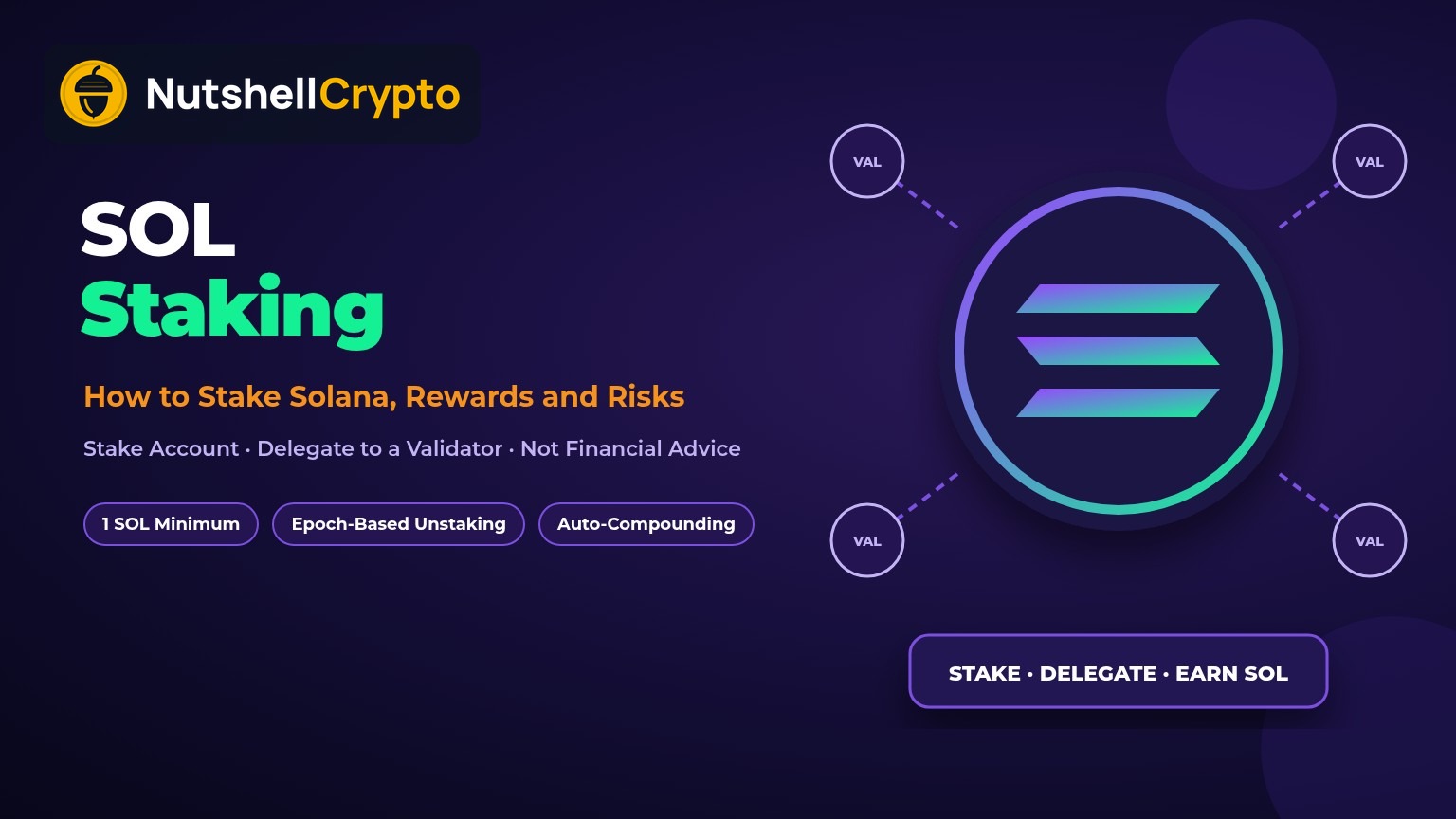
In a nutshell: SOL staking means moving SOL into a stake account and delegating it to a Solana validator. You keep control of the coins, the validator gets voting weight, and you earn SOL rewards that are added to your stake account at the end of each epoch. Wallets such as Phantom and Solflare require at least 1 SOL. Stake activates and deactivates at epoch boundaries, so you wait for an epoch to end before you can withdraw. Solana has no in-protocol slashing today, but rewards depend on your validator’s performance and commission. Educational only; not financial advice.
Last updated: October 19, 2026.
SOL staking (also called Solana staking) is how holders of SOL, the native coin of the Solana blockchain, help secure the network and earn more SOL in return. You don’t need to run a validator yourself. You delegate your SOL to one, and you share in the rewards that validator earns for voting correctly.
This guide covers what SOL staking is, how stake accounts and epochs work, live network numbers, a step-by-step walkthrough, how to pick a validator, how to unstake, liquid staking, risks, and taxes in the US and Canada. If staking is new to you, start with our explainer on what staking in crypto means.
Table of contents
What Is SOL Staking?
Solana is a proof-of-stake blockchain. Validators run the software that processes transactions and votes on blocks. According to Solana’s official staking documentation, the more stake is delegated to a validator, the more often that validator is chosen to write new transactions to the ledger, and the more rewards the validator and its delegators earn.
Key points for beginners:
- You delegate, you don’t hand over your coins. Your SOL sits in a stake account controlled by your own keys. Phantom’s help center says your SOL “stays in a stake account under your control” with native staking.
- Staking uses a separate account type. A stake account is different from your normal wallet address, and each one can delegate to only one validator at a time.
- Rewards compound automatically. Rewards are added to the stake account itself, so you don’t have to claim them.
- There’s a short wait to enter and exit. Changes take effect at epoch boundaries, not instantly.
Curious how Solana differs from Ethereum’s design? See our comparison of Solana vs Ethereum.
How Solana Staking Works
Stake accounts and authorities
Solana’s stake accounts documentation explains that each stake account has two signing authorities:
- Stake authority: delegates, deactivates, splits and merges the stake account.
- Withdraw authority: withdraws undelegated SOL back to a wallet and can reset the stake authority. The docs call securing it “of utmost importance.”
In a normal wallet app, both authorities are simply your wallet address, so you don’t have to manage them separately. To split stake across several validators, you create several stake accounts, or split one large account into smaller ones.
Epochs, warmup and cooldown
Delegating or deactivating doesn’t happen right away. Per the stake accounts docs, a delegation or deactivation takes effect over one or more epochs, with part of it becoming active or inactive at each epoch boundary. The network also caps how much total stake can activate or deactivate in a single epoch, so the exact timing depends on what other stakers are doing.
An epoch on Solana is 432,000 slots. Wallet help pages describe it differently: Phantom says epochs “typically last 2 to 3 days,” while Solflare says about 1 day. When we checked Solana’s public RPC on October 19, 2026 at about 6:08 PM PKT, the last full epoch (1061) had lasted about 26 hours by block timestamps, and slots were averaging about 0.22 seconds over the past hour. Epoch length in hours changes with network speed, so check the current epoch on Solana Explorer.
No slashing in the protocol today
Solana’s staking docs state that “there is no in protocol implementation of slashing currently.” They add that slashing could come in the future, in which case delegators could lose part of their stake if a validator acts maliciously. That’s a key difference from chains like Cosmos; see our Cosmos staking guide for how slashing works there.
Solana Staking Numbers
We pulled these figures from Solana’s public mainnet RPC and official docs on October 19, 2026 at about 6:08 PM PKT. Network values change every epoch.
| Item | Value | Source |
|---|---|---|
| Total active stake | About 437.8 million SOL | RPC getVoteAccounts (sum of voting validators) |
| Share of total supply staked | About 69% (of ~636.1 million SOL) | RPC getSupply |
| Voting validators | 666 current, plus 13 marked delinquent | RPC getVoteAccounts |
| Median validator commission | 5% | RPC getVoteAccounts (current validators) |
| Current inflation rate | About 3.60% a year (epoch 1062) | RPC getInflationRate |
| Inflation schedule | Started at 8%, falls 15% a year, long-term 1.5% | Solana.com staking page; RPC getInflationGovernor |
| Epoch length | 432,000 slots (epoch 1061 lasted about 26 hours) | RPC getEpochSchedule and getBlockTime |
| Minimum delegation in wallets | 1 SOL | Phantom and Solflare help centers |
| Stake account rent reserve | About 0.0017 SOL (Solflare rounds it to 0.002 SOL), refunded when the account closes | RPC getMinimumBalanceForRentExemption; Solflare help center |
| Protocol slashing | Not implemented today | Solana staking docs |
How SOL Staking Rewards Work
Where rewards come from
Staking rewards are paid from new SOL created by inflation. The Agave validator client’s stake delegation and rewards docs explain the mechanics: validators earn vote credits for correct votes, delegators earn points in proportion to their stake, and at the end of each epoch the epoch’s inflation reward is split by those points. The validator’s commission is taken out first, and the rest goes into your stake account.
Solana.com’s staking overview says your yield depends on the current inflation rate, the total amount of SOL staked, and your validator’s uptime and commission.
Rough math on the yield
There’s no fixed APY. As a rough illustration only: with inflation at about 3.60% and about 69% of supply staked when we checked, inflation rewards spread across stakers come to roughly 5.2% a year before commission. A validator charging 5% commission would leave you a little under 5%. Your real rate can be lower if your validator misses votes, so treat any number in a wallet or dashboard as an estimate.
Rewards auto-compound
The Agave docs note that “earned rewards are automatically added to stake.” That’s convenient, but it also means each reward lands in your stake account at the end of each epoch, which matters for taxes (see below).
How to Stake SOL Step by Step
These steps follow Phantom’s guide to staking SOL natively and Solflare’s native SOL staking guide. Menu names can change between app versions.
- Set up a Solana wallet. Phantom and Solflare both support native staking. Download only from the official site, and write your recovery phrase down offline. Our guide on how to store a seed phrase safely covers this.
- Fund it with more than 1 SOL. Both wallets require at least 1 SOL per stake account. Keep a little extra for network fees and the stake account rent reserve.
- Open the staking screen. In Phantom, native staking is in the browser extension: open Solana, then More, Stake SOL, Native Staking. Phantom says new native stakes can’t be created on mobile. In Solflare, use the Staking tab.
- Pick a validator. Compare commission, uptime and vote performance (see the next section).
- Enter the amount and confirm. The wallet creates a stake account and delegates it in one step.
- Wait for activation. The stake shows as “Activating” and starts earning once it turns “Active” after an epoch boundary.
Whatever wallet you use, never type your recovery phrase into a website or share it with anyone claiming to be support.
Exchange staking caveats
Some exchanges offer SOL staking with one click. That’s usually custodial: the exchange holds your SOL, picks validators, keeps a cut and sets its own unstaking rules. It’s simpler, but you take on exchange risk. Our guide to self-custody in crypto explains the trade-off. If your SOL is on a hardware wallet, see our guide to Ledger staking.
How to Choose a Validator
We don’t rank or endorse validators, and the Solana Foundation says it doesn’t recommend any particular one. Phantom points users to validators.app, and Solana’s docs mention Solana Beach. Things to check:
- Commission: the percentage of rewards the validator keeps. Solflare says it typically ranges from 0% to 10%. Watch for validators that raise commission suddenly.
- Uptime and vote performance: a validator that’s offline or delinquent earns fewer vote credits, which means fewer rewards for you.
- Skip rate: how often a validator misses blocks it was scheduled to produce.
- Decentralization: Phantom notes that spreading stake across validators helps keep Solana decentralized. Very large validators concentrate stake.
How to Unstake SOL
Unstaking on Solana takes two steps:
- Deactivate (Unstake): your stake shows as “Deactivating” until the epoch boundary, per Phantom. During cooldown, the Agave docs say the stake keeps earning on its still-effective portion.
- Withdraw: once the stake shows “Inactive,” withdraw it to send the SOL back to your wallet. Phantom says the stake account then closes, and Solflare says the rent fee is refunded when you withdraw and close it.
Phantom notes you can’t add SOL to an existing stake account; create a new one instead. Solflare also offers an “instant unstake” option that charges a fee of 0.5% to 3% depending on available liquidity, per its unstaking guide. Solflare also warns that closing a stake account can make its reward history harder to find, so save your records first.
Native vs Liquid SOL Staking
With liquid staking, you deposit SOL into a staking pool and get a liquid staking token (LST) back, which you can trade or use in DeFi while the SOL stays staked. Phantom’s native vs liquid staking comparison lays out the differences:
| Native staking | Liquid staking (Phantom PSOL example) | |
|---|---|---|
| Minimum | 1 SOL | None |
| What you hold | SOL in your own stake account | An LST that rises in value |
| Validator choice | You pick | The pool picks |
| Exit | Wait for the epoch, then withdraw | Instant if reserves allow, otherwise a wait |
| Fees | Network fees only | 4% protocol fee and 0.1% exit fee for PSOL |
Liquid staking adds smart-contract and depeg risk on top of normal staking risk. For the bigger picture, read our liquid staking explainer.
Risks of SOL Staking
- Price risk: rewards are paid in SOL. A few percent a year doesn’t protect you from a big drop in SOL’s price.
- Validator performance: no protocol slashing today doesn’t mean no downside. A delinquent or poorly run validator earns you fewer rewards.
- Future slashing: Solana’s docs say slashing could be added later, which would put part of your stake at risk if your validator misbehaves.
- Short lock-up: you can’t sell staked SOL until it deactivates and you withdraw it, which takes at least until the epoch ends.
- Commission changes: a validator can raise its commission, cutting your share of rewards.
- Wallet and phishing risk: fake wallet sites and “support” accounts asking for your recovery phrase are a common way people lose SOL.
- Custody and contract risk: exchange staking means trusting the exchange, and liquid staking means trusting the pool’s smart contracts.
Taxes on SOL Staking Rewards (US and Canada)
In the US, the IRS’s Revenue Ruling 2023-14 says a cash-method taxpayer includes staking rewards in gross income, at fair market value, in the year they gain dominion and control over them. Because SOL rewards land in your stake account every epoch, you can end up with hundreds of small income events a year, so keep records of each reward’s date and USD value. Selling SOL later can trigger a capital gain or loss; see our beginner guide to crypto taxes.
In Canada, the CRA’s page on reporting income from crypto mining and staking explains how staking rewards are reported as income. Our guide to cryptocurrency tax in Canada covers CRA rules in more detail.
For examples and record-keeping tips, read our full guide to crypto staking taxes. This is not tax advice; check with a tax professional.
FAQ
What is SOL staking in simple terms?
It’s delegating SOL from a stake account to a Solana validator. The validator uses your stake as voting weight, and you earn a share of inflation rewards after the validator’s commission.
What’s the minimum to stake SOL?
Phantom and Solflare require at least 1 SOL for native staking, plus a small refundable rent reserve. Liquid staking pools often have no minimum.
How long does it take to unstake SOL?
Your stake deactivates at the end of the current epoch. Phantom says this typically takes 2 to 3 days and Solflare says about 1 day; at the pace we measured on October 19, 2026, an epoch was roughly 26 hours. After that, you withdraw the SOL to your wallet.
Can I lose my SOL by staking?
Not through protocol slashing today, because Solana hasn’t implemented it. You can still lose value if SOL’s price falls, if you fall for a phishing scam, or if you use an exchange or liquid staking pool that fails.
Do SOL staking rewards compound?
Yes. With native staking, rewards are added to your stake account at the end of each epoch and start earning too.
Can I stake SOL to more than one validator?
Yes, but each stake account delegates to only one validator, so you need a separate stake account for each one.
Is SOL staking the same as Ethereum staking?
No. Solana staking has a 1 SOL wallet minimum, no protocol slashing today and short epoch-based waits, while Ethereum has its own validator rules and exit queue. Our guide on how to stake Ethereum covers that side.
Sources
- Solana Docs: Staking on Solana
- Solana Docs: Stake Accounts
- Solana.com: Staking overview
- Agave (Anza) Docs: Stake Delegation and Rewards
- Phantom Help: Stake SOL natively
- Phantom Help: Native vs liquid staking
- Solflare Help: Native SOL staking guide
- Solflare Help: Unstaking SOL
- Solana mainnet public RPC (
getVoteAccounts,getSupply,getInflationRate,getInflationGovernor,getEpochSchedule,getRecentPerformanceSamples,getBlockTime,getMinimumBalanceForRentExemption), queried October 19, 2026 at about 6:08 PM PKT - IRS: Revenue Ruling 2023-14
- CRA: Reporting income from crypto-asset mining and staking activities
This article is for educational purposes only and is not financial, investment or tax advice.