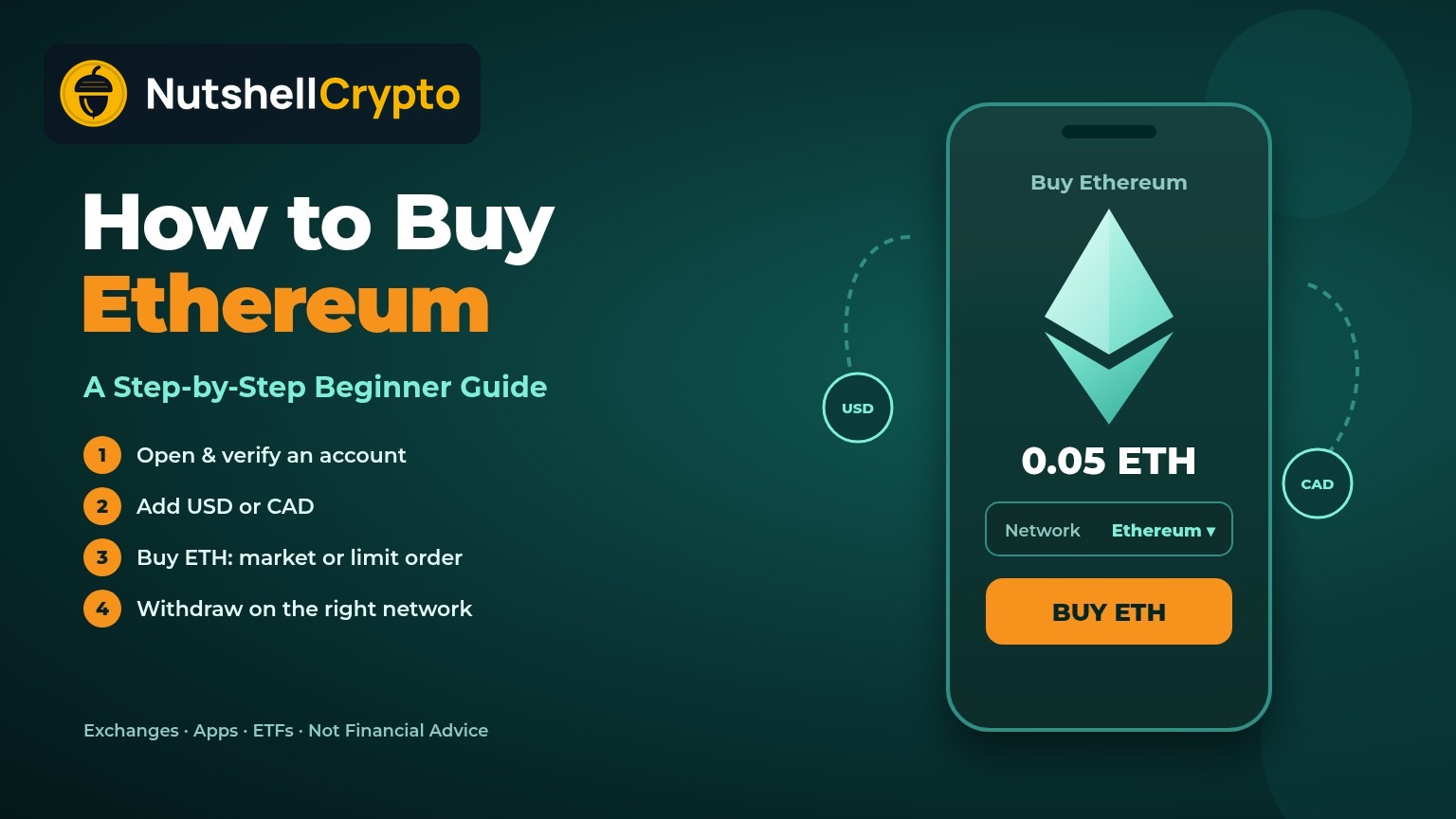
In a nutshell: To buy Ethereum, you open an account on a registered crypto exchange or app, verify your identity, add US or Canadian dollars, and buy ETH with a market or limit order. You can buy a small fraction of one coin. After that, you can leave ETH on the platform, or send it to your own wallet, choosing the same network on both ends (Ethereum mainnet or a layer 2 like Base or Arbitrum). If you only want price exposure, a spot Ethereum ETF in a brokerage account is another route. Watch the spread, trading fees and network fees, and never send crypto to anyone who contacts you first. Educational only; not financial advice.
Last updated: October 19, 2026. Market data checked on CoinGecko on October 19, 2026, at about 9:58 PM PKT (4:58 PM UTC). Fees, limits and platform lists were checked on each company’s or regulator’s official page the same evening; they change often, so confirm them before you buy.
Learning how to buy Ethereum is mostly about three choices: where you buy, how you pay, and where you keep your ETH afterwards. The buy button itself takes seconds. The mistakes that cost beginners money usually come later, such as sending ETH on the wrong network or trusting a fake “support agent.” This guide walks through each step for readers in the US, Canada and elsewhere, with the parts that are specific to Ethereum. If you are new to the network itself, start with our explainer on what Ethereum is and how ETH works.
Table of contents
- What you are actually buying
- 4 ways to buy Ethereum
- How to buy Ethereum on an exchange, step by step
- Withdrawing ETH: pick the right network
- US vs Canada: what is different
- Where to keep ETH after you buy
- Optional: staking your ETH
- Buying an Ethereum ETF instead
- Fees to watch
- Safety and common scams
- Taxes in brief
- FAQ
- Sources
What You Are Actually Buying
When you buy Ethereum, you are buying ether (ETH), the native coin of the Ethereum network. Ethereum is the blockchain; ETH is the money that runs on it. According to ethereum.org, ETH is used to pay transaction fees (called “gas”), to secure the network through staking, and as digital money. It was the second-largest cryptocurrency by market cap, at about $293.5 billion, per CoinGecko on October 19, 2026, at 9:58 PM PKT.
A few things beginners mix up:
- You can buy a fraction. ETH divides into tiny units. The smallest is the wei, and one gwei is one-billionth of an ETH, per ethereum.org’s gas page. You will mostly see gwei when wallets quote gas prices.
- ETH is not Ethereum Classic (ETC). They are separate coins with separate tickers. Some apps list both; Robinhood’s supported crypto list, for example, shows Ethereum (ETH) and Ethereum Classic (ETC) as different rows. Check the ticker before you tap “Buy.”
- There is no “Eth2” coin. ethereum.org’s staking page says the native token did not change when Ethereum moved to proof-of-stake. Anyone selling you “Eth2” is selling something else.
- WETH is a wrapped copy. Wrapped ETH is an ERC-20 token that represents ETH 1:1 inside apps; native ETH itself is not an ERC-20 token, per ethereum.org.
4 Ways to Buy Ethereum
ethereum.org’s Get ETH page lists centralized exchanges, wallets that sell ETH in-app, and decentralized exchanges as the main routes. Brokerages add a fourth: ETFs. Here is how they compare.
| Route | What you end up holding | Good for | Watch out for |
|---|---|---|---|
| Crypto exchange (e.g. Coinbase, Kraken) | Real ETH, held by the exchange until you withdraw it | Most beginners; lowest fees with bank funding | Custody risk; network choice when withdrawing |
| Broker or payment app (e.g. Robinhood, PayPal) | ETH inside the app; transfers out may have limits | People who already use the app | Spreads; fewer withdrawal options |
| Spot Ethereum ETF | Fund shares, not ETH | Retirement or brokerage accounts; no wallets | Annual fund fee; market hours; can’t send to a wallet |
| Wallet app or decentralized exchange (DEX) | ETH in your own wallet | Users comfortable with self-custody | Gas fees; fake tokens; you alone are responsible |
Crypto exchanges. A centralized crypto exchange is a business that sells crypto for regular money. ethereum.org notes that exchanges keep custody of the ETH you buy until you send it to a wallet you control.
Apps you may already use. In the US, PayPal lets customers buy, sell and hold Ethereum, alongside a short list of other coins. Its crypto terms allow a linked debit card, bank account or PayPal balance, but not credit cards. Robinhood lists ETH as tradable in its app. Cash App was long bitcoin-only; in August 2026 it began letting eligible US users buy ether and other tokens through a MoonPay integration, per CoinDesk.
ETFs. A spot Ethereum ETF gives you price exposure through a normal brokerage account. More on that below.
Wallets and DEXs. Some self-custody wallets let you buy ETH directly with a card, bank transfer or Apple Pay (regional limits apply), and a DEX lets you swap other crypto for ETH without handing your funds to a company, per ethereum.org. This route assumes you already hold some crypto and understand wallets, so it is rarely the first step.
How to Buy Ethereum on an Exchange, Step by Step
The account setup is the same for any coin, so we keep it short here. Our guide on how to buy Bitcoin covers identity checks, payment methods and funding hold times in full.
- Pick a platform that is allowed where you live. In Canada, check the regulators’ list (see US vs Canada). Type the website address yourself instead of clicking ads.
- Create the account and turn on two-factor authentication, ideally with an authenticator app.
- Verify your identity (KYC). Expect to upload a government ID and take a selfie.
- Add money. Bank transfers are usually slower but cheaper; cards are instant but cost more, per ethereum.org.
- Search for Ethereum and confirm the ticker is ETH.
- Choose the order type. A market order buys now at the current price; a limit order buys only at a price you set. Our guide to spot trading crypto explains both with examples. On Coinbase’s simple trade screen, limit orders carry a separate 1% execution fee, per its fee disclosures.
- Read the order preview, then confirm. Coinbase’s help center describes the flow as: choose Buy, enter an amount, pick a payment method, choose the asset, select Review order, then Buy now. It also notes that minimum purchase amounts vary by crypto and payment method.
Your ETH appears in your account balance. At this point it is held by the platform, not by you.
Withdrawing ETH: Pick the Right Network
This is the step where Ethereum differs most from Bitcoin. ETH can live on Ethereum mainnet and on layer 2 networks built on top of it, such as Base, Arbitrum and Optimism. An exchange may let you withdraw ETH on several of them. The address often looks the same on all of them (it starts with 0x), which is exactly why people get it wrong.
- Match the network on both ends. Coinbase’s send guide tells users to select the correct network “or your funds will be lost,” and says on-chain sends can’t be reversed. Its multichain support page adds that the same network must be used on the sending and receiving end.
- Check the receiving wallet first. Confirm that your wallet or the other exchange supports ETH on the network you pick. If unsure, choose Ethereum mainnet, which every Ethereum wallet supports.
- Copy the address carefully and compare the first and last characters. Our guide to crypto wallet addresses shows how to find and check one.
- Send a small test first. Some apps set a floor: PayPal’s minimum external ETH transfer is 0.01 ETH, per its transfer help page.
Gas fees. Every on-chain transaction pays a fee in ETH. A plain ETH transfer uses 21,000 units of gas, and the total fee is gas used times (base fee + priority tip), per ethereum.org. Fees rise when the network is busy. When you withdraw from an exchange, it charges its own estimate of that network fee; Coinbase says the fee it shows is based on prevailing network fees and is disclosed before you confirm. ethereum.org says layer 2 networks are typically 10 to 100 times cheaper than mainnet, which is why exchanges offer them.
US vs Canada: What Is Different
United States
Availability can vary by state. Robinhood’s list, for example, marks some coins as not tradable in New York or Texas (ETH is not one of them). Payment options also differ by app: PayPal’s crypto terms bar credit cards, while exchanges usually accept bank transfers (ACH), debit cards and wires.
Canada
Canadian securities regulators require crypto trading platforms that serve Canadians to register. The Ontario Securities Commission’s list of registered platforms (updated October 15, 2026) includes Coinbase Canada, Kraken (Payward Canada), Crypto.com, Wealthsimple, Shakepay, Newton, NDAX, Netcoins, Coinsquare/Bitbuy, Fidelity, Webull, Satstreet and Cybrid. The same page says Gemini no longer offers services to retail clients in Canada. Other provinces’ decisions are on the CSA’s national list. Check your own province before opening an account.
Most Canadian platforms take CAD by Interac e-Transfer. On Kraken, for example, e-Transfer deposits are free with a 5 CAD minimum and usually arrive within a day, while debit card deposits cost 0.25 CAD + 3.75%, per its CAD deposit table. Its e-Transfer guide says the name on your bank account must match your Kraken account, and limits deposits to 10,000 CAD per day.
Where to Keep ETH After You Buy
You have two options. You can leave ETH on the platform, which is simple but means trusting that company to stay solvent and secure. Or you can move it to your own wallet. ethereum.org puts the trade-off plainly: holding your own ETH means you are “completely responsible” for keeping it safe, and if you lose access to your account, in most cases “no one can help.”
A common beginner pattern is a software (hot) wallet for small amounts and a hardware (cold) wallet for long-term holdings. Our comparison of hot wallets vs cold wallets covers the choice, our seed phrase guide explains how to back up a wallet, and our walkthrough on moving crypto to a cold wallet shows the transfer step by step. Keep a little extra ETH in any wallet you use on Ethereum, since gas is always paid in ETH.
Optional: Staking Your ETH
Once you hold ETH, you can stake it for rewards. ethereum.org says running your own validator takes at least 32 ETH, some staking pools accept as little as 0.01 ETH, and exchanges let you stake any amount. It rates exchange staking as having the highest trust assumptions, because the exchange holds your ETH. Exchanges also take a cut: Coinbase’s standard commission on ETH staking rewards is 35%, per its fee page. Staking rewards are also taxable income in the US (see taxes). Our guide on how to stake Ethereum compares solo, pooled, liquid and exchange staking in detail.
Buying an Ethereum ETF Instead
US spot Ethereum ETFs began trading on July 23, 2024, with funds from BlackRock, Fidelity, Grayscale and others, per CNBC. You buy shares through a brokerage account, the same way you buy a stock fund. You get price exposure without wallets or seed phrases, but you own fund shares, not ETH: you can’t send them to a wallet or pay gas with them, and you pay an annual fund fee. Our guide to how Ethereum ETFs work and how to buy them explains the trade-offs, and the list of US Ethereum ETFs by size compares each fund’s assets and fees.
Fees to Watch
- Spread: the gap built into the quoted price on simple “Buy” screens. Coinbase says its simple orders include a spread, while its Advanced order-book trading does not.
- Trading fee: a percentage per trade, shown in the order preview. For simple limit orders, Coinbase says it may charge a 1.875% Coinbase fee (varying by payment method) on top of the 1% limit-order fee mentioned above.
- Funding fee: card deposits usually cost more than bank transfers (see the Kraken CAD example above).
- Network (gas) fee: charged when you withdraw ETH or use it on-chain; lower on layer 2 networks.
- ETF expense ratio: an annual percentage of your holding, if you go the ETF route.
Our breakdown of crypto exchange fees shows how to compare the all-in cost across platforms. If you plan to buy a fixed amount every week or month, see how dollar-cost averaging crypto works.
Safety and Common Scams
The Federal Trade Commission warns that crypto payments usually can’t be reversed and don’t come with the legal protections of credit or debit cards. Its red flags apply directly to new ETH buyers:
- “Only scammers demand payment in cryptocurrency.” No real business, agency or bank asks you to buy ETH and send it to “protect” your money.
- “Only scammers will guarantee profits or big returns.”
- If someone you met on a dating app or social media offers to teach you to invest in crypto, the FTC says that is a scam.
- Fake “celebrity” giveaways that promise to multiply the crypto you send are always scams.
Two more Ethereum-specific traps: tokens sold as “Eth2” (there is no such coin), and fake support agents who ask for your seed phrase. Real support never needs it. The IRS has also warned about letters with a QR code asking people to register their crypto on a “Digital Assets Compliance Portal”; the IRS says it is a scam, per its digital assets page. In the US, report crypto fraud at ReportFraud.ftc.gov and to the exchange you used.
Taxes in Brief
US: The IRS treats digital assets as property. Buying ETH with dollars and holding it is not a taxable sale. The IRS says someone who only bought with real currency can answer “No” to the digital asset question on Form 1040. Selling, swapping ETH for another coin, or spending it is a disposition you report. Staking rewards count as income. One Ethereum-specific detail: the IRS says moving crypto between your own wallets does not by itself mean answering “Yes,” unless you paid the transfer fee with digital assets. On Ethereum that is usually the case, because gas is paid in ETH. Brokers now report sales on Form 1099-DA, per the IRS. Our beginner guide to crypto taxes covers taxable events in full.
Canada: The CRA says trading, spending or gifting crypto is a disposition, while transfers between wallets you own are not. If your activity is not a business, half of a capital gain is taxable, per the CRA. See our guide to cryptocurrency tax in Canada.
Keep a record of every purchase: date, amount of ETH, price in USD or CAD, and fees.
FAQ
How do I buy Ethereum for the first time?
Open an account on a registered exchange or app, verify your ID, add money by bank transfer or card, search for ETH, and place a market or limit order. Start with a small amount while you learn the screens.
Can I buy less than one ETH?
Yes. ETH is divisible down to tiny units (one gwei is one-billionth of an ETH), and most apps let you buy a dollar amount. Minimums vary by platform and payment method.
Which network should I use to withdraw ETH?
Use a network that both the sending platform and the receiving wallet support. If you are unsure, choose Ethereum mainnet. Sending on an unsupported network can mean losing the funds.
Is ETH an ERC-20 token?
No. ETH is Ethereum’s native coin. ERC-20 is the standard for tokens built on Ethereum, such as wrapped ETH (WETH) or USDC.
Is buying an Ethereum ETF the same as buying ETH?
No. An ETF gives you shares in a fund that holds ETH. You get price exposure in a brokerage account, but you can’t withdraw the ETH or use it on the network, and you pay an annual fund fee.
Can I buy Ethereum with PayPal?
In the US, yes. PayPal supports buying, selling and holding ETH using a linked bank account, debit card or PayPal balance; it does not allow credit cards for crypto.
Do I pay tax when I buy Ethereum?
In the US and Canada, simply buying ETH with dollars is generally not a taxable event. Tax usually applies when you sell, swap or spend it, and staking rewards count as income in the US.
This article is for education only and is not financial advice. Crypto prices can fall sharply, and you can lose money. Check each platform’s current fees and availability in your state or province before you buy.
Sources
- CoinGecko: Ethereum (ETH), checked Oct 19, 2026, 9:58 PM PKT
- ethereum.org: What is ether (ETH)?
- ethereum.org: How to get ETH
- ethereum.org: Gas and fees
- ethereum.org: Staking
- Coinbase Help: Buy crypto
- Coinbase Help: Pricing and fees disclosures
- Coinbase Help: Multichain support
- Coinbase Help: Steps to send crypto
- PayPal: Cryptocurrency FAQs, Cryptocurrency terms and Transfer help
- Robinhood: Crypto availability
- CoinDesk: Cash App taps MoonPay (Aug 18, 2026)
- CNBC: Ether ETFs begin trading in the US (Jul 23, 2024)
- Ontario Securities Commission: Crypto businesses (updated Oct 15, 2026)
- CSA: Crypto platforms authorized to do business with Canadians
- Kraken: CAD deposit options and Interac e-Transfer funding
- FTC: What to know about cryptocurrency and scams
- IRS: Digital assets
- CRA: Reporting income from crypto-asset transactions