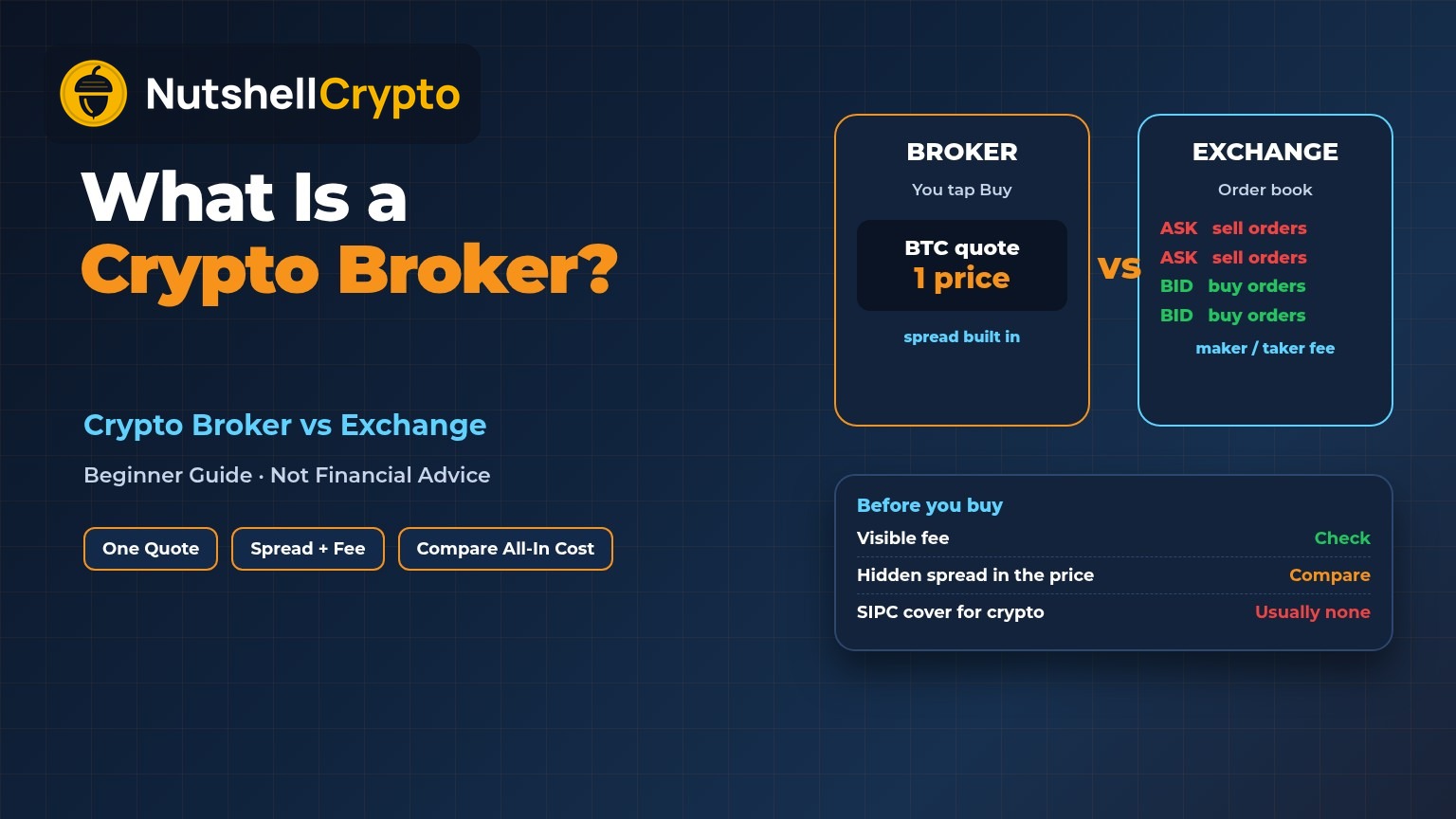
In a nutshell: A crypto broker is an app or company that sells you crypto at a quoted price and buys it back from you, so you never deal with an order book. You tap Buy, see one all-in price, and the broker fills the order from market makers or exchanges behind the scenes. A crypto exchange is different: it matches your order against other users’ orders on an order book. Brokers are simpler, but you usually pay more through a spread (a markup in the price) plus a fee. Many apps, like Coinbase, offer both a broker-style screen and an exchange screen. Educational only; not financial advice.
Last updated: October 25, 2026.
When you buy bitcoin in PayPal, Cash App or the main Robinhood app, you are using a crypto broker. When you place a limit order on Coinbase Advanced or Kraken Pro, you are using an exchange. Both get you the same coin, but the price you pay, the fees and the control you have are not the same.
This guide explains what a crypto broker is, how it works, how it makes money, how it compares with an exchange, and what US and Canadian users should check before they use one.
Table of contents
What Is a Crypto Broker?
A crypto broker is a service that stands between you and the crypto market. You tell it how much you want to buy or sell, it shows you a price, and when you confirm, it delivers the crypto (or the cash) to your account. You don’t see bids, asks or other traders. You just see one quote.
The word “broker” comes from traditional finance, where a broker-dealer buys and sells securities for customers. Quebec’s securities regulator, the AMF, describes a dealer or broker as “a professional who manages the transaction between the client and a financial institution” or exchange, on its cryptoasset trading platforms page. In crypto, the term is used more loosely for any app that sells crypto at a quoted price instead of giving you an order book.
Common examples of broker-style crypto buying in the US include:
- Robinhood Crypto, whose default setting sends your order to outside market makers.
- PayPal and Venmo, which sell crypto through PayPal Digital, Inc.
- Cash App, which sells bitcoin through Block, Inc.
- The simple Buy and Sell screen on Coinbase, which gives you a fixed quote instead of an order book.
How a Crypto Broker Works
A typical broker trade has four steps:
- You enter an amount. For example, “buy $200 of bitcoin.”
- The broker quotes a price. The quote already includes the broker’s spread, and the fee is shown on the review screen.
- You confirm. The broker locks the price for a short time and fills the order. It may buy the coins from a market maker, from an exchange, or from its own inventory.
- The crypto appears in your account. The broker holds it for you. Some brokers let you move it to your own wallet; others limit transfers.
Robinhood explains this openly in its crypto order routing article: when you buy or sell, “we send your order to third-party liquidity providers for execution,” and the default is routing to non-exchange liquidity providers, which it calls market makers. Orders are filled “at the bid or ask price, not at the mid price” shown on the chart.
Crypto Broker vs Crypto Exchange
A centralized crypto exchange runs an order book. Buyers post bids, sellers post asks, and the exchange matches them. You choose market or limit orders, and you pay a maker or taker fee. A broker hides all of that and gives you a single price.
| Crypto broker | Crypto exchange | |
|---|---|---|
| Who is on the other side? | The broker or its market makers | Other users, matched on an order book |
| What you see | One quote with the cost built in | Bids, asks, charts and order types |
| Main cost | Spread plus a fee | Maker or taker fee, usually lower |
| Order types | Mostly buy and sell at market | Market, limit, stop and more |
| Best for | Small, simple, occasional buys | Larger or more frequent trades |
The line is blurry because many apps do both. Coinbase’s Coinbase vs Coinbase Advanced help page says that on the standard app “you’ll see a fixed price quote before placing your order,” which includes fees and spread, while on Coinbase Advanced “no spread is included” because “users interact directly with the order book.” Robinhood also offers an exchange routing option that sends orders to partner exchanges for a separate fee.
Two other ways to buy crypto work differently again. On a decentralized exchange (DEX), you swap from your own wallet through a smart contract. On a peer-to-peer crypto exchange, you trade with another person and pay them directly. Large buyers often use an OTC crypto desk, which is a broker for big trades.
How Crypto Brokers Make Money
“Commission-free” does not mean free. Brokers usually earn in two ways:
1. The spread
The spread is the gap between the market’s middle price and the price you actually get. When you buy, you pay a little above the middle price; when you sell, you get a little below it. Coinbase says in its pricing and fees disclosures that for simple buy and sell orders it “includes a spread in the quoted price” and “may retain any excess spread from a transaction.”
Robinhood gives an exact number. As of June 15, 2026, for every $100 of crypto traded through market maker routing, Robinhood Crypto receives $0.95 from its market maker, and that amount is included in the spread. Its example: on a $100 buy with a 0.96% spread, Robinhood keeps $0.95 of the $0.96.
2. A transaction fee
Many brokers add a visible fee on top of the spread. PayPal’s US consumer fees page lists a crypto buy or sell fee of 2.20% for $1 to $74.99, 2.00% for $75 to $200, 1.80% for $200.01 to $1,000 and 1.50% above $1,000. PayPal’s crypto terms add that the exchange rate “will include an estimated spread of one percent (1.00%),” which can be higher or lower depending on the market.
Cash App’s bitcoin pricing page lists a market buy and sell fee of 2.0% for $1 to $499 and 1.5% for $500 to $999, and says its spread “may be anywhere between 0% and 0.75%,” with no fee or spread on Auto Invest, Round Ups or Paid in Bitcoin.
By comparison, Coinbase’s exchange fee table lists a taker fee of 0.60% and a maker fee of 0.40% at its lowest volume tier ($0 to $10K a month), with no spread added. For a full breakdown of these fee types, see our guide to crypto exchange fees.
Example: What a $500 Buy Can Cost
Here is a simple illustration using the published rates above. It ignores price moves and assumes the spread equals the figure each company gives, which can change at any moment:
- PayPal: 1.80% fee on $500 is $9.00, plus an estimated 1.00% spread of about $5.00, so roughly $14 in total cost.
- Cash App: $500 falls in its $500 to $999 tier, listed at 1.5%, which is $7.50, plus a spread of up to 0.75% (up to about $3.75), so up to roughly $11.25.
- Robinhood (market maker routing): no commission, but a spread of around 0.96% in Robinhood’s own example would cost about $4.80.
- Coinbase Advanced (exchange): a market order at the 0.60% taker rate costs $3.00, with no added spread, though the order book’s own bid-ask gap still applies.
The point is not which app is cheapest today, since rates change. It is that the broker screen bundles the cost into the price, so you have to look for the spread to compare fairly.
Pros and Cons of Using a Crypto Broker
Pros
- Very easy: one screen, one price, no order types to learn.
- Often built into apps you already use, like PayPal or Cash App.
- The price is locked for a few seconds, so you know what you’ll pay.
- Good for small, regular buys, such as dollar-cost averaging.
Cons
- Usually more expensive than trading on an order book, especially for larger amounts.
- The spread is not always shown as a separate number.
- Fewer coins and fewer order types than a full exchange.
- The broker holds your crypto, so you depend on the company. Some limit withdrawals to outside wallets. See self-custody for the alternative.
Is a Crypto Broker Safe? US and Canada Checks
The biggest misunderstanding is about insurance. In the US, the Securities Investor Protection Corporation (SIPC) protects up to $500,000 in cash and securities if a member brokerage fails. But SIPC’s What SIPC Protects page says it “does not protect any digital or crypto asset that does not qualify as a ‘security’,” and that unregistered digital asset securities are not protected “even if held by a SIPC-member brokerage firm.” So buying bitcoin through an app that also offers stocks does not give your bitcoin stock-style protection.
FINRA’s crypto asset risks page warns that when you buy crypto through a broker-dealer’s affiliate or partner, you “might interact with an entity that’s subject to more limited regulatory oversight.” It suggests checking firms on BrokerCheck.
In Canada, crypto trading platforms that hold crypto for clients must register with provincial securities regulators. Ontario’s OSC keeps a list of registered crypto asset trading platforms and points to the Canadian Securities Administrators (CSA) for decisions in other provinces. As of the OSC page’s October 23, 2026 update, it named 14 entries, including Coinbase Canada, Kraken, Wealthsimple, Newton, Shakepay and Crypto.com. Quebec’s AMF also warns that crypto transactions “are not covered by Deposit protection.”
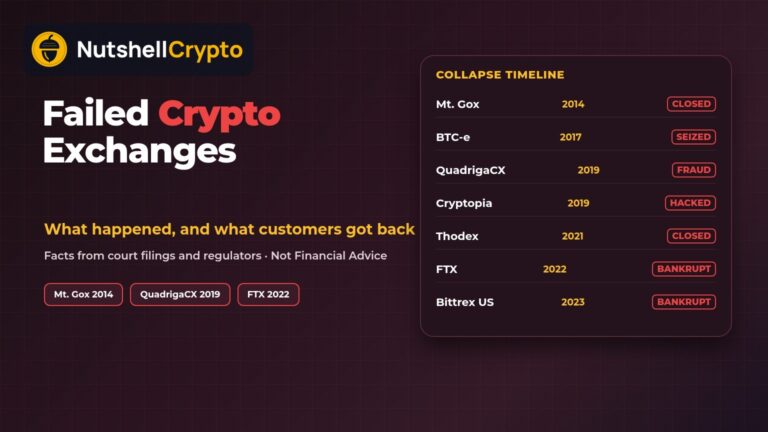
Brokers can also fail. Our list of failed crypto exchanges shows what happened to customers when platforms collapsed.
How to Compare Crypto Brokers
Instead of asking which broker is “best,” check these points for your own situation:
- Is it registered where you live? Use BrokerCheck and your state’s money transmitter rules in the US, or the OSC or your provincial regulator’s list in Canada.
- What is the all-in cost? Compare the fee and the spread on the review screen with the live market price.
- Can you withdraw to your own wallet? If you plan to hold long term, check transfer support and network fees.
- Which coins and payment methods does it support? Bank transfers are usually cheaper than cards.
- Does it have an exchange mode? If you trade often, an order-book screen can cut costs.
- What identity checks are needed? Regulated brokers require KYC verification.
Whichever route you use, crypto sales are taxable events in the US and Canada. See our guide to crypto capital gains tax.
FAQ
Is Coinbase a broker or an exchange?
Both. The standard Coinbase app works like a broker, with a quoted price that includes a spread. Coinbase Advanced is an exchange with an order book and maker and taker fees.
Is Robinhood a crypto broker?
Yes. By default, Robinhood Crypto routes your orders to market makers and earns part of the spread. It also offers exchange routing for a separate fee.
Are crypto brokers cheaper than exchanges?
Usually not. A broker bundles a spread and often a fee into one price, while an exchange charges a maker or taker fee on an order book. Brokers can still make sense for small, simple buys.
Is my crypto insured at a broker?
Generally no. SIPC does not cover crypto that isn’t a registered security, and crypto is not a bank deposit, so FDIC and CDIC deposit insurance don’t apply to the coins themselves.
Can I move crypto from a broker to my own wallet?
Often, yes. PayPal and Robinhood support transfers to outside wallets, with a network fee. Check your broker’s transfer page first, because support varies by coin and country.
This article is for education only and is not financial, legal or tax advice. Fees, spreads and features change often. Check each company’s own fee pages for your country before you trade.