In a nutshell: As of October 27, 2026, the largest decentralized exchange by 30-day spot trading volume is Uniswap, with about $64.4 billion, roughly 30% of all spot DEX volume tracked by DefiLlama. PancakeSwap ($23.6 billion) and Aero ($16.7 billion, the new name for Aerodrome and Velodrome) come next. Six of the top 10 are mainly on Solana. The ranking moves every week, so treat it as a snapshot, not a recommendation. Educational only; not financial advice.
Last updated: October 27, 2026. Data checked on DefiLlama at 8:54 PM PKT (3:54 PM UTC).
There are hundreds of decentralized exchanges (DEXs), and most lists online either sort them by the price of their tokens or call some of them “the best.” This list does neither. It ranks DEXs by one provable number: how much spot trading actually went through them in the last 30 days, using public data from DefiLlama’s DEX volume dashboard.
If you are new to DEXs, start with our guide to how decentralized exchanges work. This page is the ranked list.
Table of contents
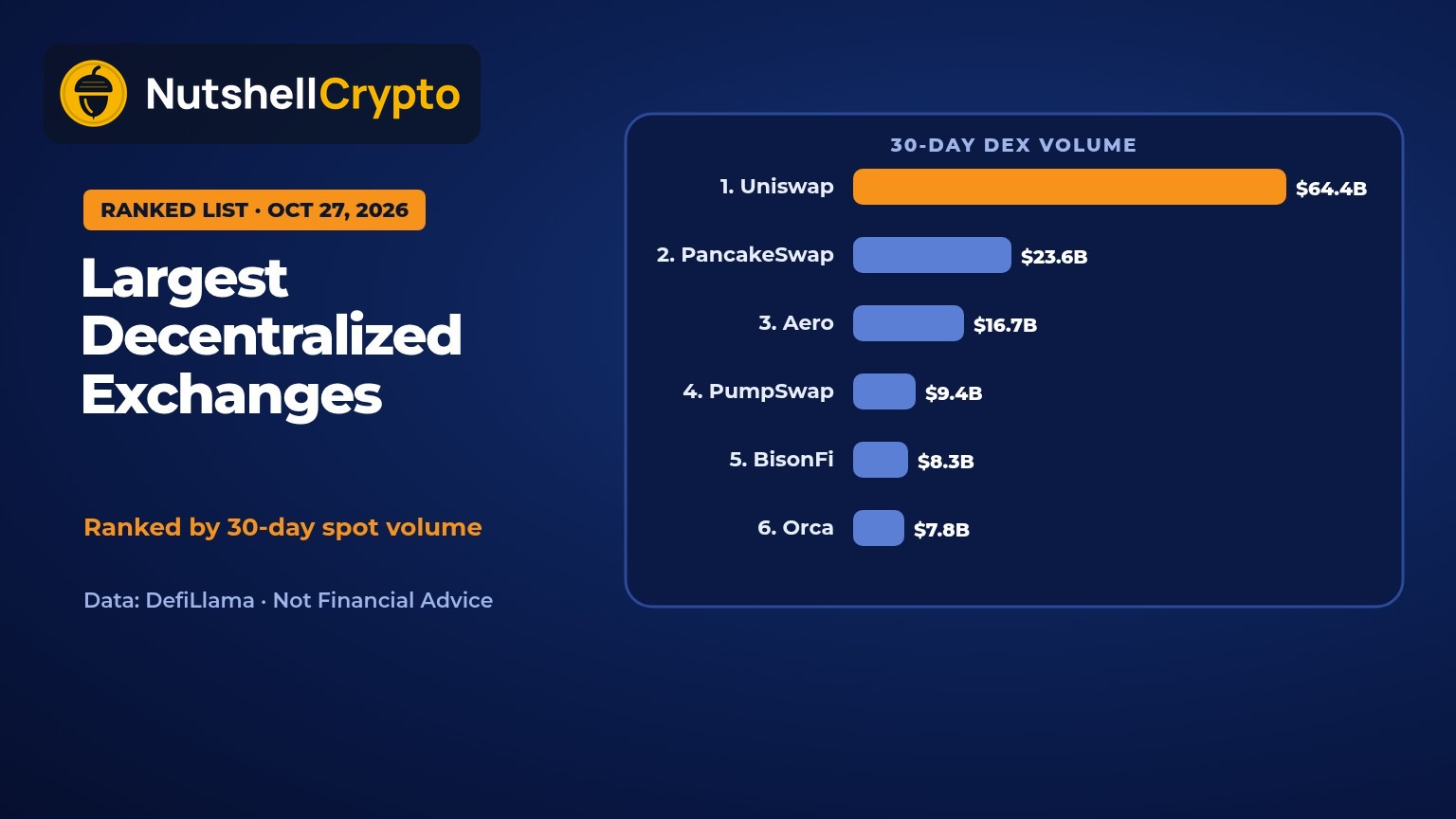
Largest Decentralized Exchanges by Volume (as of October 27, 2026)
Volumes are DefiLlama’s spot DEX figures, with each exchange’s versions added together (for example Uniswap V2, V3 and V4 count as one). TVL means total value locked, the money sitting in the exchange’s pools.
| Rank | DEX | 30-day volume | 24-hour volume | Share of 30-day spot DEX volume | TVL | Main chains |
|---|---|---|---|---|---|---|
| 1 | Uniswap | $64.4B | $1.76B | 30.2% | $3.75B | Ethereum, Base, Arbitrum and many more |
| 2 | PancakeSwap | $23.6B | $0.82B | 11.0% | $2.38B | BNB Chain, Ethereum, Base |
| 3 | Aero (Aerodrome + Velodrome) | $16.7B | $0.72B | 7.8% | $0.35B | Base, OP Mainnet |
| 4 | PumpSwap (pump.fun) | $9.4B | $0.17B | 4.4% | $0.33B | Solana |
| 5 | BisonFi | $8.3B | $0.29B | 3.9% | $0.02B | Solana |
| 6 | Orca | $7.8B | $0.19B | 3.6% | $0.30B | Solana |
| 7 | Tessera V | $6.1B | $0.24B | 2.9% | $0.01B | Solana (also Base, BNB Chain) |
| 8 | Raydium | $5.5B | $0.13B | 2.6% | $1.13B | Solana |
| 9 | Metric | $4.7B | $0.20B | 2.2% | $0.02B | BNB Chain, Base, Ethereum, Robinhood Chain |
| 10 | Meteora | $4.3B | $0.12B | 2.0% | $0.22B | Solana |
Together these 10 handled about $150.6 billion, or roughly 70% of the $213.6 billion in 30-day spot DEX volume DefiLlama tracked at the time of checking.
How This List Is Ranked
- One metric: 30-day spot swap volume, because a single day can be distorted by one big event. The 24-hour number is shown for context.
- Spot only: perpetual futures exchanges such as Hyperliquid’s perps market are a different product and are left out. Hyperliquid’s spot order book alone did about $3.7 billion, just outside the top 10. If you want to know what perps are, see perpetual futures explained.
- No aggregators: tools like Jupiter or 1inch route your trade through other DEXs, so counting them would count the same trade twice.
- No launchpads or prediction markets: DefiLlama tracks pump.fun’s bonding-curve launchpad and markets like Polymarket separately; only PumpSwap, pump.fun’s actual exchange, is counted here.
- Versions combined: each brand’s versions are added together, using DefiLlama’s own parent grouping.
We will refresh this list monthly. Numbers move daily, so check the live dashboard if you need today’s figure.
The Top 10 Decentralized Exchanges, One by One
1. Uniswap
Uniswap is the automated market maker (AMM) that made swapping tokens from pools, instead of an order book, popular on Ethereum. DefiLlama tracks it on 49 chains, and its newest version, V4, lets developers attach custom code called “hooks” to pools (Uniswap docs). With about $64.4 billion in 30-day volume it handled nearly three times as much as the next DEX.
2. PancakeSwap
PancakeSwap is the largest DEX on BNB Chain and also runs on Ethereum, Base, Arbitrum and other networks. It offers several pool types, including its newer “Infinity” pools. It did about $23.6 billion over 30 days.
3. Aero (Aerodrome and Velodrome)
Aero is brand new as a name, but not as an exchange. Aerodrome, the biggest DEX on Base, and Velodrome, the biggest on OP Mainnet, merged into Aero on October 21, 2026, launching across seven networks including Ethereum mainnet, Base and Arbitrum (The Block). Old AERO tokens convert 1:1 to the new AERO, and VELO converts at 0.044 AERO, according to the project’s upgrade page. The combined brand did about $16.7 billion over 30 days.
4. PumpSwap
PumpSwap is the exchange built by pump.fun, the Solana meme coin launchpad. When a new token “graduates” from pump.fun’s launch curve, it trades on PumpSwap. Most of what trades here is very new, very small tokens, which is worth keeping in mind: high volume does not mean low risk. It did about $9.4 billion over 30 days.
5. BisonFi
BisonFi is listed by DefiLlama as a “prop AMM on Solana.” A proprietary AMM uses a market maker’s own money, not deposits from the public, and updates its prices many times per block from outside price data (Solana Foundation explainer). Most people never visit a prop AMM directly; their trades reach it through aggregators. That is why BisonFi can do $8.3 billion a month with only about $21 million in TVL.
6. Orca
Orca is one of the longest-running AMMs on Solana, known for concentrated liquidity pools called “Whirlpools.” It did about $7.8 billion over 30 days with about $300 million in TVL.
7. Tessera V
Tessera V is another prop AMM, mainly on Solana, with smaller activity on Base, BNB Chain and Robinhood Chain according to DefiLlama. Like BisonFi, it holds little TVL (about $9 million) compared with the $6.1 billion that passed through it in 30 days. Public information about who runs it is limited.
8. Raydium
Raydium is a major Solana AMM. It has far more money in its pools than most of the exchanges above it, about $1.13 billion in TVL, but did less volume, about $5.5 billion over 30 days. That gap shows why TVL and volume rank exchanges differently.
9. Metric
Metric calls itself a DEX for “active pools”: a price provider sets the bid, ask and reference price, and the pool’s liquidity moves with that quote (Metric docs). It runs on BNB Chain, Base, Ethereum, Robinhood Chain and others, and did about $4.7 billion over 30 days.
10. Meteora
Meteora is a Solana DEX best known for its dynamic liquidity market maker (DLMM) pools, which charge fees that change with volatility. It did about $4.3 billion over 30 days.
Just outside the top 10: Fluid DEX (about $3.8 billion), Hyperliquid’s spot order book (about $3.7 billion) and Curve (about $2.4 billion). Curve is worth knowing even with lower volume: it holds about $1.16 billion in TVL and specializes in stablecoin swaps. See USDT vs USDC for why stablecoin trading matters.
Which Blockchains See the Most DEX Trading
DefiLlama’s chain pages showed this 30-day DEX volume at the time of checking:
| Chain | 30-day DEX volume |
|---|---|
| Solana | $62.1B |
| Ethereum | $37.6B |
| Base | $29.6B |
| BNB Chain | $27.3B |
| Arbitrum | $4.7B |
Solana leads because trades there cost a fraction of a cent, which suits high-frequency meme coin trading and prop AMMs. Base and Arbitrum are Ethereum layer 2 networks; see our ranking of Ethereum layer 2s and why Ethereum gas fees change.
What Volume Does Not Tell You
- Volume is not safety. A DEX can be busy and still have a bug, a bad pool or a fake token. Volume only says how much traded.
- Volume can be inflated. Bots trading back and forth, airdrop farming and wash trading can all pump the number.
- Aggregators shift the ranking. Prop AMMs rank high because aggregators send them orders, not because many people open their websites.
- TVL ranks differently. By money locked, Raydium and Curve rank much higher than by volume.
- It is a snapshot. These figures were checked on October 27, 2026; a new launch or a market spike can reshuffle the middle of the list within days.
Risks of Using Any DEX
A DEX lets you trade from your own wallet without an account, which also means nobody can reverse a mistake for you. The main risks:
- Fake tokens: anyone can create a token with any name. Always check the contract address from an official source.
- Smart contract risk: code can have bugs or be exploited.
- Slippage and front-running: on thin pools, the price you get can be worse than the quote.
- Phishing sites: fake copies of popular DEX websites try to get you to approve a malicious transaction.
- Taxes still apply: in the US and Canada, swapping one crypto for another is usually a taxable event, even on a DEX. See crypto capital gains tax.
If you prefer a company to hold your funds and handle identity checks, a centralized exchange is the other route, with its own risks, as our list of failed crypto exchanges shows. For the bigger picture, see the top 10 cryptocurrencies by market cap.
FAQ
What is the largest decentralized exchange?
By 30-day spot volume, Uniswap, with about $64.4 billion as of October 27, 2026, roughly 30% of tracked spot DEX volume.
How many decentralized exchanges are there?
Hundreds. DefiLlama’s DEX category counted 1,923 protocol entries on October 27, 2026 (DefiLlama), though many are small, inactive or separate versions of the same exchange.
What is the largest DEX on Solana?
In our snapshot, PumpSwap had the most 30-day volume among Solana DEXs (about $9.4 billion), followed by BisonFi and Orca. Solana’s ranking changes often.
Is the biggest DEX the safest?
Not necessarily. Size shows how much is traded, not how safe a specific pool or token is. Check the token contract, the pool’s liquidity and the site’s address every time.
Do I need KYC to use a DEX?
Usually not for the smart contracts themselves, but some website front ends block certain countries or tokens, and you still need a way to buy crypto first. See KYC in crypto.
Sources
- DefiLlama DEX volume rankings (API checked October 27, 2026, 8:54 PM PKT)
- DefiLlama: Metric protocol page
- The Block: Aerodrome and Velodrome merge to launch Aero
- Aero upgrade and launch hub
- Solana: Understanding proprietary AMMs
- Uniswap v4 documentation
- Metric documentation
This article is for education only and is not financial advice. Rankings are based on public data at the time of checking and are not a recommendation to use any exchange.