In a nutshell: USD1 is a US dollar stablecoin from World Liberty Financial that is issued, minted and redeemed by BitGo, which also holds the reserves. Each token is meant to be redeemable 1:1 for US dollars and is backed by cash and US government money market funds, with monthly reserve reports examined by an outside accounting firm. Only approved BitGo customers can mint or redeem directly; everyone else buys and sells USD1 on exchanges such as Coinbase, Kraken and Binance (where available). USD1 pays holders nothing, and BitGo can freeze addresses. As of November 9, 2026 (2:37 PM PKT), about 3.40 billion USD1 are in circulation, according to CoinGecko.
Last updated: November 9, 2026.
USD1 trades near $1 like USDT or USDC, but it gets more attention than most stablecoins of its size because of who stands behind the brand. Reuters describes World Liberty Financial as a Trump-backed crypto venture, and USD1 was picked to settle a $2 billion investment in Binance in 2025. Underneath the headlines, the token itself works like other cash-backed stablecoins: a regulated company holds dollar assets and issues tokens against them.
This guide covers who issues USD1 and who supervises that issuer, what backs it, which blockchains it runs on, how big it is today, the fees, how to buy or redeem it, the main risks, and the tax points for the US, Canada and Australia. New to the topic? Start with our explainer on what stablecoins are.
Table of contents
What Is USD1?
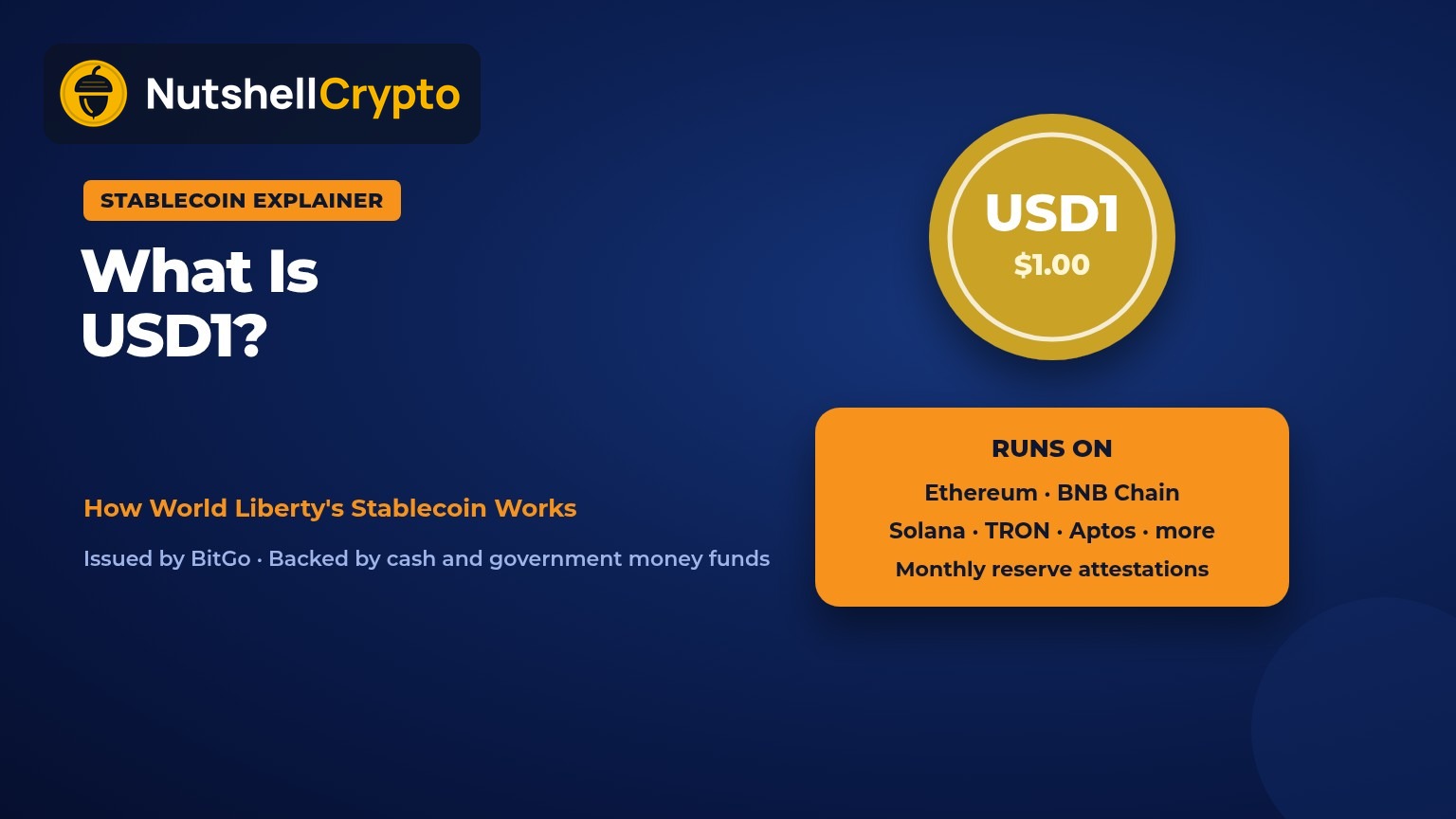
USD1 is World Liberty Financial’s “flagship stablecoin,” which its documentation says is “redeemable on a 1:1 basis for the U.S. dollar” and intended for value transfer and settlement across on-chain and traditional financial systems (World Liberty Financial docs).
World Liberty Financial announced USD1 on March 25, 2025, saying it would be 100% backed by short-term US government Treasuries, US dollar deposits and other cash equivalents, with reserves custodied by BitGo and tokens first minted on Ethereum and BNB Chain (World Liberty Financial via Business Wire; CoinDesk). Reuters reported at the time that the venture had already raised more than half a billion dollars from selling its separate WLFI token (Reuters).
USD1 grew quickly after a big early deal. On May 1, 2025, World Liberty co-founder Zach Witkoff said USD1 would be used to settle Abu Dhabi firm MGX’s $2 billion investment in Binance (Reuters). Binance founder Changpeng Zhao later told CNBC that MGX chose USD1 and that Binance has since converted the investment out of USD1 in portions over time (CNBC).
USD1 is not the same as WLFI. WLFI is World Liberty’s governance token, and its price floats with the market. USD1 is the dollar token that is supposed to stay at $1.
Who Issues USD1: World Liberty Financial and BitGo
World Liberty Financial owns the brand, but it does not issue the coin. Its docs say USD1 “is issued and minted by BitGo,” which handles issuance, custody, minting and redemption, and that “World Liberty Financial does not issue or custody USD1 directly” (World Liberty Financial docs). BitGo’s September 2026 reserve report puts it the same way: USD1 is issued and redeemed by BitGo Bank & Trust, N.A., while the USD1 brand and trademarks are owned and controlled by World Liberty Financial, Inc. and SC Financial Technologies, LLC (BitGo USD1 Reserve Report, September 2026).
BitGo Bank & Trust, N.A. is a national trust bank supervised by the US Office of the Comptroller of the Currency (OCC). It was previously BitGo Trust Company, Inc., a South Dakota trust company; BitGo said the OCC approved the conversion to a federal charter on December 12, 2025 (BitGo). The OCC’s decision letter says the bank will not take deposits and will not be insured by the FDIC (OCC).
On ownership, Forbes reported in October 2025 that an LLC connected to President Donald Trump and members of his family owns about 38% of World Liberty Financial (Forbes). Zach Witkoff is a co-founder (CoinDesk).
What Backs USD1: Reserves and Attestations
World Liberty says USD1 is backed by cash, US government money market funds and other cash equivalents, and that all reserve assets are held or maintained by BitGo (World Liberty Financial docs). BitGo’s USD1 terms say it holds reserves that, at the end of each business day, are worth at least the value of all outstanding USD1 (BitGo USD1 Terms).
BitGo publishes monthly reserve reports. The latest one listed, for September 2026, was examined by KPMG LLP under AICPA attestation standards, and KPMG’s report is dated October 29, 2026. It showed, as of September 30, 2026:
| Item (Sept 30, 2026) | Amount |
|---|---|
| USD1 redeemable tokens outstanding | 4,416,180,490 |
| Cash in demand deposit accounts | $1,162,488,934 |
| Government money market funds (at net asset value) | $3,254,103,967 |
| Total redemption assets | $4,416,592,901 |
| Assets above tokens outstanding | $412,411 |
Source: BitGo USD1 Reserve Report, September 2026. The same report says reserve assets may include cash, short-term US Treasuries, reverse repos fully backed by Treasuries, and government money market funds. You can find every monthly report on BitGo’s USD1 attestations page and on World Liberty’s attestation page, which lists reports back to April 2025.
Between reports, World Liberty runs a live Proof of Reserves dashboard that reads reserve data from a Chainlink oracle on Ethereum and compares it with on-chain supply. World Liberty notes the dashboard’s accuracy “is not guaranteed” and points to the monthly reports as the formal record.
Which Blockchains USD1 Runs On
World Liberty’s contract list says USD1 is deployed on 11 networks: Ethereum, BNB Chain, Plume, AB Core, Monad, Mantle, Morph, X Layer, Solana, TRON and Aptos. Cross-chain transfers use Chainlink’s Cross-Chain Interoperability Protocol (CCIP) (World Liberty Financial contract addresses). On Ethereum and BNB Chain, the official contract is 0x8d0d000ee44948fc98c9b98a4fa4921476f08b0d.
BitGo’s September report lists a narrower set where USD1 is minted and redeemed directly: Ethereum, BNB Smart Chain, Solana, Tron, Aptos and Tempo. On September 30, about 1.60 billion USD1 sat on Ethereum, 1.39 billion on BNB Smart Chain and 1.42 billion on the other networks combined (BitGo). Always copy contract addresses from the official list; look-alike tokens are a common scam. Our guide to crypto wallet addresses explains how to check you are on the right network.
How Big Is USD1?
As of November 9, 2026 at 2:37 PM PKT, CoinGecko showed USD1 at $0.998 with a market cap of about $3.39 billion and a circulating supply of about 3.40 billion tokens, ranking #29 among all crypto assets (CoinGecko). DefiLlama put circulation at about $3.40 billion at the same time, sixth among stablecoins behind USDT, USDC, USDS, USDe and DAI (DefiLlama).
Supply has been shrinking. Bitcoin.com News, citing DefiLlama, reported a February 2026 peak of about $5.39 billion and about $4.43 billion in late September (Bitcoin.com News). For context against the rest of the market, see our ranking of the largest stablecoins by market cap.
USD1 Fees
- Minting and redeeming with BitGo: BitGo says some mint and redeem orders carry “a flat, pre-disclosed fee” that varies by asset and is shown before you confirm; its own example shows USD1 minted with no mint fee, only the network fee. Clients are told to ask their account manager for the current schedule (BitGo Mint and Redeem guide). BitGo’s USD1 terms also say bank, payment and blockchain network fees may apply and that BitGo can change its fees (BitGo USD1 Terms).
- On exchanges: you pay the platform’s normal trading or spread fees. When Binance added USD1 pairs in December 2025, CoinDesk reported it offered zero-fee conversion between USD1 and USDC or USDT (CoinDesk). Our guide to crypto exchange fees explains maker, taker and spread costs.
- Network fees: moving USD1 on-chain costs gas in that network’s coin, such as ETH on Ethereum or BNB on BNB Chain.
- No yield for holders: World Liberty’s risk disclosures say BitGo and the WLFI parties keep the net interest earned on the reserves and USD1 holders are not entitled to it (USD1 Risk Disclosures).
How to Buy, Use and Redeem USD1
Minting and redemption. Minting is handled only by BitGo and is subject to its onboarding and compliance checks; World Liberty does not process mint requests (World Liberty Financial docs). BitGo’s report says only registered customers in good standing have mint and redemption rights; people who hold USD1 without a BitGo account can transfer it but “do not have direct redemption rights” (BitGo). BitGo also says every mint or redeem order goes to its Trust team for approval, so orders do not settle instantly (BitGo).
Buying on an exchange. Most people get USD1 on a trading platform:
- Coinbase listed USD1 for trading on August 21, 2025, which gave US users access (Decrypt).
- Kraken opened USD1 trading on August 30, 2025, and says geographic restrictions may apply (Kraken).
- Binance listed a USD1/USDT pair in May 2025 but excluded users in the US, Canada and the European Economic Area at the time (CryptoSlate). In December 2025 it added BNB/USD1, ETH/USD1 and SOL/USD1 pairs and moved the collateral behind its BUSD-pegged token into USD1 (CoinDesk).
In Canada and Australia, we could not find an official World Liberty list of local platforms, so check that your exchange supports USD1 in your province or state, and on the network you plan to use, before you send funds. If you buy with Australian or Canadian dollars, your cost in local currency moves with the exchange rate even though the token tracks the US dollar.
Using it. BitGo pitches USD1 for payments, DeFi lending and borrowing, and trading (BitGo). World Liberty also runs a USD1 Points program; its docs say points are non-transferable and “not a cryptocurrency or digital asset,” and on WLFI Markets you need to supply at least 1,000 USD1 through the Dolomite protocol to earn them (World Liberty Financial docs). If you want to hold USD1 yourself, our guide to choosing a stablecoin wallet covers the options.
USD1 and the GENIUS Act
World Liberty says USD1 is designed to align with the GENIUS Act’s stablecoin standards (World Liberty Financial docs). The GENIUS Act became law on July 18, 2025, and takes effect on January 18, 2027. On October 21, 2026, the OCC issued its final rule for stablecoin issuers under its supervision, covering reserve assets, redemption, custody and audits, also effective January 18, 2027 (OCC Bulletin 2026-50). Because BitGo’s trust bank is OCC-supervised, those are the rules to watch for USD1. Our explainer on what stablecoins are has more on the law.
USD1 Risks
- No deposit insurance. World Liberty’s risk disclosures say USD1 is not covered by FDIC or SIPC insurance (USD1 Risk Disclosures).
- Redemption limits and runs. Only eligible BitGo customers can redeem directly, and the disclosures warn that a sudden spike in redemptions could outpace liquidity, so redemptions “may be deferred or suspended in certain circumstances.” Everyone else depends on exchange prices, which can trade above or below $1.
- Freezes. BitGo can block addresses and freeze USD1 linked to illegal activity or a legal order, and holders of frozen tokens may lose the right to redeem them (USD1 Risk Disclosures). This has been used: after the late-October Binance hack, World Liberty and BitGo froze about $27 million in USD1 on October 29, 2026 (Bitcoin.com News). Our coverage of the Binance hack has the background.
- Issuer and custody risk. The reserves sit with banks and money funds through BitGo, which the disclosures say can face loss, insolvency or regulatory seizure. Smart contract bugs and network outages can also delay transfers or redemptions.
- Conflicts of interest and political scrutiny. The disclosures say BitGo’s and World Liberty’s interests may differ from holders’ because they keep the reserve income. On November 5, 2026, World Liberty said it would launch a WLFI token buyback funded by an allocation that could include revenue from USD1 reserves (Reuters via U.S. News). Bitcoin.com News reported that a House Oversight panel could open probes into the company as early as February 2027 (Bitcoin.com News).
For how stablecoins have lost their peg in the past and what to look for, read are stablecoins safe? To see how USD1 compares with the two biggest coins, see USDT vs USDC, and for other cash-backed rivals, our guides to Ripple’s RLUSD and PayPal’s PYUSD.
Is USD1 Taxable?
United States. The IRS says digital assets, a category that covers stablecoins like USD1, are treated as property, not currency, for US tax purposes. Selling USD1, swapping it for another coin or spending it is a disposal, so you work out a capital gain or loss against what you paid, which is usually tiny for a coin that stays near $1. Digital assets you receive as a reward or payment are reported at their fair market value in US dollars, and staking-type income goes on Schedule 1. Keep records of each purchase, sale and swap (IRS: Digital assets).
Canada. The CRA says trading a crypto-asset for government currency or another crypto-asset, or using it to buy goods or services, is a disposition. The result is either business income or a capital gain or loss depending on how you trade, and half of a capital gain is taxable. Moving USD1 between your own wallets is not a taxable disposition. Because you would normally buy USD1 with Canadian dollars, exchange-rate moves can create a small gain or loss in CAD (CRA: Reporting income from crypto-asset transactions).
Australia. The ATO treats crypto held as an investment as a CGT asset, and converting it to Australian or foreign currency or swapping it is a CGT event, with values worked out in AUD (ATO).
Our stablecoin taxes guide goes through these cases in more detail. This is general information, not tax advice.
FAQ
Who issues USD1?
BitGo Bank & Trust, N.A., an OCC-supervised national trust bank, issues, mints and redeems USD1 and holds the reserves. World Liberty Financial owns the brand.
Is USD1 the same as WLFI?
No. WLFI is World Liberty’s floating-price governance token. USD1 is a dollar stablecoin meant to stay at $1.
What backs USD1?
Cash in bank accounts and government money market funds, according to BitGo’s September 2026 reserve report, with monthly reports examined by an outside accounting firm.
Can I redeem USD1 for dollars directly?
Only if you are an approved BitGo customer. Other holders usually sell USD1 on an exchange.
Does USD1 pay interest?
No. The issuer and World Liberty keep the reserve income. Any yield or points you see come from a separate program or platform with its own risks.
Can USD1 be frozen?
Yes. BitGo can block addresses and freeze USD1, and it froze about $27 million after the Binance hack in October 2026.
Sources
- World Liberty Financial docs: What is USD1?
- World Liberty Financial docs: Minting
- World Liberty Financial docs: Contract addresses
- World Liberty Financial docs: Attestation reports
- World Liberty Financial docs: Proof of Reserves
- World Liberty Financial docs: USD1 Points Program
- World Liberty Financial docs: USD1 Risk Disclosures
- World Liberty Financial: Plans to launch USD1 (Mar 25, 2025)
- BitGo: USD1
- BitGo: USD1 Terms
- BitGo: USD1 attestations
- BitGo: USD1 Reserve Report, September 2026 (KPMG examination)
- BitGo: Mint and Redeem User Guide
- BitGo: OCC approval to convert to a national trust bank (Dec 12, 2025)
- OCC: Decision letter on BitGo Trust Company conversion
- OCC Bulletin 2026-50: GENIUS Act final rule
- Reuters: World Liberty Financial to launch stablecoin (Mar 25, 2025)
- Reuters: USD1 chosen for $2 billion MGX investment in Binance (May 1, 2025)
- Reuters via U.S. News: WLFI buyback program (Nov 5, 2026)
- CoinDesk: World Liberty confirms stablecoin plans with BitGo
- CoinDesk: Binance expands USD1 trading and collateral (Dec 11, 2025)
- Forbes: MGX on why it used USD1 (Oct 2, 2025)
- CNBC: Binance founder on the USD1 investment (Jan 23, 2026)
- Decrypt: Coinbase lists USD1 (Aug 21, 2025)
- Kraken: USD1 is available for trading (Aug 30, 2025)
- CryptoSlate: Binance lists USD1 with regional restrictions (May 22, 2025)
- Bitcoin.com News: Ripple and World Liberty freeze Binance hacker funds (Oct 30, 2026)
- Bitcoin.com News: WLFI buyback and USD1 supply (Nov 6, 2026)
- CoinGecko: USD1
- DefiLlama: World Liberty Financial USD
- IRS: Digital assets
- CRA: Reporting income from crypto-asset transactions
- ATO: How to work out and report CGT on crypto
This article is for education only and is not financial, legal or tax advice. Stablecoin availability and rules change; check World Liberty Financial, BitGo and your platform for the latest terms in your country.