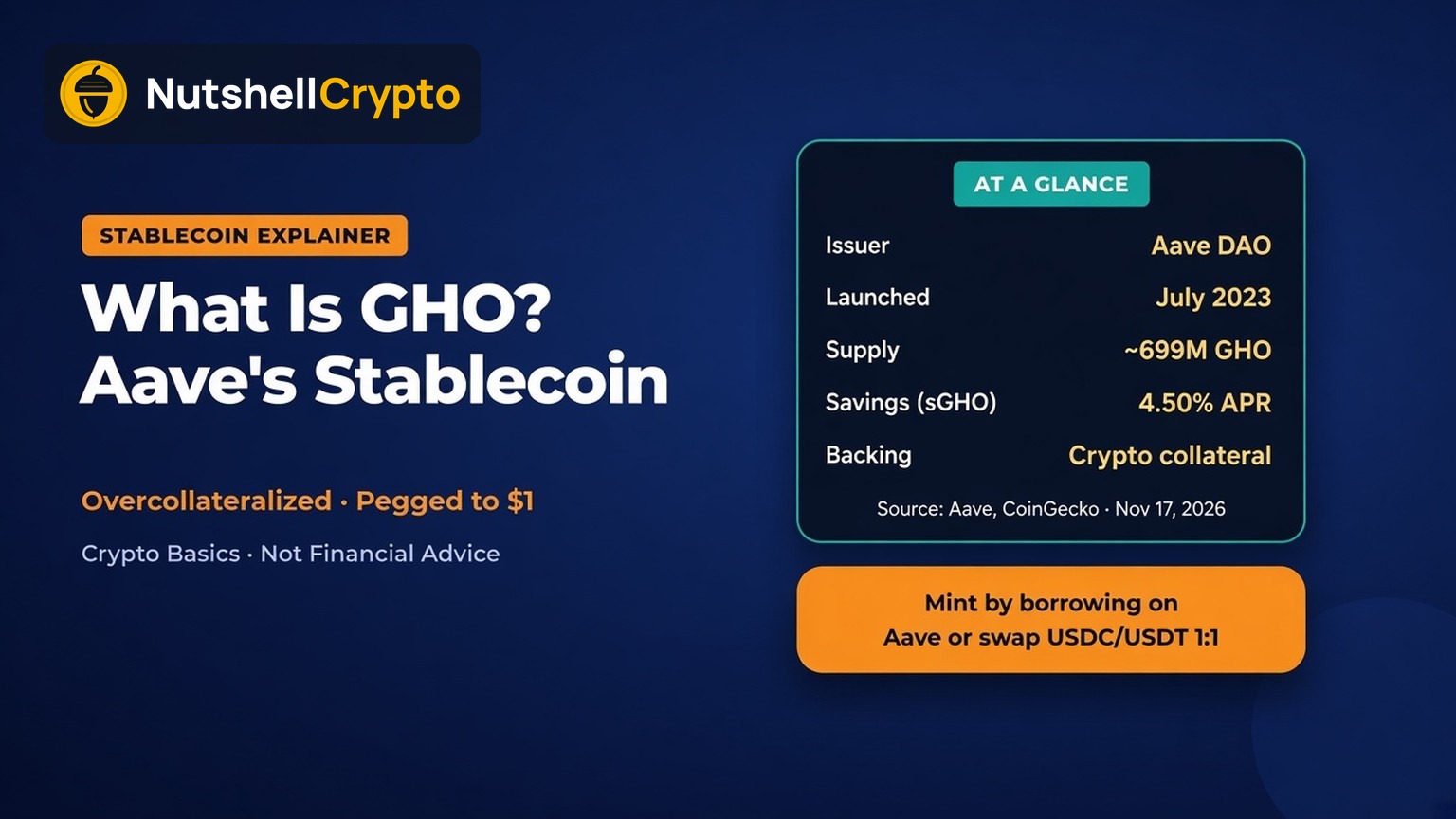
In a nutshell: GHO is the US dollar stablecoin of the Aave lending protocol. You get it by borrowing it against crypto you deposit on Aave, or by swapping USDC or USDT for it. Every GHO is backed by more than $1 of crypto, it is governed by the Aave DAO, and you can deposit it into sGHO to earn a savings rate that was 4.50% APR on November 17, 2026. About 699 million GHO were in circulation that day, according to CoinGecko.
GHO stablecoin (pronounced “go”) is Aave’s own digital dollar: an overcollateralized token that aims to stay worth $1 and is minted on demand by Aave users. Below is how it works, how you can earn on it with sGHO, what it costs to borrow, where to get it, the main risks, and how it is taxed in the US, Canada and Australia.
New to the topic? Start with our guide to what stablecoins are and how they work.
Table of contents
What Is GHO?
Aave describes GHO as “a decentralized, over-collateralized stablecoin that is fully backed, transparent, and native to the Aave Protocol” (Aave docs: GHO). It is an ERC-20 token on Ethereum, designed to keep a value pegged to the US dollar.
GHO went live on Ethereum mainnet on July 15, 2023, when the Aave DAO executed the “GHO Mainnet Launch” proposal (Aave governance proposal 268). At launch, the Aave V3 Ethereum market was the first facilitator with a mint capacity of $100 million, and a second “FlashMinter” facilitator was approved (Aave: GHO live on Ethereum mainnet).
What makes GHO different from USDT and USDC is who stands behind it. There is no company holding cash in a bank for every token. GHO is created when someone borrows it against crypto collateral, and the Aave DAO votes on its rules, rates and caps (Aave: GHO). Interest paid by GHO borrowers goes to the Aave DAO treasury rather than to lenders, as set out in the launch proposal.
How GHO Works: Facilitators and Minting
GHO uses a “facilitator” model. Facilitators are smart contracts approved by Aave governance that can mint and burn GHO, each up to its own cap, called a bucket capacity (Aave docs). The main ones are:
- Aave V3 markets: you supply collateral such as ETH or wBTC, then borrow GHO against it. Because GHO is minted rather than lent out by depositors, the limit is the facilitator cap and your collateral, not the pool’s available cash.
- GHO Stability Modules (GSMs): contracts that swap GHO with approved stablecoins such as USDC and USDT at a set ratio.
- FlashMinter: lets developers mint GHO and repay it in the same transaction, which is used for liquidations, debt switches and peg arbitrage.
When you repay a GHO loan, the repaid GHO is burned. If the value of your collateral falls too far and your health factor drops below 1, your position can be liquidated like any other Aave loan (Aave docs: liquidation). Our guide to how crypto liquidation works explains this in plain steps.
How GHO Keeps Its $1 Peg
Three things hold GHO near $1. First, overcollateralization: Aave says every GHO is backed by more than $1 of crypto held inside the protocol (Aave: GHO). Second, the stability modules let traders swap USDC or USDT for GHO 1:1 and back, so a gap between GHO and $1 can be arbitraged. Third, governance can move the borrow rate and the savings rate to push demand up or down.
The peg is not perfect. In August 2026, Aave’s GHO Stewards wrote that GHO “traded below par consistently over the last weeks”, mainly because of USDT weakness, before recovering to $0.9997 (Aave governance, August 2026). Their October update said GHO traded below $0.999 for most of September, the USDC stability module was depleted and the USDT module held about 22.5 million USDT (Aave governance, October 2026). On November 17, 2026 (1:20 PM PKT), CoinGecko showed GHO at $0.9986 (CoinGecko: GHO).
sGHO: Earning the Aave Savings Rate
sGHO is Aave’s savings vault for GHO. You deposit GHO, receive sGHO, and the savings rate builds up inside the value of each sGHO. Aave says there is “no lockup, no minimum, no cooldown”, and the rate is set by Aave governance and paid in GHO (Aave: GHO).
The money comes from borrowers: interest on GHO loans plus yield on the stablecoin reserves in the stability modules. In August 2026 governance raised the Aave Savings Rate from 4.25% to 4.50% (Aave governance). On November 17, 2026, the tracker Aavescan showed about 201 million GHO deposited in sGHO with a 4.60% APY after daily compounding, and deposits down about 12% over 30 days (Aavescan: sGHO).
The savings rate is not a fixed promise. Governance can change it at any time, so treat 4.50% as today’s figure. For other ways to earn on dollars on-chain, see our guide to stablecoin staking and yield.
GHO Borrow Rate and Fees
Borrowing GHO on Aave works like a loan with a rate set by governance, not by supply and demand. In August 2026 the GHO borrow rate on the Ethereum Core market rose from 3.75% to 4.25%. In October 2026 the GHO Stewards proposed raising it to 4.50% so it matches the savings rate, and lifting the Ethereum Prime base rate from 2.75% to 3.00% (Aave governance, October 2026). Check the live rate in the Aave app before you borrow.
Other costs to keep in mind:
- Swap fees: the October 2026 governance update says users can mint GHO through a stability module with USDC or USDT “with no mint fee”. Aave’s GHO page lists a maximum swap fee that can change.
- Network fees: every deposit, borrow, swap and repay is an Ethereum (or other chain) transaction. See our guide to Ethereum gas fees.
- DEX costs: buying GHO on a decentralized exchange adds pool fees and price slippage.
How Big Is GHO?
On November 17, 2026 (1:20 PM PKT), CoinGecko listed GHO at rank #85 with a market cap of about $698 million, a circulating supply of about 699 million and 24-hour trading volume of about $9.2 million (CoinGecko). That makes it much smaller than USDT or USDC; see our list of the largest stablecoins by market cap.
GHO started on Ethereum and now runs on more chains. Aave’s docs list GHO token contracts on Ethereum, Arbitrum, Base, Avalanche, Gnosis, Mantle, Monad, Plasma and X Layer, connected through Chainlink CCIP token pools (Aave docs). Most trading happens on decentralized exchanges such as Fluid, Uniswap and Curve, according to CoinGecko’s market list.
How to Get GHO
There are two main paths, both shown on Aave’s GHO page:
- Swap stablecoins: connect a self-custody wallet to the Aave app and swap USDC or USDT for GHO at 1:1 through a stability module, as long as the module has room.
- Borrow against crypto: supply collateral such as ETH or wBTC on Aave, then borrow GHO. Keep your health factor well above 1 so a price drop does not trigger liquidation.
You can also buy GHO on a decentralized exchange such as Uniswap or Curve. Large centralized exchanges like Coinbase and Kraken did not list GHO on CoinGecko’s market page when we checked; Gate was the only centralized venue shown. For every route you need a wallet that holds ERC-20 tokens, such as one from our guide to non-custodial ERC-20 wallets.
GHO Risks
- Depeg risk: GHO has traded slightly below $1 for weeks at a time in 2026, as the Aave governance updates above show.
- Smart contract risk: GHO, sGHO and the stability modules are code. A bug or exploit could cause losses.
- Collateral risk: GHO is backed by crypto that can fall fast. Overcollateralization and liquidations are meant to cover this, but a crash could still strain the system.
- Stablecoin dependency: the stability modules hold USDC and USDT, so problems with those coins can hit GHO, as USDT weakness did in August 2026.
- Governance risk: the Aave DAO can change rates, caps and contracts. sGHO’s savings rate can go down.
- Liquidation risk for borrowers: if you mint GHO and your collateral falls, you can lose part of it plus a liquidation bonus paid to the liquidator.
- No deposit insurance: GHO is not a bank deposit and has no FDIC or CDIC cover.
For a broader look, read our guide to whether stablecoins are safe, or compare GHO with another crypto-native dollar in our USDe explainer.
Is GHO Taxable?
United States
The IRS treats digital assets, including stablecoins, as property. Swapping another crypto for GHO, or selling GHO, can be a taxable event, and income such as rewards is taxable when received (IRS: Digital assets). Because sGHO earnings build up inside the token’s value rather than being paid out, ask a tax professional how and when to report them.
Canada
The CRA says crypto transactions can create business income or capital gains, and trading one crypto for another counts as a disposition (CRA: income from crypto transactions). Keep records of the Canadian dollar value of each swap.
Australia
The ATO says disposing of crypto, including swapping one crypto for another, can trigger capital gains tax, and rewards can be ordinary income (ATO: crypto asset investments).
More detail is in our guide to how stablecoins are taxed.
FAQ
What does GHO do?
GHO gives Aave users a dollar-pegged token they can borrow against their crypto without selling it. Holders can also deposit it into sGHO to earn the Aave Savings Rate, which was 4.50% APR on November 17, 2026 (Aavescan).
What does GHO stand for?
Aave does not present GHO as an acronym. Its docs simply say the name is pronounced “go” (Aave docs), and it is used as the token’s name and ticker.
How do stablecoins make money?
Fiat-backed issuers like Tether and Circle mostly earn interest on the reserves behind their coins. GHO works differently: borrowers pay interest to the Aave DAO, and stablecoin reserves in the stability modules earn yield, part of which funds the sGHO savings rate (Aave: GHO).
Is it worth buying stablecoins?
Stablecoins are tools for moving and holding dollars on-chain, not investments that should rise in price. GHO aims to stay at $1, so any return comes from yield like sGHO, which carries smart contract and depeg risk. This is general information, not financial advice.
Is GHO the same as AAVE?
No. AAVE is Aave’s governance token, which floats in price (about $112.92 on CoinGecko at 1:20 PM PKT on November 17, 2026). GHO is a separate stablecoin meant to stay at $1. AAVE holders vote on GHO’s rates and caps through the Aave DAO.
Sources
- Aave: GHO and sGHO
- Aave docs: GHO stablecoin
- Aave governance: GHO Mainnet Launch (proposal 268)
- Aave: GHO live on Ethereum mainnet
- GHO Stewards: August 2026 rate update
- GHO Stewards: October 2026 borrow rate update
- CoinGecko: GHO
- Aavescan: sGHO yield and deposits
- The Block: Aave activates GHO on Ethereum mainnet
This article is for education only and is not financial or tax advice.