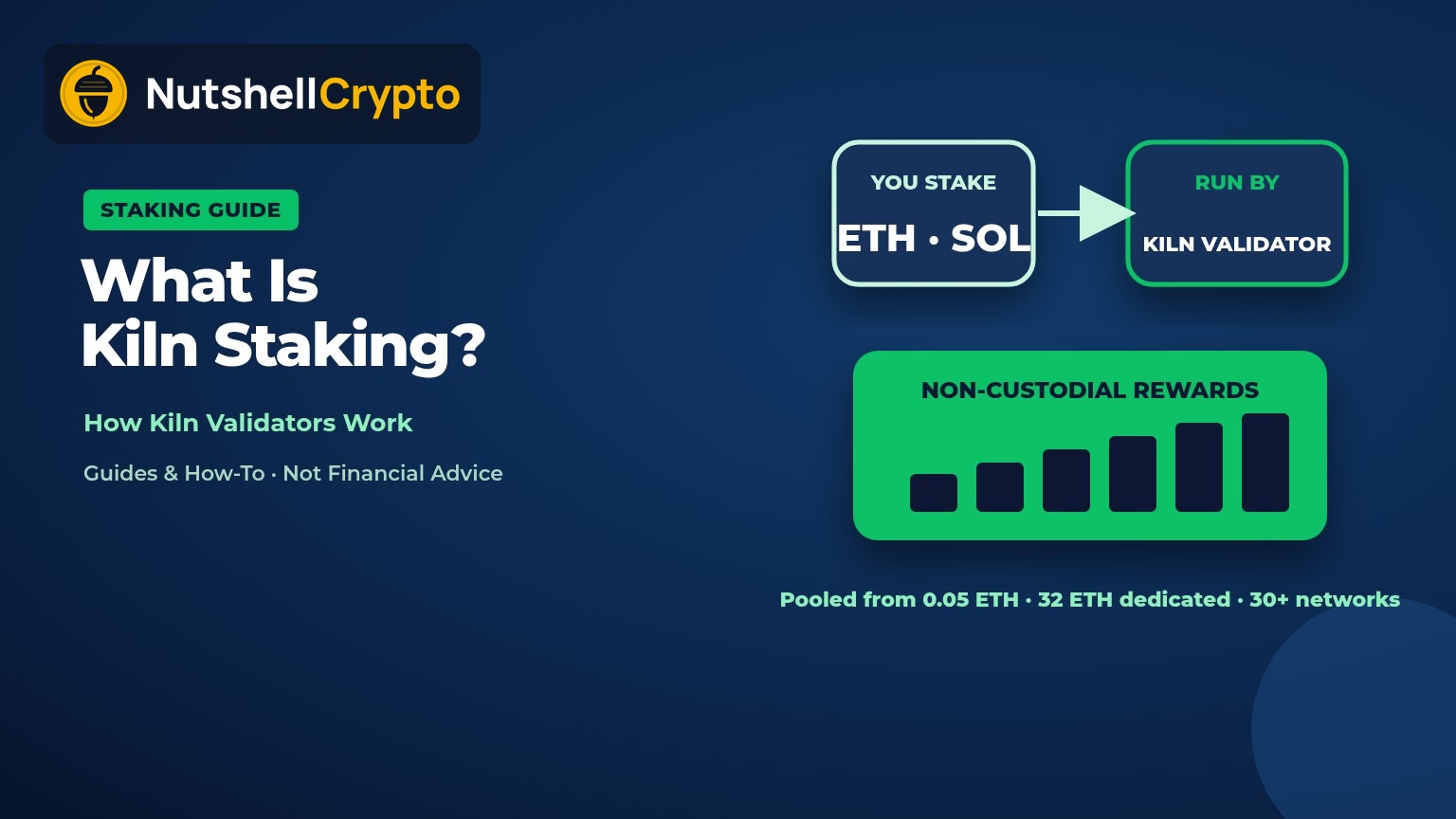
In a nutshell: Kiln is a Paris-based staking infrastructure company, not a coin or a liquid staking token. It runs validators on 30+ proof-of-stake networks and builds the staking tools that wallets and custodians plug in, including the Ethereum pool you see as “Kiln Staking” inside Ledger Wallet. Through Ledger you can stake from 0.05 ETH into a pool that charges 12% of rewards, or stake 32 ETH per dedicated validator. Kiln’s staking is non-custodial, but in September 2025 a breach of Kiln’s API led to the loss of about 193,000 SOL from SwissBorg and pushed Kiln to exit all of its Ethereum validators. Educational only; not financial advice.
Last updated: October 30, 2026.
If you have staked ETH from Ledger Wallet, Safe or a wallet that uses Kiln behind the scenes, you have already used Kiln, even if you never visited its website. Searches for “Kiln staking” usually come from people who saw the name inside another app and want to know who is actually holding their stake.
Below: what Kiln is, how its pooled and dedicated Ethereum staking works, what it charges, how Solana staking with Kiln works, what happened in the 2025 security incident, the risks, and tax notes for the US, Canada and Australia. Figures come from Kiln’s website and docs, checked on October 30, 2026, at about 6:40 PM PKT.
Table of contents
What Is Kiln?
Kiln’s docs describe it as “a staking platform you can use to stake directly, or whitelabel staking into your product” (Kiln docs). In plain terms, it does two jobs. It operates validators, the always-on machines that propose and check blocks on proof-of-stake networks. And it sells the software layer (APIs, smart contracts, dashboards and a widget) that lets exchanges, wallets and custodians offer staking to their own users. If staking itself is new to you, start with what staking is.
The company is based in Paris and was co-founded by CEO Laszlo Szabo, CPO Ernest Oppetit and COO Thomas de Phuoc (Business Wire). It raised a €17 million Series A led by Illuminate Financial in November 2022, then a further $17 million round led by 1kx in January 2024, bringing its total to $35 million (CoinDesk). TechCrunch reported at the time that Ledger, Crypto.com and Coinbase used Kiln’s technology for pooled staking in their non-custodial wallets (TechCrunch).
The key point for users is that Kiln is non-custodial. Kiln says it lets clients stake “while maintaining custody of your funds” in their existing wallet or custody setup. That makes it different from staking on an exchange, which holds your coins for you (see custodial wallets). Kiln does not issue its own token.
Kiln by the Numbers
These are Kiln’s own published figures on October 30, 2026, plus two press figures for context. Company figures are self-reported.
| Metric | Figure | Source |
|---|---|---|
| Assets delegated (all-time high) | $18B+ | Kiln home page |
| Yield generated through Kiln | $800M+ | Kiln home page |
| Networks with Kiln validators | 30+ proof-of-stake networks | Kiln home page |
| Running validators since | 2018 | Kiln home page |
| Staked ETH managed (January 2024) | 1,168,288 ETH | TechCrunch |
| ETH staked through Kiln (September 2025) | About 1.6 million ETH | CoinDesk |
| Ledger pooled staking fee | 12% of pooled rewards | Kiln docs |
| Solana validator commission (Kiln1) | 5% | Kiln docs |
Kiln’s docs list validators on networks including Ethereum, Solana, Cardano, Cosmos, Avalanche, Celestia, Near, Polygon, Sui, Tezos, Tron, Hyperliquid and Monad (Kiln protocols list).
Kiln Pooled ETH Staking (Any Amount)
Solo Ethereum staking needs 32 ETH per validator. Kiln’s pooled staking product exists because, in Kiln’s words, “99.93% of Ethereum wallets” hold less than that (Kiln pooled staking docs). Users deposit any amount of ETH into a smart contract, the pool groups deposits into 32 ETH validators, and each user’s share grows as rewards come in.
The version most retail users meet is inside Ledger Wallet (formerly Ledger Live). Kiln’s Ledger guide says:
- Minimum: 0.05 ETH, though Kiln warns that on small amounts “gas fees could exceed your stake and potential rewards.”
- Maximum: none.
- Fee: “12% of total pooled rewards,” taken automatically from rewards.
- Displayed rate: a trailing 7-day average of the pool, after fees, updated daily.
(Kiln Ledger pooled staking guide.) One quirk: your staked ETH shows up in the Kiln app inside Ledger, not as a normal balance in your Ethereum account. Also note that Ledger says “for legal reasons, US-based users cannot use the pooled staking service through Ledger Wallet” (Ledger support), so US holders usually see only the 32 ETH or liquid staking options. Our Ledger staking guide walks through the Ledger side.
Partners can also choose whether pool users get a transferable receipt token. If they do, it works a bit like a liquid staking token; if not, the position stays locked in the pool contract.
Dedicated Validators (32 ETH)
With 32 ETH or more, you can get your own validator run by Kiln. Kiln’s Ethereum docs explain that your ETH goes into the official Ethereum deposit contract and is tied to a validation key Kiln generates and runs on its infrastructure. Rewards accrue to your withdrawal wallet, and “only the wallet you use to issue your deposit can be used to withdraw your stake” (Kiln Ethereum docs). You stake and unstake in multiples of 32 ETH.
Since Ethereum’s Pectra upgrade, Kiln also supports compounding validators that auto-compound rewards up to 2,048 ETH, while older “skimming” validators pay rewards out instead. Kiln’s standalone dApp for this was retired in 2026; its docs now point Ledger users to “Kiln Staking” in Ledger Wallet’s Discover section (Kiln dApp notice).
A newer option for larger holders is Kiln stVaults on Lido V3: isolated vaults where Kiln runs the validators and the owner can optionally mint stETH against the staked ETH (Kiln stVaults docs). See our Lido staking guide for how stETH works.
Kiln Solana Staking
On Solana you don’t send coins to Kiln. Each stake creates a stake account with your wallet set as the withdrawer, and that account is delegated to Kiln’s validator. Kiln’s docs list its main Kiln1 validator at a 5% commission, with MEV rewards passed back through off-chain rebates. Activation and deactivation happen at epoch boundaries, roughly 0 to 1.5 days each (Kiln Solana docs). For the wider picture, read our SOL staking guide.
How to Stake With Kiln
- Find Kiln in a supported app, not a search ad. Kiln’s official site is kiln.fi. When we searched Google for “kiln staking” on October 30, 2026, a lookalike site with a misspelled address calling itself “Kiln Staking” ranked on page one, so never connect your wallet to a site you reached from search results. For most people that is Ledger Wallet’s Discover section (“Kiln Staking”), Safe{Wallet}, or another wallet that embeds Kiln’s widget. Businesses use the Kiln Dashboard or API.
- Pick pooled or dedicated. Pooled for under 32 ETH; dedicated validators for multiples of 32 ETH.
- Check the fee and current rate shown in the app, and compare it with alternatives on our staking APR explainer.
- Sign the transaction on your own device. Read what you’re signing. Kiln itself recommends decoding transactions before signing (more on why below).
- Track rewards in the app or on a block explorer, and keep records for tax.
How Unstaking Works
Unstaking from the pool is a two-step process. You request an exit, which locks your position and gives you an “exit ticket” NFT showing your place in the queue. When ETH arrives, you claim it. Kiln says this “generally takes about 1-4 days” under normal conditions, but can take much longer if many people exit at once, because it depends on Ethereum’s own exit and withdrawal queue (Kiln exit docs).
For dedicated validators, you request the validator exit, wait for Ethereum’s exit queue, and then the withdrawal is swept to your wallet. On Solana, you deactivate the stake account and withdraw after the epoch ends.
The 2025 Kiln Security Incident
Kiln is best known to many traders because of September 2025. According to Kiln’s own post-incident report, an attacker stole a GitHub access token from a Kiln infrastructure engineer, used it to harvest cloud credentials, and changed the Kiln Connect API so that a routine Solana “deactivate stake” request also returned a hidden transaction. That hidden transaction handed control of stake accounts to the attacker, but only for accounts with more than 150,000 SOL (Kiln incident report).
One Kiln client, the SwissBorg app, signed such a transaction. SwissBorg says the attack triggered the unstaking of “over 192,000 SOL” on September 8, 2025, and that its own wallet systems were not breached (SwissBorg). The loss was valued at about $41 million.
The next day, Kiln began an orderly exit of all of its Ethereum validators as a precaution, saying client assets remained secure and the exit would take 10 to 42 days plus up to 9 days for withdrawals (Kiln statement). Around 1.6 million ETH went into the queue, and Ethereum’s exit wait passed 46 days, the longest in its staking history at that point (CoinDesk). Lido, which used Kiln as one of its node operators, estimated about 207 ETH of missed protocol rewards from the forced exits (Lido research forum).
Kiln later said all of its services were back online after a security review with the firm Sygnia, and that it found no evidence of losses for other customers. The lesson for ordinary stakers: non-custodial does not mean risk-free. If an app builds the transaction for you, a compromised provider can slip something extra into it, which is why “decode before you sign” matters, especially for large positions. Our stakefish guide covers another big operator if you want to compare.
Risks
- Slashing and downtime. Kiln’s own risk page says validators “face staking penalties, which can result in up to a 100% loss of their staked ETH” if they fail their duties (Kiln staking risks).
- Smart contract risk. The pooled product runs on smart contracts. Kiln lists audits by Spearbit and Ledger Donjon and a bug bounty with a maximum payout of $1,000,000 (Kiln audits page). Audits reduce risk; they don’t remove it.
- Infrastructure risk. As 2025 showed, a breach at the provider can hit users even when the staking contracts are fine.
- Liquidity delays. Exits depend on Ethereum’s queue and can stretch from days to weeks.
- Price risk. Rewards are paid in the coin you stake, so a falling price can wipe out the yield.
- Concentration. Large operators running thousands of validators is a known decentralization concern for proof-of-stake networks.
US, Canada and Australia Tax Notes
United States: the IRS treats staking rewards as income when you gain “dominion and control” over them (IRS Rev. Rul. 2023-14). With pooled staking, where your share grows inside the contract, the timing of that income is a question to raise with a tax professional.
Canada: the CRA treats crypto earned from staking as income or business income depending on your situation (CRA). See our Canada crypto tax guide.
Australia: the ATO says staking rewards are ordinary income when you receive them, valued in AUD at that time, and disposing of the coins later is a CGT event (ATO). If you stake through Ledger from Australia, keep the AUD value of each reward.
For the full picture, read our guide to crypto staking taxes. This is general information, not tax advice.
FAQ
Is Kiln staking safe?
Kiln is non-custodial, has run validators since 2018, and its pooled contracts are audited. But the September 2025 breach showed that provider infrastructure is a real risk, and slashing, exit delays and price swings still apply.
Does Kiln have a token?
No. Kiln is a staking infrastructure company, not a protocol with its own coin.
What is the minimum to stake with Kiln?
Through Ledger Wallet’s pooled staking, 0.05 ETH. Dedicated validators need 32 ETH each.
How much does Kiln charge?
The Ledger pooled product charges 12% of pooled rewards. Kiln’s main Solana validator lists a 5% commission. Partner apps can set their own fees on top, so check the number shown in the app you use.
Why did Kiln exit its Ethereum validators?
As a precaution after the September 2025 API breach that led to SwissBorg’s loss of about 192,000 SOL. Kiln said ETH stakers’ funds remained secure while the validators exited.
Sources: Kiln website, docs and blog (checked October 30, 2026), Business Wire, CoinDesk, TechCrunch, SwissBorg, Lido research forum, IRS, CRA, ATO. Staking involves risk; this article is for education only and is not financial or tax advice.