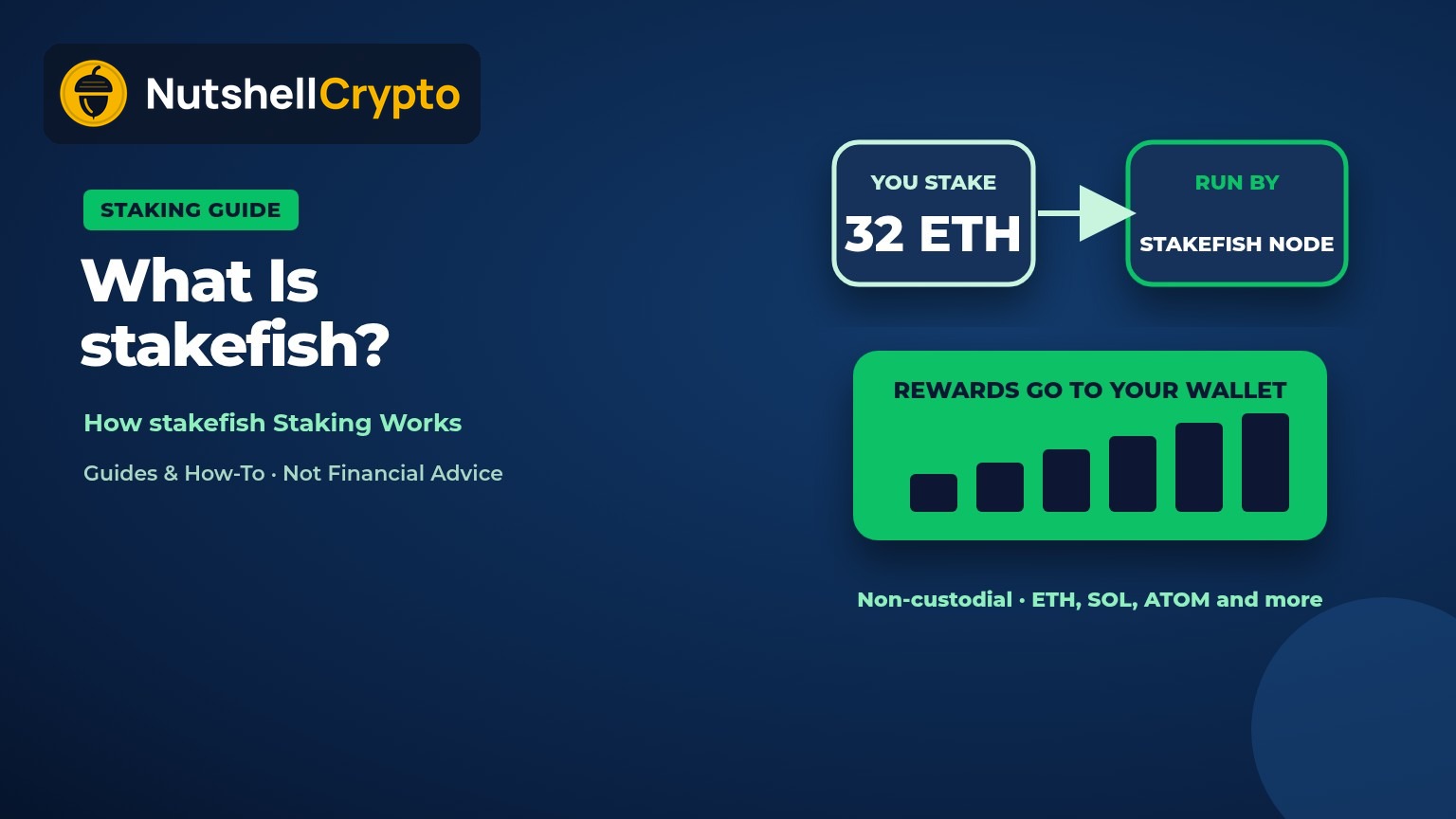
In a nutshell: stakefish is a non-custodial staking provider: it runs validators for Ethereum, Solana, Cosmos and other proof-of-stake networks, and you delegate or stake your own coins to them while keeping control of your keys or withdrawal address. It was started in 2018 by Chun Wang, a co-founder of the F2Pool Bitcoin mining pool. On Ethereum it offers native “Classic” staking from 32 ETH with no liquid token, and on Solana it charges 5% of protocol rewards and 10% of MEV rewards. The main risks are slashing, downtime penalties, slow exit queues and the fact that you, not stakefish, hold the keys. Educational only; not financial advice.
Last updated: October 30, 2026.
If you have looked at where to stake ETH or SOL outside an exchange, you have probably seen the name stakefish (written in lower case). It is not a token or a liquid staking protocol like Lido. It is a company that operates validator nodes and lets you point your stake at them.
Below: what stakefish is, how its Ethereum and Solana staking works, what it charges, how to stake and unstake, how it compares with liquid staking, the risks, and tax notes for the US, Canada and Australia. Figures come from stakefish’s own pages, checked on October 30, 2026, at about 2:15 PM PKT.
Table of contents
What Is stakefish?
stakefish calls itself “one of the longest-running and most trusted validators in the crypto ecosystem” (stakefish About page). A validator is the computer that does the work of a proof-of-stake network: it proposes and checks blocks, and earns rewards for doing it. Most coin holders don’t want to run that hardware 24/7, so they delegate to a professional operator instead. That is the business stakefish is in. If staking itself is new to you, read what staking is first.
The company’s developer docs say it “has been operating validators from 2018” (stakefish docs). Its co-founder Chun Wang also co-founded F2Pool, one of the first Bitcoin mining pools in China, and launched stakefish in 2018 (Wikipedia). In April 2025 Wang flew on SpaceX’s Fram2 mission, which is why the stakefish home page shows an astronaut.
The key word in stakefish’s pitch is non-custodial. For delegation networks such as Solana and Cosmos, its pages say “stakefish will never have the ability to move your” coins (stakefish Solana page). On Ethereum, you set the withdrawal address, so your principal and rewards go back to a wallet you control. That is the main difference from staking on an exchange, which holds your coins for you (see custodial wallets).
stakefish by the Numbers
These are stakefish’s own published figures on October 30, 2026. They are self-reported and change daily.
| Metric | Figure | Source |
|---|---|---|
| Assets staked | $1.47 billion | About page |
| Networks supported | 17 (About page); “20+” in the docs | About page, docs |
| ETH staked with stakefish | 840,544 ETH | Home page |
| SOL staked with stakefish | 508,284 SOL | Home page |
| Classic Ethereum staking | 414,739 ETH across 5,101 validators | Ethereum page |
| Ethereum rewards (calculator average) | 2.68% APR (2.49% protocol + 0.18% tips/MEV) | Ethereum page |
| Solana expected reward rate | 4.72% | Solana page |
The two ETH figures measure different things: the home page total is larger than the Classic staking count on the Ethereum page, which suggests the larger number also covers validators stakefish runs for partners. stakefish is listed as a node operator for Lido on its networks page, for example. stakefish doesn’t break the number down, so treat it as a rough size guide.
Also note that APR and APY are not the same thing. Our guide to staking APR vs APY explains why a quoted rate rarely matches what lands in your wallet.
How stakefish Ethereum Staking Works
stakefish’s retail Ethereum product is called Classic staking. It is native staking: your ETH goes into Ethereum’s official deposit contract to activate a validator, and stakefish runs the validator software. There is no liquid token like stETH. The stakefish Ethereum page lists these points:
- Minimum 32 ETH. Each validator needs at least 32 ETH. If you have less, stakefish itself points you to staking pools; see our guides to liquid staking and Lido.
- Up to 2048 ETH per validator. Since the Pectra upgrade, which went live on May 7, 2025, one validator can hold an effective balance of up to 2048 ETH (ethereum.org). Big holders no longer need hundreds of separate 32 ETH validators.
- You control the withdrawal address. Consensus rewards are paid by the network straight to that address.
- Fee/MEV smoothing pool. A single validator only proposes a block “once or twice per year,” so tips and MEV income are lumpy. stakefish pools that income across validators so payouts are steadier (fee pool docs).
- Restaking option. stakefish also offers EigenLayer native restaking, which adds extra rewards and extra risk. See what restaking is.
Activation is not instant. stakefish says deposits take about 12 to 24 hours to be verified, and then the validator waits in Ethereum’s entry queue, which “can be significant (ranging from days to over a month).” Its own research blog says the ETH entry queue peaked at 4.10 million ETH and 71 days in February 2026 (stakefish blog). You can check the current wait on validatorqueue.com. For every other way to stake ETH, see how to stake Ethereum.
How stakefish Solana Staking Works
On Solana you don’t send SOL to stakefish. You create a stake account in your own wallet and delegate it to stakefish’s validator (address 7VGU4ZwR1e1AFekqbqv2gvjeg47e1PwMPm4BfLt6rxNk, per its Solana page). The page lists:
- Expected reward rate: 4.72%
- Commission: 5% of protocol rewards and 10% of MEV rewards
- Payouts every epoch (about 2 days), with the first payout after about 2 to 3 days
- Unbonding period: 48 hours
The developer docs add that the minimum stake through its API is 0.01 SOL, each stake account needs about 0.00228288 SOL of refundable rent, and activation and deactivation take 1 to 2 epochs (stakefish docs). Our SOL staking guide covers how Solana delegation works in general.
Other Networks stakefish Supports
The networks page listed these expected reward rates on October 30, 2026: Ethereum 4% to 8%, Solana 4.72%, Sui 1.32%, Tezos 3% (delegation) or 6.69% (staking), Cardano 2.38%, Polygon 4.59%, Cosmos 18.69%, Conflux 4% to 12%, Babylon Genesis 6.72%, zkVerify 15.77%, Starknet 6.51% and Monad 7.82%. It also runs a Chainlink oracle node and is a node operator for Lido and Centrifuge.
A high rate is not free money. On networks like Cosmos, much of the reward comes from new token issuance, so the token supply grows too. On Cosmos stakefish charges a 5% commission, and the unbonding period is 21 days (stakefish Cosmos page). See our Cosmos staking guide for why that matters.
stakefish Fees
| Network | Fee (as published) |
|---|---|
| Ethereum (Classic) | 0% on consensus-layer rewards; execution-layer (tips/MEV) terms vary on the page, see below |
| Solana | 5% of protocol rewards, 10% of MEV rewards |
| Cosmos | 5% commission |
One caution on Ethereum: stakefish’s page gives two different descriptions of execution-layer fees. Its rewards calculator shows a “Tip/MEV rewards commission” of 50%, while its FAQ says stakefish charges 0% on consensus rewards “and retains 100% of execution-layer rewards, including priority fees and MEV since Glamsterdam upgrade.” Ask stakefish for the current terms in writing before you stake, because the execution-layer share decides a meaningful part of your yield. On top of any commission you pay normal network fees for deposits and withdrawals; see Ethereum gas fees.
How to Stake With stakefish
- Pick the network on stake.fish and click Stake Now. You will be sent to the stakefish staking dashboard.
- Connect your wallet. Use a self-custody wallet such as MetaMask, Phantom or a hardware wallet. stakefish’s FAQ says Ledger users stake ETH by connecting the Ledger to MetaMask. Our Ledger staking guide covers that setup.
- Enter the amount. For Ethereum, that is 32 ETH or more per validator. For Solana, any amount above the small minimum.
- Check the withdrawal address (Ethereum). stakefish’s FAQ says you can verify it by finding your deposit transaction on Etherscan and checking that the withdrawal credential matches your deposit file. Do this before you send a large amount.
- Sign and wait. Rewards start only after activation: 1 to 2 epochs on Solana, or the deposit check plus the entry queue on Ethereum.
Watch out for copycat sites. Only use the address you type yourself (stake.fish), and never enter a seed phrase on any staking site. Read what a seed phrase is if you’re unsure why.
How to Unstake
Ethereum: stakefish says withdrawals can be started at any time. Since Pectra, rewards auto-compound into your validator balance, and only amounts above the 2048 ETH cap are swept to your wallet automatically. To get your principal back you signal a voluntary exit, and your ETH then passes through Ethereum’s exit queue, “typically taking a few days.” When an exit goes through stakefish’s API, the owner must sign a challenge message with the withdrawal-address wallet, which expires after 5 minutes for regular wallets (stakefish exit docs).
Solana: deactivate the stake account in the dashboard. It becomes withdrawable after the unbonding period (about 48 hours, per stakefish), and then you withdraw the SOL back to your wallet.
stakefish vs Liquid Staking and Exchanges
| stakefish (native) | Liquid staking (e.g. Lido) | Exchange staking | |
|---|---|---|---|
| Who holds the coins | You (your keys / withdrawal address) | A smart contract; you hold a token | The exchange |
| Minimum on Ethereum | 32 ETH | Very small | Very small |
| Liquid token | No | Yes (stETH, rETH, etc.) | Sometimes |
| Smart contract risk | Low (Ethereum deposit contract; fee pool for MEV) | Higher | Low on-chain, but counterparty risk |
| Getting out | Exit queue / unbonding | Sell the token or queue | Exchange rules |
In short: stakefish suits holders with 32 ETH or more who want native staking without running hardware, and SOL or ATOM holders who simply want a well-known validator. Smaller ETH holders usually look at liquid staking instead, such as Rocket Pool or StakeWise. Another large operator, Kiln, runs the pooled ETH option inside Ledger Wallet; see our Kiln staking guide.
Risks of Staking With stakefish
- Slashing and downtime. stakefish’s own FAQ names slashing (a penalty for malicious behavior such as double signing) and downtime penalties as the main risks, and both can reduce your balance. Its Ethereum page claims “zero slashing,” but past performance doesn’t guarantee the future.
- Locked funds. Ethereum exits and the entry queue can take days or weeks; Cosmos unbonding takes 21 days. You can’t sell staked coins instantly in a crash.
- Your keys, your responsibility. stakefish warns that because you keep custody, “losing your withdrawal keys or seed phrase will result in the permanent loss of your funds.”
- Operator concentration. Big operators running many validators is a known decentralization concern for proof-of-stake networks.
- Price risk. Rewards are paid in the coin you stake. A 4% reward does not protect you from a 30% price fall.
- Extra layers. Restaking or MEV programs add their own rules and risks on top of plain staking.
US, Canada and Australia Tax Notes
United States: the IRS says staking rewards are taxable income when you gain “dominion and control” over them (IRS Rev. Rul. 2023-14). With native Ethereum staking, that timing question matters because rewards compound inside the validator.
Canada: the CRA treats crypto received from staking as income or as part of business income depending on your situation (CRA). See our Canada crypto tax guide.
Australia: the ATO says staking rewards are ordinary income when you receive them, valued in AUD at that time, and selling the coins later is a CGT event (ATO).
stakefish’s dashboard lets you track rewards per validator, which helps with records. For the full picture, read our guide to crypto staking taxes. This is general information, not tax advice.
FAQ
Is stakefish safe?
stakefish has run validators since 2018, says it is SOC 2 compliant, and its staking is non-custodial, so it can’t move your coins. That removes exchange-style counterparty risk, but not slashing, downtime, queue delays or the risk of losing your own keys.
Does stakefish have a token?
No. stakefish is a validator service, not a protocol with its own coin, and Classic Ethereum staking doesn’t give you a liquid staking token.
Can I stake less than 32 ETH with stakefish?
Not with Classic staking, which needs 32 ETH per validator. stakefish’s own FAQ suggests staking pools for smaller amounts.
How much does stakefish charge?
On Solana, 5% of protocol rewards and 10% of MEV rewards. On Cosmos, 5%. On Ethereum, 0% on consensus rewards; check the current execution-layer terms with stakefish, because its page describes them in two different ways.
Who founded stakefish?
Chun Wang, a co-founder of the F2Pool mining pool, launched stakefish in 2018.
Sources: stakefish website, docs and blog (checked October 30, 2026), ethereum.org, Wikipedia, IRS, CRA, ATO. Staking involves risk; this article is for education only and is not financial or tax advice.