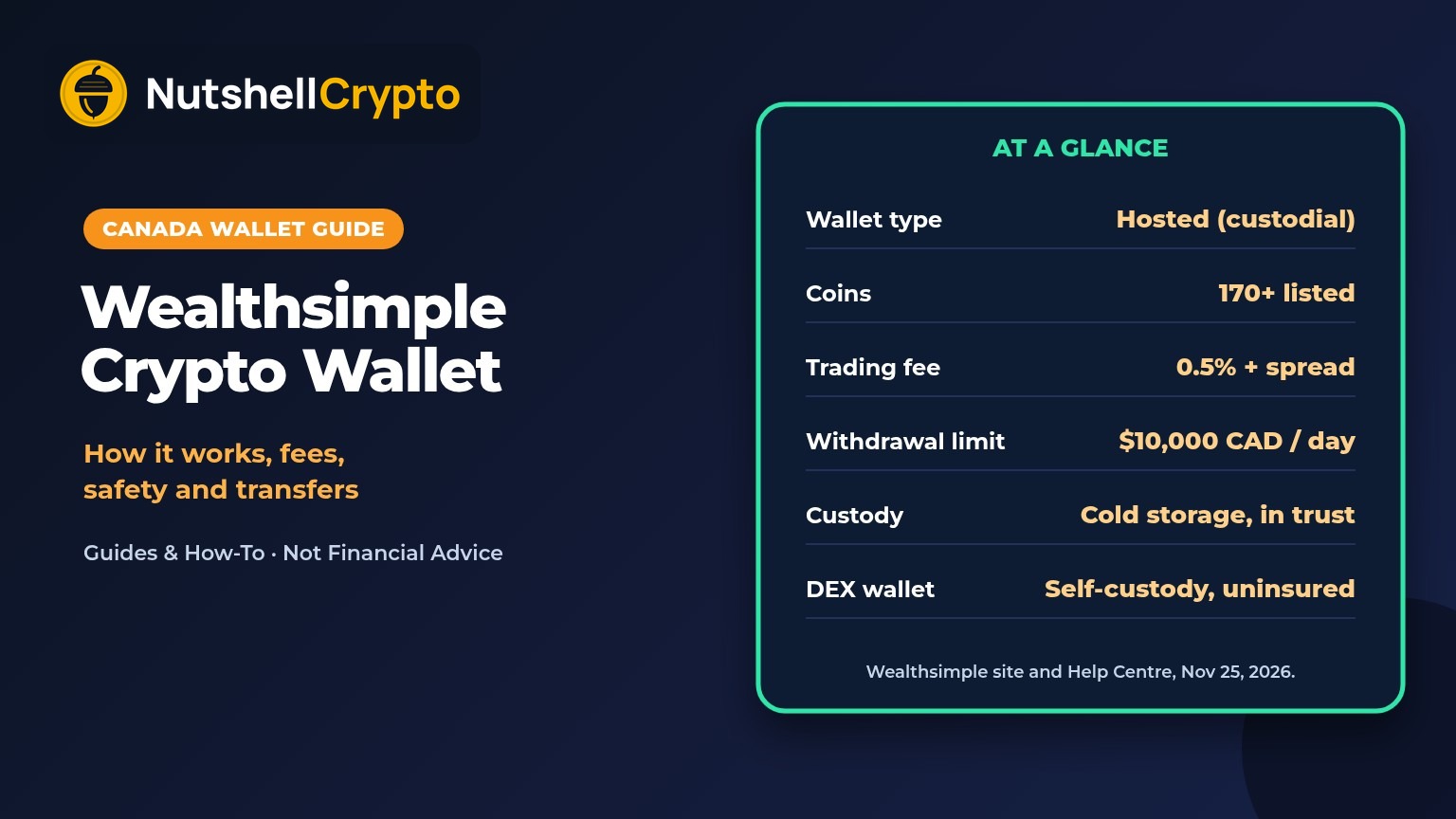
In a nutshell: Wealthsimple gives Canadians two kinds of crypto wallet in one app. The main Crypto account is a hosted (custodial) wallet: Wealthsimple and its custodians hold your coins in trust, mostly in insured cold storage, and you can send and receive 170+ coins. The newer DEX wallet is a self-custody wallet for on-chain tokens that Wealthsimple can’t access, but it isn’t insured. It’s only for Canadian residents. Educational only; not financial advice.
Yes, you can use Wealthsimple as a crypto wallet: its Crypto account lets you buy, hold, send and receive coins, and Wealthsimple keeps the keys for you. If you want to hold your own keys, its separate DEX wallet is self-custody, and you can always withdraw coins to a hardware or software wallet you control.
This guide explains how the Wealthsimple crypto wallet works, its fees and transfer limits (checked on Wealthsimple’s site and Help Centre on November 25, 2026), how safe it is, how to move crypto in and out, how to close the account, and tax notes for Canada, the US and Australia.
Table of contents
- What is the Wealthsimple crypto wallet?
- Hosted wallet vs DEX wallet
- Fees and limits
- Is Wealthsimple a safe wallet?
- How to send crypto from Wealthsimple to a wallet
- How to deposit crypto into Wealthsimple
- Closing your Wealthsimple crypto account
- Is Wealthsimple good for crypto?
- Canada, US and Australia notes
- FAQ
What Is the Wealthsimple Crypto Wallet?
Wealthsimple is a Toronto-based financial app founded in 2014. Its newsroom says it serves more than 4 million Canadians and held about $169 billion in assets under administration as of September 30, 2026. Crypto is one product inside the same app as its chequing, stock trading and tax tools.
The “wallet” is the transfer feature of the Wealthsimple Crypto account. Before 2022, coins bought on Wealthsimple were stuck inside the app. On March 1, 2022, Wealthsimple announced crypto wallets so clients could send and receive coins, and it described them as “hosted wallets, not non-custodial wallets.” Today its crypto page lists bitcoin, ether, Solana and 170+ other coins to trade, transfer and deposit.
Wealthsimple Crypto is offered by Wealthsimple Investments Inc., a member of the Canadian Investment Regulatory Organization (CIRO). Crypto can only be held in a non-registered account, not a TFSA or RRSP, per the same page. Wealthsimple is on our list of regulated crypto exchanges in Canada.
Hosted Wallet vs DEX Wallet
Wealthsimple now runs two very different wallets, and the difference matters for safety.
1. The Crypto account (hosted, custodial)
This is the default. Wealthsimple holds your coins in trust for you, so it’s a custodial wallet: you never see a seed phrase, and if you lose your phone you recover access through Wealthsimple, not a backup phrase. You get a deposit address for each coin and can withdraw to outside wallets.
2. The DEX wallet (self-custody)
Wealthsimple has since added DEX trading, which lets you buy on-chain tokens through a decentralized exchange from inside the app. Its Help Centre guide says your first DEX trade creates a self-custody wallet run by Wealthsimple Web3 Inc., separate from your Crypto account. Under its Web3 wallet terms, your private keys are generated and stored in a trusted execution environment (TEE), and Wealthsimple says it can’t access your keys or sign for you.
The trade-off: DEX assets aren’t insured, support can’t recover the wallet or reverse transactions, and the terms warn that losing your login methods or a TEE failure “may result in the permanent loss” of access. As of November 25, 2026, the Help Centre says it runs on Ethereum only, is labelled beta, can’t receive tokens from outside wallets, can’t be opened in another wallet app, and seed phrase export is “coming soon”.
| Crypto account (hosted) | DEX wallet (self-custody) | |
|---|---|---|
| Who holds the keys | Wealthsimple and its custodians | You, via keys in a TEE |
| Coins | 170+ listed coins | On-chain tokens on Ethereum |
| Trading fee | 0.5% plus spread | 0.85%, $0 network fees for now |
| Insurance | Custodian and Wealthsimple coverage | None |
| Send to outside wallet | Yes, within limits | Yes |
| Receive from outside wallet | Yes, supported coins and networks | No |
| Staking | Yes, some coins | No |
Sources: Wealthsimple crypto fee schedule and DEX Help Centre guide, checked November 25, 2026.
If you want a wallet that no company can touch, a hardware wallet is still the cleaner choice. See our guides to self-custody and hot vs cold wallets.
Wealthsimple Crypto Fees and Limits
From Wealthsimple’s crypto fee schedule and crypto page, checked November 25, 2026:
- Trading fee: a flat 0.5% on every order, plus a price spread on market orders that’s shown before you confirm. The fee schedule’s own example shows a 0.5% fee plus a 1% spread costing 1.5% in total.
- Small orders: a $1 surcharge on any order under $100.
- Active Trader status: spread drops to 0% and the fee falls as your 30-day trading volume rises.
- Limit orders and auto-invest: limit orders are spread-free, and paycheque auto-invest into crypto has no fees, spreads or surcharges, per the crypto page.
- Staking fee: Wealthsimple keeps 30% of staking rewards for Core and Premium clients and 15% for Generation clients, on top of validator commissions.
- Network fees: you pay the blockchain fee when you withdraw; Wealthsimple shows an estimate first.
- DEX trades: 0.85% per order, with network fees covered by Wealthsimple Web3 Inc. “subject to change or removal at any time.”
Transfer limits come from the withdrawal and deposit Help Centre pages:
- Withdrawals: up to $10,000 CAD per day and $25,000 CAD per week across all coins, on a rolling basis (some clients have different limits).
- Deposits: no limit, with a minimum of 0.000001 of a coin.
- Coins bought with money from a linked bank account have a 5-business-day hold before you can withdraw them. Interac e-Transfer and debit card deposits skip that hold, per the get started guide.
There’s also a buying cap in some provinces. In Ontario, Newfoundland and Labrador, PEI, Nova Scotia, New Brunswick and the three territories, most coins have a $30,000 net purchase limit per rolling 12 months, but BTC, ETH, LTC, BCH, USDC and SOL are exempt, per the purchase limit page. Alberta, BC, Manitoba, Quebec and Saskatchewan have no annual limit. For how these costs compare with other platforms, see our crypto exchange fees guide.
Is Wealthsimple a Safe Wallet?
For a custodial platform, Wealthsimple has strong safeguards. Its crypto product risk disclosure names three custodians, Tetra Trust Company (Calgary), Coinbase Custody Trust Company (New York) and BitGo Trust Company (South Dakota), which keep client coins in cold storage. Wealthsimple may keep up to 20% of client crypto by value in its own hot wallets for transfers and settlement. Its crypto page says each custodial partner has over $75 million in cold storage insurance and that hot wallets have extra coverage through Coincover. Coins are held in trust, so they belong to you if Wealthsimple fails.
The limits are important too:
- Crypto isn’t covered by CIPF or CDIC. Only the cash balance in your Crypto account has CIPF protection within limits, per the risk disclosure and the Help Centre.
- Insurance has exclusions and pays in cash, so a claim could pay less than your coins are worth later.
- It’s custodial: Wealthsimple can pause or review your account. One Reddit user reported their whole account was locked for about a day after sending USDC to a Binance wallet.
- Transfers are final. Sending a coin on the wrong network, or without a required memo, can lose it for good.
- The DEX wallet has none of the insurance above.
Turn on two-factor authentication, use a strong unique password, and never share your login. Big balances you plan to hold for years are safer in a wallet you control.
How to Send Crypto From Wealthsimple to a Wallet
Yes, you can transfer crypto from Wealthsimple to another wallet. The steps below follow the withdrawal guide:
- Open the receiving wallet and copy its address for the right coin and network. Our wallet address guide explains what to check.
- In the Wealthsimple app, tap the Move tab, then Send crypto under Transfer assets.
- Pick the coin, paste the address, add a memo or tag if the coin needs one, and choose the network. ETH can go out on Ethereum or Base, and USDC on Ethereum, Base or Solana.
- Enter the amount, review the network fee, and confirm.
Expect a selfie and photo ID check if you didn’t verify that way when you opened the account. Send a small test amount first, because withdrawals can’t be reversed. For a full walkthrough to a hardware device, see how to transfer crypto to a cold wallet.
How to Deposit Crypto Into Wealthsimple
Per the deposit guide, tap Move, then Receive crypto, pick the coin and copy its deposit address (and memo, if shown). Then send from your other wallet or exchange.
Be careful with networks. Deposits only work on the single network listed for each coin, and Wealthsimple says coins sent on unsupported networks such as Base, Arbitrum, Optimism, Polygon or BNB Smart Chain are “permanently lost.” Check the supported coins list first. Wealthsimple records the deposit at its market value on arrival, so your average cost on Wealthsimple won’t match what you paid elsewhere; keep your own records for tax.
Closing Your Wealthsimple Crypto Account
To close the Crypto account, your balance must be zero. Sell or send out all coins, withdraw the cash, and cancel pending deposits, orders and recurring buys, then use Settings > Close account, per the close an account page. If you used DEX trading, send or sell every DEX token first, because support can’t recover assets from a closed account.
The usual snag is “dust”, tiny leftover amounts below the minimum trade size. Wealthsimple’s crypto account agreement treats amounts under about $0.02 as dust and removes them at zero value when you close. Users on Reddit who saw a “Crypto could not be closed” error said support closed it manually, so contact support if the button fails.
Is Wealthsimple Good for Crypto?
It suits Canadians who want crypto in the same regulated app as their savings and stocks, with easy CAD funding, staking and the option to withdraw. It’s less suited to frequent traders who don’t qualify for Active Trader pricing, because 0.5% plus a spread costs more than order-book exchanges, and to anyone who wants full control of their keys for large holdings. Bitcoin-only buyers can compare it with our Shakepay guide, and regular buyers can test a plan with our DCA calculator.
Staking is available on coins such as ETH, SOL, ADA and DOT, with rewards of “up to 5% per year” per Wealthsimple, before its 30% or 15% cut. Rates vary and aren’t guaranteed; our staking guide explains the risks.
Canada, US and Australia Notes
Canada: Moving coins between wallets you own isn’t a sale, and Wealthsimple’s withdrawal page says sending crypto to your own external wallet “doesn’t constitute a taxable event.” Selling, swapping or spending crypto can create a capital gain or business income, per the CRA’s crypto guide. Every DEX trade is also taxable, and Wealthsimple doesn’t produce a gains report for DEX trades, so you need to track those yourself. See our cryptocurrency tax Canada guide, wallet transfer tax rules and staking taxes guide.
United States: Wealthsimple doesn’t serve US residents. It sold its US client accounts to Betterment in 2021 to focus on Canada, as BetaKit reported, and the Web3 wallet terms require users to live in Canada. US readers looking for a similar app-based wallet can read our Robinhood Wallet guide; the IRS asks every filer the digital asset question.
Australia: Wealthsimple isn’t available in Australia. Australians can check an exchange on AUSTRAC’s public virtual asset service provider register, and the ATO explains capital gains tax on its crypto asset investments page.
FAQ
Can I use Wealthsimple as a crypto wallet?
Yes. The Wealthsimple Crypto account works as a hosted wallet: you can hold 170+ coins and send or receive them on supported networks. Wealthsimple holds the keys for you, so it’s custodial; its separate DEX wallet is self-custody but only covers Ethereum tokens bought through the app.
Is Wealthsimple a safe wallet?
It’s one of the more protected custodial options in Canada. It’s run by a CIRO member, keeps most coins in cold storage with regulated custodians, and holds them in trust, per its risk disclosure. But crypto isn’t covered by CIPF or CDIC, and as with any custodial wallet you depend on the company’s security and account access.
Can you transfer crypto from Wealthsimple to a wallet?
Yes. Use Move, then Send crypto, paste your wallet address and pick the right network. Withdrawals are limited to $10,000 CAD a day and $25,000 CAD a week, and coins bought with linked bank deposits have a 5-business-day hold, per the withdrawal guide.
Is holding crypto on Wealthsimple safe?
For small and medium amounts it’s reasonably safe: coins are held in trust, mostly offline, and backed by custodian insurance with limits. Insurance has exclusions and pays in cash, and you can’t use your coins if your account is frozen. For large long-term holdings, many people move coins to a hardware wallet they control.
Is Wealthsimple a good app for crypto?
It’s good for Canadians who want a simple, regulated app with CAD funding, staking and transfers. The 0.5% fee plus spread is higher than many order-book exchanges unless you qualify for Active Trader pricing, so cost-focused traders may prefer another platform.
Why won’t Wealthsimple let me close my crypto account?
Usually because something is left in it: dust, cash, a pending order or deposit, a recurring buy, or DEX tokens. The balance must be zero, and dust is removed at zero value on closing under the crypto account agreement. If the close button still fails, contact support so they can close it for you.
This article is for education only and isn’t financial or tax advice. Wealthsimple’s fees, limits and features change; check the app before you trade or transfer.