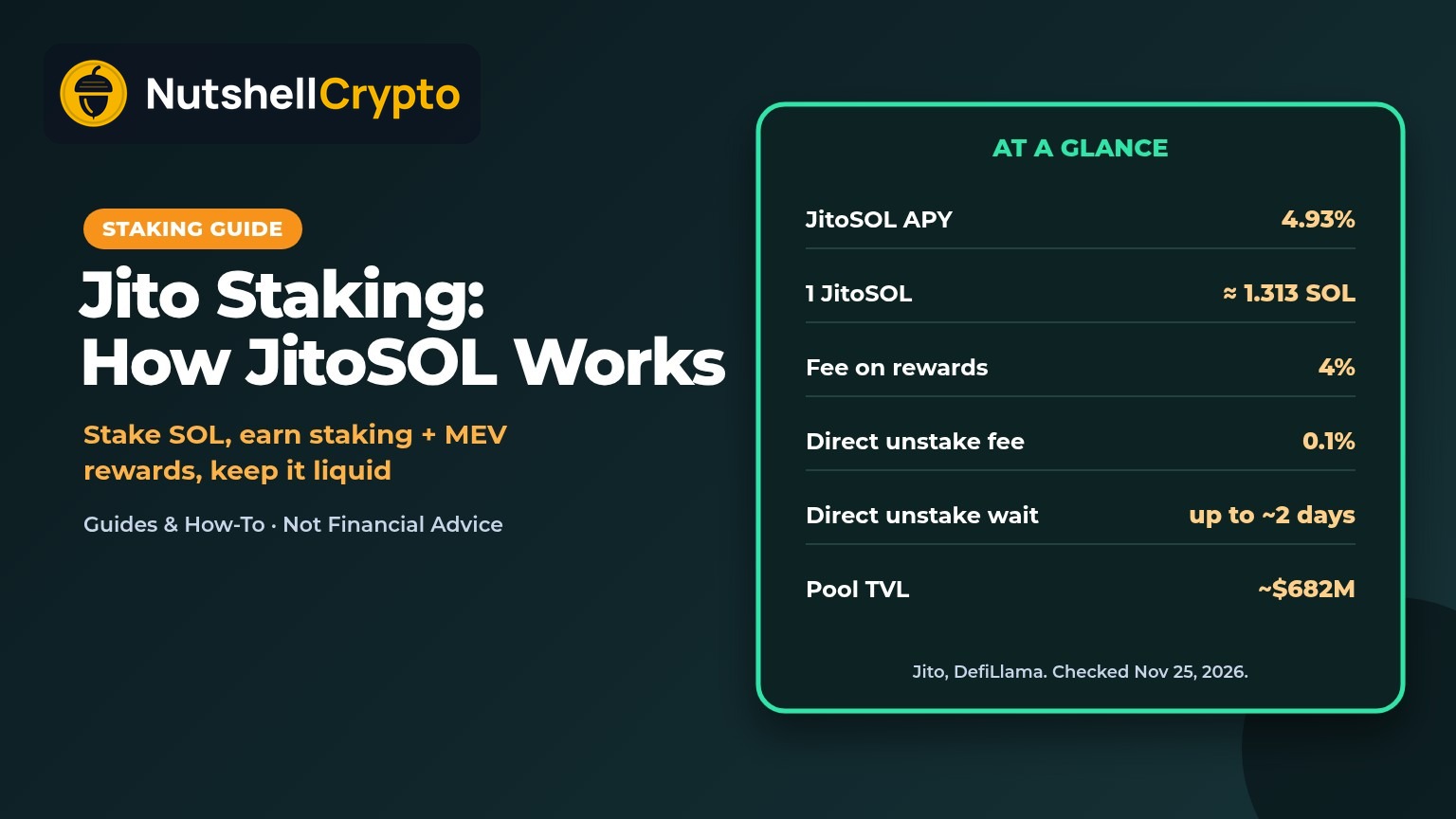
In a nutshell: Jito staking means depositing SOL into Jito’s stake pool and getting JitoSOL back, a liquid staking token that grows in value against SOL as it earns regular Solana staking rewards plus MEV tips. Jito’s site showed a 4.93% APY and 1 JitoSOL at about 1.313 SOL on November 25, 2026. Jito keeps 4% of rewards, direct unstaking costs 0.1% and takes up to about 2 days, or you can swap JitoSOL for SOL instantly on Jupiter. The main risks are smart contract bugs, the JitoSOL price slipping below its SOL value in a sell-off, and SOL’s own price swings. Educational only; not financial advice.
Jito staking lets you stake SOL without locking it up: you deposit SOL on Jito, get JitoSOL in your wallet right away, and the token’s value rises against SOL as staking and MEV rewards come in. You can hold JitoSOL, use it in DeFi, or swap it back to SOL at any time.
This guide covers how Jito and JitoSOL work, current rates and fees, how to stake and unstake step by step, how JitoSOL compares with mSOL and native staking, the risks, and tax notes for the US, Canada and Australia. Figures were checked on November 25, 2026, Pakistan time, on the pages linked below.
Table of contents
What Is Jito Staking?
Jito is a liquid staking service on Solana. Its documentation describes the Jito Stake Pool as a way to stake SOL in exchange for JitoSOL, a liquid stake pool token that “provides liquidity while earning a combination of staking rewards and MEV rewards”. MEV (maximum extractable value) is the extra income validators earn from the order of transactions in a block, and Jito passes part of it to stakers.
JitoSOL came onto the market in November 2022, according to the 21Shares JitoSOL cheat sheet. If you are new to staking itself, start with our guide to what staking in crypto is, then our SOL staking guide for the Solana basics.
How JitoSOL Works
When you stake through Jito, your SOL joins a pool that is spread across many validators. Jito’s general FAQs say an automated system called StakeNet picks the top 400 validators by commission, voting performance, running Jito’s MEV software and size, and rebalances about every 20 to 30 days.
- Rewards show up in the price, not as payouts. The number of JitoSOL in your wallet stays the same. Jito’s FAQ explains that 1 JitoSOL started at 1 SOL and rises against SOL as rewards accrue. On November 25, 2026, the Jito staking page showed 1 JitoSOL at about 1.313 SOL.
- Two reward streams. Validators earn new SOL issuance every epoch (about 2 days), and Jito adds MEV tips from its transaction auction on top. The FAQ notes MEV income is higher in busy, volatile markets and lower in quiet ones.
- It stays liquid. JitoSOL is a normal Solana token, so you can send it, trade it or use it as collateral in DeFi. Our liquid staking guide explains how value-accruing tokens like JitoSOL differ from rebasing ones.
Jito’s security page says liquid staking is non-custodial and that “even if Jito were to disappear, holders could still withdraw their SOL from validators along with accumulated rewards.” The Jito DAO manages the pool with limited powers over validator selection and fees.
Jito Staking by the Numbers
| Item | Figure (Nov 25, 2026) | Source |
|---|---|---|
| JitoSOL APY | 4.93% | Jito staking page |
| 1 JitoSOL in SOL | About 1.313 SOL | Jito staking page |
| Solana network reward rate | 5.02% | Staking Rewards |
| Jito pool TVL | About $682 million | DefiLlama |
| All-time high TVL | $3.91 billion (Jan 26, 2025) | DefiLlama |
| Validators in the pool | Top 400 picked by StakeNet | Jito FAQ |
DefiLlama ranked Jito eighth among liquid staking protocols by TVL on November 25, 2026. Its TVL is shown in US dollars, so part of the drop from the 2025 peak reflects SOL’s lower price, not only withdrawals. The Solana-wide reward rate comes from Staking Rewards.
Note that JitoSOL’s quoted APY (4.93%) was slightly below the network average (5.02%) on the day we checked. 21Shares says JitoSOL has historically earned about 30 to 60 basis points more than plain Solana staking over longer periods, but that the premium is “not fixed” and shrinks when network activity is low. Rates change daily; our staking APR guide explains how to read them, and you can model rough returns with our staking rewards calculator by entering SOL figures in place of LINK.
Jito Staking Fees
Jito’s general FAQs list the fees:
- Management fee: 4% of total rewards (staking and MEV, after validator commissions). Jito says this works out to about 0.3% of deposited value a year, or about 30 cents per $100.
- Direct unstake fee: 0.1% of the withdrawal value, only if you unstake directly on the Jito site.
- Validator commissions: charged before Jito’s fee. Jito says it excludes validators with high fees or poor performance.
- Network fees: you need a small SOL balance for transactions. Jito’s staking guide suggests about 0.01 SOL.
Swapping JitoSOL for SOL on a DEX avoids the 0.1% fee but adds swap costs and slippage. Jito’s unstaking guide puts the typical cost of an instant swap at under 0.3%, and Phantom’s JitoSOL help article says a 0.1% to 0.3% unstaking fee may apply.
How to Stake SOL With Jito
According to Jito’s staking guide, the whole process takes 2 to 5 minutes. Supported wallets include Phantom, Solflare, Backpack and Ledger (through a browser wallet), plus Squads and Fireblocks for teams.
- Fund a Solana wallet. Hold the SOL you want to stake plus a little extra for fees.
- Go to jito.network/staking and open the Stake tab. Check the address carefully; fake staking sites are a common scam.
- Connect your wallet and approve the connection.
- Enter the SOL amount and pick “Direct Mint”. Jito recommends minting through the stake pool contract, which has no slippage. The other option swaps SOL for JitoSOL on a DEX.
- Review and confirm the transaction in your wallet. Ledger users approve it on the device.
- Check your wallet. JitoSOL arrives within seconds and starts earning right away.
You can also do this inside Phantom: its help article shows how to search for Jito Staked SOL in the extension and stake from there. If you already have a native stake account, Jito can convert it to JitoSOL, but the FAQ says the Interceptor program holds the JitoSOL for 10 hours first, as protection against abuse, while it keeps earning rewards. For keeping keys offline while staking, see our guide to staking with a hardware wallet.
How to Unstake JitoSOL
Jito’s unstaking guide gives two ways out:
| Method | Speed | Typical cost | Best for |
|---|---|---|---|
| Instant swap via Jupiter | Instant | Under 0.3% | Most users |
| Direct unstake on Jito | Up to about 2 days | 0.1%, no slippage | Large amounts |
A direct unstake moves your stake out of the pool into a stake account in your wallet. You then click Deactivate, wait for the end of the Solana epoch, and click Withdraw. Jito says the wait is a Solana rule, not a Jito one, and that the action can’t be reversed once started. Phantom’s help center says epochs typically last 2 to 3 days. Our unbonding period guide compares exit times across chains.
JitoSOL vs mSOL vs Native SOL Staking
| JitoSOL (Jito) | mSOL (Marinade) | Native SOL staking | |
|---|---|---|---|
| What you hold | Liquid token that rises vs SOL | Liquid token that rises vs SOL | A stake account |
| Rewards | Staking + MEV tips | Staking (see our Marinade guide) | Staking, plus MEV if your validator shares it |
| Protocol fee | 4% of rewards | See our Marinade guide | Validator commission only |
| Usable in DeFi | Yes | Yes | No |
| Exit | Instant swap or ~2-day unstake | Instant swap or delayed unstake | Wait for the epoch to end |
Our Marinade staked SOL guide goes deeper on mSOL fees and how the two tokens compare. Phantom’s help center notes that native staking in Phantom needs at least 1 SOL to open a stake account.
Risks of Jito Staking
- Smart contract risk. JitoSOL runs on the stake pool program developed by Solana Labs. Jito says three firms have audited it, and Phantom says the program has been audited nine times and that “a small residual risk exists.” Audits lower risk; they don’t remove it.
- Depeg and liquidity risk. The instant exit depends on DEX liquidity. In a sharp sell-off, JitoSOL can trade below its SOL value, and 21Shares notes that very large redemptions may not be immediate.
- Variable rewards. MEV income rises and falls with network activity, so the APY moves around. Jito’s FAQ says the only ways JitoSOL could lose value against SOL are extreme events such as large-scale slashing (which Solana doesn’t currently have) or a critical contract bug.
- DeFi stacking risk. Using JitoSOL as collateral adds the other protocol’s risks, including liquidation. See our guide to crypto DEXs before swapping or lending.
- SOL price risk. JitoSOL tracks SOL, so its dollar value falls when SOL falls. Staking rewards don’t protect against that.
If you want to see how other holders weigh these trade-offs, the r/solana thread “Is it any good staking with JitoSol?” is one of the top Google results for Jito staking. Treat forum comments as opinions, not facts.
US, Canada and Australia Tax Notes
United States: under IRS Revenue Ruling 2023-14, staking rewards are income at fair market value when you gain “dominion and control” over them. The IRS hasn’t said how that applies to value-accruing tokens like JitoSOL, where rewards build up in the price rather than arriving as new coins. Swapping SOL for JitoSOL may also count as a trade: the IRS virtual currency FAQ says exchanging one virtual currency for another creates a capital gain or loss. Keep records of every deposit and exit, and ask a tax professional. Our crypto staking taxes guide has more.
Canada: the CRA says trading or exchanging a crypto-asset for “another type of crypto-asset” can be a disposition, on its page about income from crypto-asset transactions, so converting SOL to JitoSOL and back may trigger capital gains or losses. The CRA’s page on mining and staking income doesn’t address liquid staking tokens directly. See our Canada crypto tax guide.
Australia: the ATO’s page on DeFi and wrapping crypto says a CGT event generally happens when you send a fungible token to an address you don’t control that already holds that token, and that the proceeds equal the market value of what you get back. It has no ruling specific to JitoSOL, so ask a registered tax agent how your deposit and exit are treated.
FAQ
What is jito in crypto?
Jito is a Solana project best known for JitoSOL, a liquid staking token that earns regular staking rewards plus MEV tips. It also runs the transaction auction that collects those tips and shares them with validators and stakers. Its JTO token lets holders vote on treasury allocations and protocol parameters.
How does jito work?
You deposit SOL into Jito’s stake pool and receive JitoSOL, while Jito spreads the SOL across up to 400 validators chosen by StakeNet. Rewards and MEV tips flow back into the pool, so each JitoSOL is worth more SOL over time. On November 25, 2026, 1 JitoSOL was worth about 1.313 SOL on Jito’s site.
Is JitoSOL audited and safe?
JitoSOL uses the Solana Labs stake pool program, which Jito says three firms have audited, and Phantom says the program has been audited nine times. It is non-custodial, so Jito can’t move your SOL. It still carries smart contract, liquidity and price risk, so only stake what you can afford to have tied up in those risks.
What is the difference between MSOL and JitoSOL?
Both are Solana liquid staking tokens that rise in value against SOL. JitoSOL comes from Jito and adds MEV tips to staking rewards, with a 4% fee on rewards; mSOL comes from Marinade, which uses its own validator selection. Our Marinade guide compares their fees side by side.
How risky is staking Solana?
Native SOL staking is fairly low risk on the protocol side, since your SOL stays in a stake account you control and Solana doesn’t currently slash stakers. The bigger risks are SOL’s price swings and, with liquid staking, smart contract bugs and the token trading below its SOL value. Exits also take until the end of an epoch, about 2 to 3 days.
Is staking sol a good idea?
Staking can make sense if you plan to hold SOL anyway, since it earned about 5% a year on November 25, 2026, per Staking Rewards. It doesn’t protect you from price drops, and rewards are taxable in the US, Canada and Australia. This guide is educational, not financial advice.