In a nutshell: Liquid staking lets you stake crypto like ETH or SOL through a protocol and get back a tradable token, such as stETH, rETH, mSOL or JitoSOL, that represents your staked coins plus rewards. You keep earning staking rewards while the token stays usable in your wallet or in DeFi. The trade-off is extra risk: the token can trade below the coins behind it, and you rely on smart contracts and the protocol’s validators. Educational only; not financial or tax advice.
Last updated: October 6, 2026. Figures like TVL and APR change daily; check the linked sources before you act.
Regular staking usually means your coins are locked and you wait to get them back. Liquid staking was built to fix that. If you are new to the basics, read our guide to staking in crypto first. This guide covers how liquid staking tokens work, the main examples, DeFi uses, and the risks.
Table of contents
- What is liquid staking?
- How liquid staking works
- Rebasing vs value-accruing tokens
- Liquid staking examples: stETH, rETH, mSOL, JitoSOL
- Liquid staking vs regular staking
- How liquid staking tokens are used in DeFi
- Liquid staking risks
- SOL staking, Polygon staking and “stablecoin staking”
- Taxes and rules in the US and Canada
- FAQ
- Sources
What Is Liquid Staking?
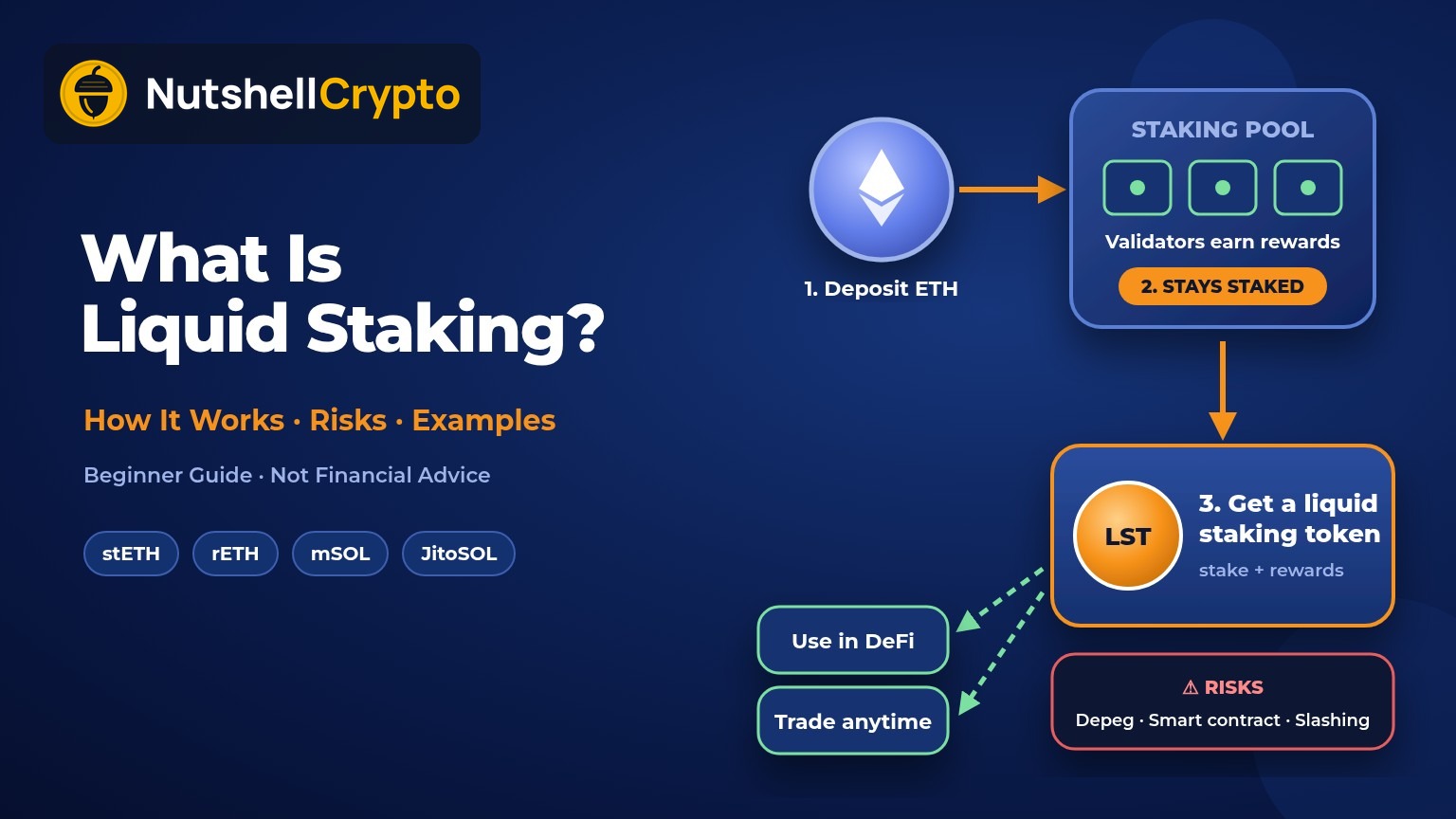
Liquid staking is a way to stake coins on a proof-of-stake blockchain such as Ethereum without giving up the ability to move or use them. You deposit coins with a liquid staking protocol, it stakes them with its validators, and it gives you a liquid staking token (LST) as a receipt.
Ethereum.org describes an LST as a token that “represents a claim on staked ETH and the rewards it earns.” You can hold it, transfer it, or sell it at any time, while the underlying ETH stays staked. The US SEC’s staff uses a plainer name: “Staking Receipt Tokens” that let holders “maintain liquidity without having to withdraw the deposited” assets from staking.
It is popular. Ethereum.org says liquid staking protocols account for around a third of all staked ETH. On October 6, 2026, DefiLlama tracked about $61.9 billion in total value locked across its liquid staking category.
How Liquid Staking Works
- Deposit. You send ETH, SOL or another proof-of-stake coin to the protocol’s smart contract. Most pools accept small amounts, unlike solo Ethereum staking, which needs 32 ETH per validator.
- Stake. The protocol delegates the pooled coins to its node operators, who run the validators.
- Mint. The protocol mints an LST to your wallet. Lido, for example, issues stETH “at 1:1 ratio” for each ETH deposited, according to the Lido docs.
- Earn. Staking rewards flow back to the pool, minus the protocol’s fee. Lido’s docs state its current fee is 10% of staking rewards, split between node operators and the DAO treasury.
- Exit. You either redeem the LST through the protocol (which can mean a withdrawal queue) or sell it on an exchange for an immediate exit at the market price.
One subtle point from ethereum.org: the blockchain pays the protocol’s validators and “doesn’t know your token exists.” You hold a claim on a service that stakes for you.
Rebasing vs Value-Accruing Tokens
LSTs pass rewards to you in one of two ways:
- Rebasing tokens grow your token balance. Lido’s stETH balance updates daily when Lido’s oracle reports validator balances, so 1 stETH stays roughly equal to 1 ETH. The rebase can also be negative if validators are penalized.
- Value-accruing (exchange-rate) tokens keep your balance fixed while each token becomes worth more of the underlying coin. Rocket Pool’s rETH works this way; its token contract describes rETH as backed by ETH “at a variable exchange rate.” Lido also offers wstETH, a wrapped, non-rebasing version of stETH that many DeFi apps prefer.
Ethereum.org notes the two designs behave differently in wallets and DeFi apps and may be taxed differently in some places.
Liquid Staking Examples: stETH, rETH, mSOL, JitoSOL
| Token | Protocol | Chain | How rewards show up | Protocol TVL (DefiLlama, Oct 6, 2026) |
|---|---|---|---|---|
| stETH / wstETH | Lido | Ethereum | stETH rebases; wstETH accrues value | About $26.8 billion (all Lido chains) |
| rETH | Rocket Pool | Ethereum | Exchange rate rises | About $1.4 billion |
| JitoSOL | Jito | Solana | Value accrues, including MEV rewards | About $1.3 billion |
| mSOL | Marinade | Solana | Exchange rate rises each epoch | About $276 million (Marinade Liquid) |
Lido (Lido Finance). The largest liquid staking protocol by TVL in DefiLlama’s rankings.
Rocket Pool. An Ethereum protocol built around independent node operators. Ethereum.org notes Rocket Pool operators post a bond of their own ETH to run validators using pooled ETH. See the Rocket Pool docs.
Jito. According to Jito’s docs, JitoSOL earns regular Solana staking rewards plus MEV (maximum extractable value) rewards, and automatically accrues value.
Marinade. Marinade’s docs explain that your mSOL balance never changes; its price versus SOL is recalculated every Solana epoch as rewards come in.
These are examples, not recommendations.
Liquid Staking vs Regular Staking
| Regular (native) staking | Liquid staking | |
|---|---|---|
| What you hold | Staked coins, often locked | A tradable LST |
| Getting out | Wait through unbonding or exit queues | Redeem via the protocol, or sell the LST right away |
| Minimum on Ethereum | 32 ETH to solo stake | Usually any amount |
| Use in DeFi | No | Yes, as collateral or liquidity |
| Extra risks | Slashing, lockups | Slashing plus smart contract, depeg and governance risk |
| Fees | Validator commission (or none if solo) | Protocol fee on rewards |
On Solana, native delegation leaves you in control of your SOL, says Solana.com, but changes only take effect at epoch boundaries, about every 2 days. Liquid staking skips that wait if you sell at the market rate.
How Liquid Staking Tokens Are Used in DeFi
Because LSTs are normal tokens, they plug into decentralized finance. The Lido docs list examples:
- Collateral for loans. wstETH is listed as collateral on Aave v3 markets and on Maker, so you can borrow against it while it keeps earning rewards.
- Liquidity pools. stETH/ETH and wstETH/ETH pools on Curve, Uniswap and Balancer let people swap between the LST and ETH.
Some products stack more yield on top through “restaking.” Ethereum.org calls restaking a separate risk category with additional slashing conditions. If a yield is well above the normal network staking rate (ethereum.org showed about 2.5% APR for ETH on October 6, 2026), ask where the extra comes from.
Liquid Staking Risks
1. Depeg risk
An LST’s market price can fall below the value of the coins behind it. This happened in 2022. CoinDesk reported that stETH’s discount to ETH hit a record 8% in June 2022 as Celsius and Three Arrows Capital came under stress. Ethereum withdrawals were not yet enabled then, so there was no direct redemption. Withdrawals have been possible since April 2023, but ethereum.org warns that prices can still deviate “particularly during periods of market stress.”
2. Smart contract risk
Your coins sit in contracts that could contain bugs or be exploited. Lido’s own docs list this as a risk, noting its code is open-source, audited and covered by a bug bounty. Audits reduce risk; they do not remove it.
3. Slashing risk
If a pool’s validators break the rules or are penalized, ethereum.org says the loss is typically shared across all token holders. Lido’s docs say up to 100% of staked funds are at risk if validators fail, which is why it spreads stake across many operators.
4. Centralization and governance risk
When a large share of stake sits with a few protocols or operators, ethereum.org warns it can create “conditions for censorship, value extraction, and single points of failure.” Governance can also change fees or even shut a product down. Lido, for example, sunset Lido on Polygon, stopping new deposits on December 16, 2024, and stMATIC holders stopped receiving rewards during the wind-down.
5. Custodial look-alikes
Ethereum.org says some exchange “earn” programs are custodial, can change terms at any time, and “may not be staking at all.” Prefer products you can verify on-chain, with the LST held in your own crypto wallet.
SOL Staking, Polygon Staking and “Stablecoin Staking”
SOL staking. Solana has native delegation plus liquid staking options like JitoSOL and mSOL. Our Solana vs Ethereum guide covers how the chains differ.
Polygon staking. The best-known liquid option on Polygon, Lido’s stMATIC, has been discontinued, as noted above. Check that any Polygon LST is still supported before using it.
Stablecoin staking. Stablecoins like USDC do not secure a proof-of-stake network, so “staking” them is not liquid staking. Those yields usually come from lending or other activities, with different risks.
Taxes and Rules in the US and Canada
US taxes. IRS Revenue Ruling 2023-14 says staking rewards are income at fair market value when you gain “dominion and control” over them. The ruling does not specifically address liquid staking tokens, so ask a tax professional whether swapping into an LST is a taxable trade and when its rewards count as received. Selling an LST can trigger a gain or loss. See our US crypto taxes guide and crypto capital gains tax guide.
US securities rules. In August 2025, SEC staff said certain liquid staking activities and Staking Receipt Tokens, as described in its statement, do not involve securities offerings. In March 2026, the SEC issued a formal interpretation, joined by the CFTC, that covers protocol staking. Our staking guide explains its limits.
Canada. The CRA generally treats staking rewards as income. See our cryptocurrency tax in Canada guide.
FAQ
Is liquid staking safe?
It is riskier than holding the coin alone. You take on normal staking risk plus smart contract, depeg and governance risk.
What is Lido Finance?
Lido is the liquid staking protocol behind stETH and wstETH and the largest liquid staking protocol by TVL on DefiLlama. LDO is its governance token.
Can I lose money with liquid staking?
Yes. The coin’s price can fall, the LST can trade at a discount, and slashing or hacks can reduce its backing.
How do I get my ETH back from stETH?
Redeem through Lido’s withdrawal queue, or sell stETH on an exchange. The Lido docs explain the queue works first-in, first-out.
Sources
- Ethereum.org: Liquid and pooled staking
- Ethereum.org: Staking
- Lido Docs: Lido tokens integration guide
- Lido Help: Sunsetting Lido on Polygon
- Rocket Pool: rETH token contract
- Jito Docs: Introduction to JitoSOL
- Marinade Docs: What is mSOL?
- Solana.com: Staking on Solana
- DefiLlama: Liquid staking protocols
- CoinDesk: Staked ether becomes focus of crypto stress (June 2022)
- SEC: Statement on Certain Liquid Staking Activities (Aug. 5, 2025)
- IRS: Revenue Ruling 2023-14
Educational content only. This is not financial, investment or tax advice. Crypto is volatile and you can lose money. Do your own research before you act.