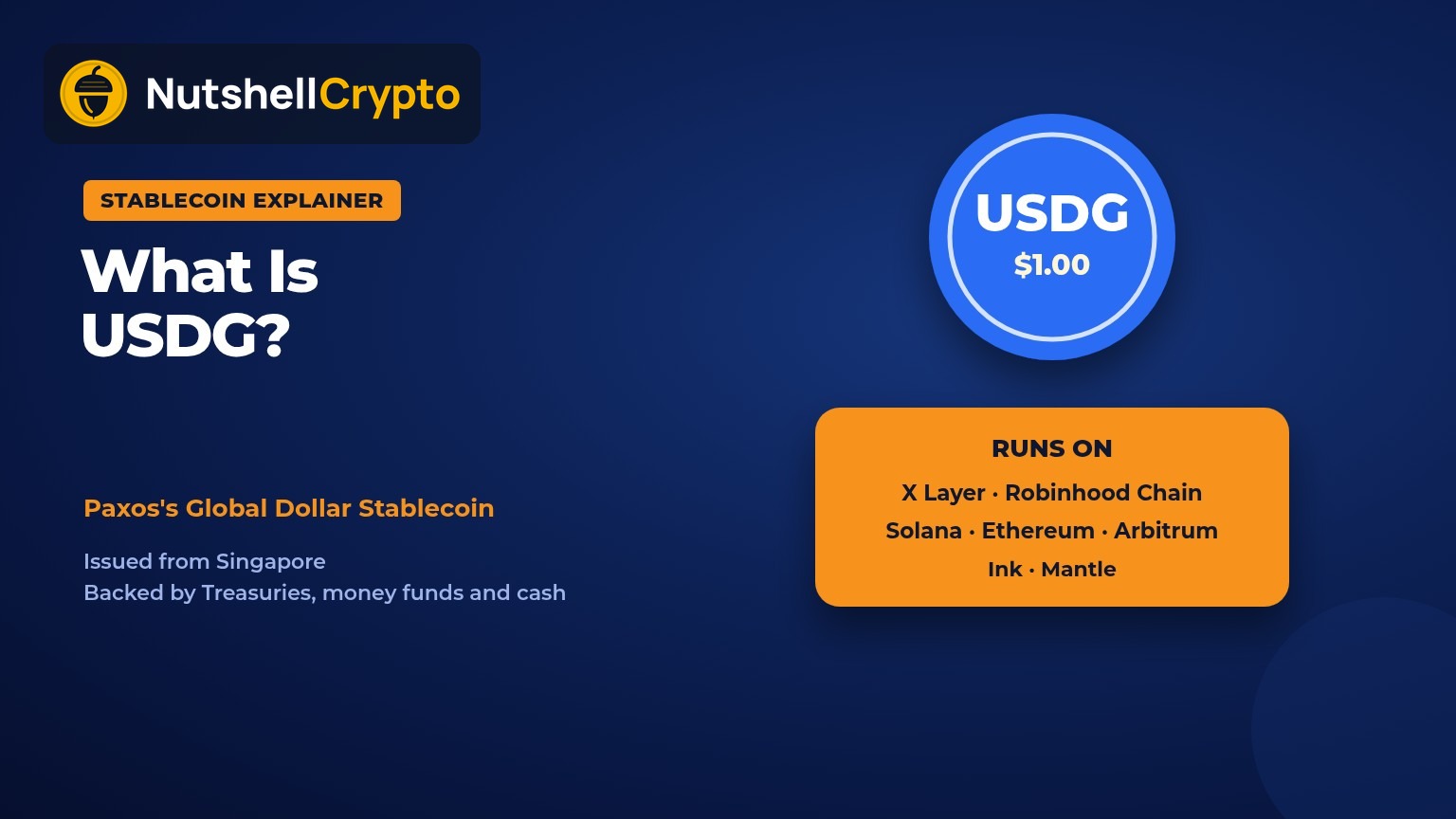
In a nutshell: USDG, or Global Dollar, is a US dollar stablecoin issued by Paxos out of Singapore (and in the EU under MiCA). Each token is meant to be redeemable 1:1 for US dollars and is backed by cash, short-term US Treasuries and government money market funds, with monthly reserve reports examined by KPMG. Its twist is the Global Dollar Network: partner companies such as Robinhood, Kraken, Mastercard and OKX share the income from the reserves, and some pass part of it to users as rewards. Holders get no interest from Paxos itself. As of November 10, 2026 (12:07 PM PKT), about 2.72 billion USDG were in circulation, according to CoinGecko.
USDG launched quietly in November 2024, but it now ranks among the ten largest stablecoins. What makes it different from USDT or USDC is not the token itself, which works like any cash-backed stablecoin, but who earns the money from its reserves. Instead of the issuer keeping most of the interest, Paxos shares it with the exchanges, brokers and payment firms that hold and distribute USDG.
This guide covers who issues USDG and who regulates it, what backs it, which blockchains it runs on, how big it is today, the Global Dollar Network and its rewards, fees, how to buy it in the US, Canada and Australia, the main risks, and the tax points for each country. New to the topic? Start with our explainer on what stablecoins are and how they work.
Table of contents
- What is USDG?
- Who issues USDG: Paxos in Singapore and the EU
- The Global Dollar Network and how rewards work
- What backs USDG: reserves and attestations
- Which blockchains USDG runs on
- How big is USDG?
- USDG fees
- How to buy and use USDG in the US, Canada and Australia
- USDG and the US GENIUS Act
- USDG risks
- Is USDG taxable?
- FAQ
What Is USDG?
Paxos describes Global Dollar (USDG) as “a single-currency stablecoin pegged to the US dollar” that is “fully redeemable from Paxos on a one-to-one basis for US dollars” (Paxos: USDG). Paxos introduced it on November 1, 2024, saying it was issued by Paxos Digital Singapore Pte. Ltd. and was “substantively compliant” with the Monetary Authority of Singapore’s (MAS) upcoming stablecoin framework. It went live first on Ethereum (Paxos blog).
A few days later, on November 4, 2024, Paxos and six partners, Anchorage Digital, Bullish, Galaxy Digital, Kraken, Nuvei and Robinhood, announced the Global Dollar Network built around the token (Paxos newsroom; Reuters). DBS Bank was named the primary banking partner for cash management and custody of the reserves at launch.
USDG is not the same as Paxos’s other dollar coins. PayPal USD (PYUSD) and Pax Dollar (USDP) are issued by the US entity Paxos Trust Company, N.A., which is supervised by the US Office of the Comptroller of the Currency (OCC). USDG comes from Paxos’s Singapore and EU entities (Paxos). Our guide to PayPal’s PYUSD stablecoin covers the US-issued sibling.
Who Issues USDG: Paxos in Singapore and the EU
Paxos says the entity issuing USDG, Paxos Digital Singapore Pte. Ltd. (PDS), “is a Major Payments Institution supervised by the Monetary Authority of Singapore.” USDG is also issued in the EU by Paxos Issuance Europe Oy under the supervision of Finland’s Financial Supervisory Authority (FIN-FSA), in line with the EU’s MiCA rules (Paxos). Paxos says it is authorized to issue stablecoins in four markets: the US, the UAE, Singapore and the EU.
Where you live decides which company owes you dollars. The Global Dollar Network’s July 2026 Robinhood Chain announcement says all USDG holders in the EU have a right of redemption against the EU issuer at any time and at par (Global Dollar Network). Holders outside the EU deal with the Singapore issuer.
The USDG white paper says MAS rules require PDS to keep the reserves in segregated custody accounts for the benefit of token holders, so they “would be inaccessible to PDS creditors” if PDS or an affiliate became insolvent. It also says PDS does not hold fractional reserves and that “USDG holders are not entitled to any interest that may be earned on the reserve assets” (USDG White Paper).
The Global Dollar Network and How Rewards Work
The Global Dollar Network (GDN) is the part that makes USDG unusual. Its site tells partner companies they can “receive up to 100% of the returns generated by assets backing USDG held on your platform,” plus extra revenue for minting USDG and accepting it as payment (Global Dollar Network). At launch, Paxos CEO Charles Cascarilla told CoinDesk the network would distribute “something like 97% of the economics” (CoinDesk).
The network has grown well beyond its founders. Mastercard said in June 2025 it would join the GDN so that any Mastercard institution could mint, distribute and redeem USDG (Mastercard). GDN’s July 2026 release lists partners including Bullish, Kraken, Mastercard, OKX, Paxos, Robinhood and Worldpay (Global Dollar Network), and a November 6, 2026 post from Paxos Labs, a Paxos spin-out, says the network has passed 150 partners (Paxos Labs).
The key point for ordinary users: the reserve income goes to partner companies, not straight to you. Whether you see any of it depends on your platform. Two examples, checked on November 10, 2026:
- Kraken runs Stablecoin Rewards on USDG. Its support page says non-subscribers earn “up to 2.25% APY” and Kraken+ subscribers “up to 4.50% APY depending on your region,” that rates are variable, and that USDG rewards are available where Kraken serves clients except the EEA and prohibited regions. Kraken calls the program “a loyalty initiative fully funded by Kraken” that it can change or end (Kraken Support). Kraken’s regional rules add that the rewards feature is only available in select US states (Kraken).
- Robinhood Earn lets eligible US customers buy USDG and lend it through the Morpho protocol from a self-custody wallet in the app. Robinhood says this is “fundamentally different from a savings account,” has no deposit insurance, and that the rate “can change at any time, including dropping to zero” (Robinhood).
Rewards like these are paid by the platform or come from DeFi lending, so they carry that platform’s or protocol’s risks on top of the stablecoin’s. Our guide to stablecoin staking and its real risks explains the trade-offs of chasing yield.
What Backs USDG: Reserves and Attestations
Paxos publishes a monthly USDG reserve report. Reports posted on or after February 27, 2026 are examined by KPMG LLP in Singapore; earlier ones were examined by Enrome LLP (Paxos USDG attestations). The latest report available on November 10, 2026, signed on October 23, 2026, showed, as of September 30, 2026 at 5:00 PM US Eastern Time:
| Item (Sept 30, 2026) | Amount |
|---|---|
| USDG redeemable tokens outstanding | 3,164,996,248 |
| Government money market funds (at net asset value) | $1,678,019,554 |
| US Treasury obligations (at fair value) | $1,412,278,860 |
| Cash at commercial banks | $78,124,993 |
| Total redemption assets | $3,168,423,407 |
| Reserves above par | 0.11% |
Source: Paxos USDG Redemption Assets Report, September 2026 (KPMG examination). The same report says the cash is held in uninsured demand deposits, mostly at a MAS-regulated bank in Singapore, with about $8.4 million held in Luxembourg for the EU issuer. It states that all USDG tokens were redeemable, with no frozen or time-locked tokens, and that the money fund and Treasury holdings “are subject to market pricing risk.” Cash fell from about $425 million on September 17 to $78 million on September 30 as supply shrank and more money moved into Treasury bills, so the mix can shift a lot within a month.
Which Blockchains USDG Runs On
Paxos says USDG is issued on Arbitrum, Ethereum, Ink, Mantle, Robinhood Chain, Solana and X Layer (Paxos). The September report lists the official contracts, including 0xe343167631d89B6Ffc58B88d6b7fB0228795491D on Ethereum and Ink and 2u1tszSeqZ3qBWF3uNGPFc8TzMk2tdiwknnRMWGWjGWH on Solana. Always copy addresses from Paxos’s own documents; look-alike tokens are a common scam. Our guide to checking a crypto wallet address and network explains how to avoid sending to the wrong chain.
Most USDG does not sit on Ethereum. On September 30, 2026, Paxos’s report put about 1.42 billion tokens on X Layer (OKX’s network), 693 million on Robinhood Chain, 652 million on Solana and 321 million on Ethereum. DefiLlama’s breakdown on November 10, 2026 (12:09 PM PKT) showed a similar order: about $1.12 billion on X Layer, $646 million on Robinhood Chain, $491 million on Solana and $321 million on Ethereum (DefiLlama).
Arbitrum One is the newest network. Paxos launched USDG there on October 6, 2026, with the Morpho lending protocol among the first integrations, according to TokenPost (TokenPost).
How Big Is USDG?
As of November 10, 2026 at 12:07 PM PKT, CoinGecko showed USDG at $0.99998 with a market cap of about $2.72 billion and a circulating supply of about 2.72 billion tokens, ranking #36 among all crypto assets (CoinGecko). DefiLlama put circulation at about $2.72 billion at 12:09 PM PKT, eighth among stablecoins, just behind PYUSD and ahead of RLUSD (DefiLlama).
DefiLlama’s history shows supply of about $1.01 billion a year earlier, on November 10, 2025, a peak of about $3.44 billion on May 12, 2026, and a decline since then. For how it compares with the rest of the market, see our ranking of the largest stablecoins by market cap.
USDG Fees
- Minting and redeeming with Paxos: Paxos advertises “zero fees to mint, hold or redeem Paxos-issued stablecoins using Paxos infrastructure,” for businesses that go direct with a Paxos account (Paxos Mint and Redeem). Paxos’s terms set out who can redeem and how (Paxos US Dollar-Backed Stablecoin Terms).
- On exchanges and apps: you pay the platform’s trading fee or spread when you buy or sell. Our guide to crypto exchange fees explains maker, taker and spread costs.
- Network fees: moving USDG on-chain costs gas in that network’s coin, such as ETH on Ethereum or SOL on Solana.
- Rewards programs: Kraken says there are no fees for its USDG rewards (Kraken), but lending products such as Robinhood Earn depend on DeFi vault rates that can fall.
How to Buy and Use USDG in the US, Canada and Australia
Direct from Paxos. Minting and redemption at par are mainly for businesses and institutions with an onboarded Paxos account. In November 2026, Paxos and Taurus added USDG minting and redemption for banks on the Taurus-NETWORK custody network (Taurus). Most individuals buy USDG on a trading app instead.
United States. Kraken was a founding GDN partner and offered USDG from launch day (Paxos). USDG is not on Kraken’s list of restricted assets for US clients, but Kraken does not serve residents of New York or Maine (Kraken). Robinhood lets eligible customers buy USDG on Robinhood Crypto, but says “USDG is not available in New York” (Robinhood).
Canada. Be careful here. Kraken’s regulatory page, checked on November 10, 2026, lists USDG among the assets that clients in Canada “cannot deposit, hold or trade” (Kraken). Under CSA Staff Notice 21-333, Canadian securities regulators only let registered platforms offer US or Canadian dollar stablecoins whose issuers meet set conditions on reserves, redemption and disclosure (OSC: CSA Staff Notice 21-333), so check your platform’s current list before you buy, and do not rely on generic “buy USDG” pages.
Australia. USDG is not on Kraken’s list of assets Australian clients cannot deposit, hold or trade, but Kraken says Opt-In Rewards are not available in Australia (Kraken). Kraken says it operates in Australia through Bit Trade Pty Ltd, registered with AUSTRAC. Before using any platform, check it on AUSTRAC’s virtual asset service provider register. If you buy with Australian or Canadian dollars, your cost in local currency moves with the exchange rate even though the token tracks the US dollar.
Using it. USDG is used for trading, DeFi lending such as Morpho vaults, and settlement. On June 3, 2026, Mastercard said it would let card issuers and acquirers settle in several regulated stablecoins, including USDG, alongside its normal fiat settlement (CoinDesk). If you want to hold USDG yourself, our guide to choosing a stablecoin wallet covers the options.
USDG and the US GENIUS Act
The GENIUS Act, signed on July 18, 2025, sets US rules for payment stablecoins and takes effect on January 18, 2027. The OCC issued its final rule on October 21, 2026 (OCC Bulletin 2026-50). Two parts matter for USDG, according to law firm Mayer Brown’s summary of the rule (Mayer Brown):
- Foreign issuers. A foreign issuer can offer its stablecoin in the US through service providers only if the US Treasury finds its home rules comparable, it registers with the OCC, and it holds enough reserves at US institutions to meet US customers’ redemptions. USDG’s issuers are in Singapore and Finland.
- No yield to holders. The Act bans issuers from paying holders interest or yield just for holding the coin. The OCC dropped a proposed presumption against affiliate and partner payouts, but it also declined to create a safe harbor for rewards programs and said it will watch for evasion.
As far as we could find on November 10, 2026, Paxos had not said publicly how USDG’s US availability or partner rewards will change after January 18, 2027. Our guide to World Liberty’s USD1 stablecoin shows how a US-issued rival approaches the same law.
USDG Risks
- No deposit insurance. Paxos’s report says the cash reserves sit in uninsured bank deposits, and Robinhood stresses there is “no government-backed insurance” on USDG used in Robinhood Earn.
- Redemption depends on where you are. Only onboarded Paxos customers redeem directly, and EU holders redeem against a different Paxos company than everyone else. Other holders rely on exchange prices, which can briefly move away from $1.
- Freezes and seizures. The white paper says USDG or its reserves “can be frozen, seized or forfeited as required by law enforcement for illegal or sanctioned use” (USDG White Paper).
- Custodian and market risk. The white paper warns that holders are exposed to the banks and custodians holding the reserves, and the September report notes that Treasury and money fund holdings carry market pricing risk. The reserve buffer above par was only 0.11% on September 30.
- Concentration on a few platforms. More than half of USDG on September 30 sat on X Layer and Robinhood Chain, so the token’s growth depends heavily on a handful of partners.
- Rewards and DeFi risk. Platform rewards can be cut at any time, and lending through Morpho adds smart contract, liquidity and collateral risk, as Robinhood’s own disclosure explains.
- Regulatory change. US rules on foreign issuers and on yield sharing take effect in January 2027, and Canada’s platform rules already keep USDG off at least one major exchange.
For how stablecoins have lost their peg in the past and what to watch, read are stablecoins safe? To compare USDG with the two biggest coins, see USDT vs USDC, and for another regulated rival, our guide to Ripple’s RLUSD stablecoin.
Is USDG Taxable?
United States. The IRS says digital assets, a category that covers stablecoins like USDG, are treated as property, not currency, for US tax purposes. Selling USDG, swapping it for another coin or spending it is a disposal, so you work out a capital gain or loss against what you paid, which is usually tiny for a coin that stays near $1. Digital assets you receive as a reward, such as USDG rewards paid by an exchange, are generally income at their fair market value in US dollars when you receive them. Keep records of each purchase, sale, swap and reward (IRS: Digital assets).
Canada. The CRA says trading a crypto-asset for government currency or another crypto-asset, or using it to buy goods or services, is a disposition. The result is either business income or a capital gain or loss depending on how you trade, and half of a capital gain is taxable. Moving crypto between your own wallets is not a taxable disposition. Because you would normally pay for a US dollar stablecoin with Canadian dollars, exchange-rate moves can create a gain or loss in CAD (CRA: Reporting income from crypto-asset transactions).
Australia. The ATO treats crypto held as an investment as a CGT asset, and converting it to Australian or foreign currency or swapping it is a CGT event, with values worked out in AUD (ATO).
Our stablecoin taxes guide goes through these cases in more detail. This is general information, not tax advice.
FAQ
Who issues USDG?
Paxos Digital Singapore Pte. Ltd., a Major Payments Institution supervised by the Monetary Authority of Singapore. In the EU it is issued by Paxos Issuance Europe Oy under Finland’s FIN-FSA and MiCA.
Is USDG the same as PYUSD?
No. Both are Paxos stablecoins, but PYUSD is issued for PayPal by Paxos’s US trust bank, while USDG is issued from Singapore and the EU and powers the Global Dollar Network.
What backs USDG?
Government money market funds, US Treasury bills and cash, according to Paxos’s September 2026 report examined by KPMG. Total reserves were about $3.17 billion against about 3.16 billion tokens on September 30, 2026.
Does USDG pay interest?
Not from Paxos. The white paper says holders are not entitled to reserve interest. Partner platforms such as Kraken may pay their own rewards on USDG balances, and those can change or end.
Can I buy USDG in Canada?
Not on Kraken, which lists USDG among assets Canadian clients cannot deposit, hold or trade. Check your own platform’s current stablecoin list.
Which network should I use for USDG?
Use the network your exchange and wallet both support for USDG. It is issued natively on Ethereum, Solana, X Layer, Robinhood Chain, Arbitrum, Ink and Mantle, and sending on the wrong one can lose funds.
Sources
- Paxos: Global Dollar (USDG)
- Paxos: Paxos introduces Global Dollar (Nov 1, 2024)
- Paxos: Introducing Global Dollar Network (Nov 4, 2024)
- Paxos: USDG White Paper
- Paxos: USDG attestation reports
- Paxos: USDG Redemption Assets Report, September 2026 (KPMG)
- Paxos: Mint and Redeem
- Paxos: US Dollar-Backed Stablecoin Terms and Conditions
- Global Dollar Network
- Global Dollar Network: USDG on Robinhood Chain (Jul 1, 2026)
- Paxos Labs: One Dollar, Many Tokens (Nov 6, 2026)
- Reuters: Crypto firms launch global stablecoin network (Nov 4, 2024)
- CoinDesk: New Global Dollar stablecoin (Nov 4, 2024)
- Mastercard: Joining Global Dollar Network (Jun 23, 2025)
- CoinDesk: Mastercard expands onchain settlement (Jun 3, 2026)
- Kraken: Stablecoin Rewards
- Kraken: Where is Kraken licensed or regulated?
- Robinhood: Robinhood Earn
- Taurus: Paxos and Taurus partner on USDG (Nov 5, 2026)
- TokenPost: Global Dollar lending on Morpho reaches $143 million (Nov 3, 2026)
- CoinGecko: Global Dollar
- DefiLlama: Global Dollar
- OCC Bulletin 2026-50: GENIUS Act final rule
- Mayer Brown: OCC finalizes GENIUS Act rulemaking
- OSC: CSA Staff Notice 21-333
- AUSTRAC: Virtual asset service provider register
- IRS: Digital assets
- CRA: Reporting income from crypto-asset transactions
- ATO: How to work out and report CGT on crypto
This article is for education only and is not financial, legal or tax advice. Stablecoin availability, rewards and rules change; check Paxos, the Global Dollar Network and your platform for the latest terms in your country.