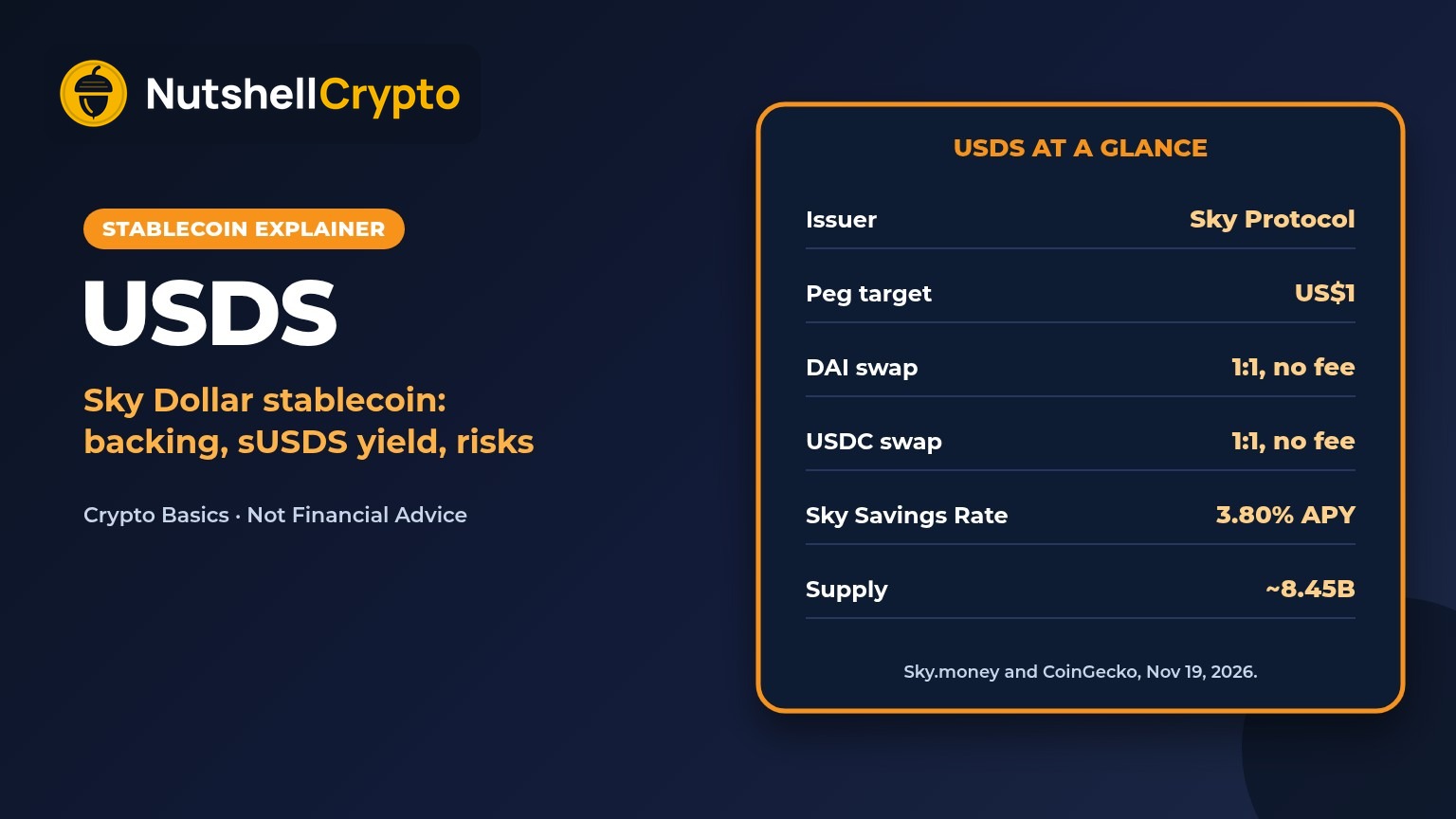
In a nutshell: USDS (Sky Dollar) is a US dollar stablecoin issued by Sky, the protocol formerly known as MakerDAO. It is the upgraded version of DAI: you can swap DAI for USDS 1:1 with no fee, and it is backed by more collateral than the USDS in circulation. You can deposit USDS into sUSDS to earn the variable Sky Savings Rate, which was 3.80% APY on November 19, 2026. The main risks are depegs, smart contract bugs and governance changes, and some Sky.money features are blocked in certain countries.
The USDS stablecoin is Sky’s dollar token, launched on September 18, 2024 as the successor to DAI, and it aims to stay worth $1. Below is how USDS is backed, how it differs from DAI and USDC, how sUSDS earns yield, the risks, and how it is taxed in the US, Canada and Australia.
New to dollar tokens? Start with our guide to what stablecoins are, then come back here.
Table of contents
What Is the USDS Stablecoin?
USDS, also called Sky Dollar, is a decentralized stablecoin that aims to hold a soft peg to the US dollar. It is issued by the Sky Protocol, which MakerDAO renamed itself in August 2024. CoinDesk reported that the new USDS stablecoin and SKY governance token would go live on September 18, 2024, with DAI and MKR staying in circulation alongside them (CoinDesk).
Unlike USDC or PYUSD, no company holds a bank deposit for every token. USDS is created by smart contracts against collateral, and holders of the SKY token vote on the rules, such as which collateral is accepted and what the savings rate is. Sky’s interface, Sky.money, is run by Skybase International, which says it does not control the protocol contracts or governance (Sky.money).
How USDS Is Backed and Keeps Its Peg
USDS uses the same model that MakerDAO built for DAI:
- Overcollateralized minting: borrowers lock approved collateral and mint USDS against it, up to a limit that keeps the system holding more value than it owes. If collateral falls too far, the position is liquidated. Our guide to crypto liquidation explains how that works.
- 1:1 swaps with USDC: Sky.money offers a zero-fee, no-slippage conversion between USDC and USDS in both directions, which pulls the price back toward $1 when it drifts (Sky.money).
- Rates set by governance: borrowing rates and the savings rate push demand up or down.
On November 19, 2026, Sky.money showed about $12.68 billion of collateral behind about 8.45 billion USDS and DAI combined. That collateral figure includes the excess above what is needed, and the full breakdown by category, network and protocol is on Sky’s collateral backing page.
USDS vs DAI
USDS is the upgraded form of DAI, not a replacement that forced anyone to switch. Sky’s developer docs say the DAI-USDS converter swaps the two at a fixed 1:1 ratio in both directions, with no fees, and that fees cannot be turned on for that route in the future (Sky Protocol Docs: USDS).
The main practical differences are where the new features live. Sky’s newer savings and reward products are built around USDS and sUSDS, while the older sDAI works the same way for DAI. The governance token changed too: MKR holders can upgrade to SKY, and the SKY price on Sky.money was about $0.0471 on November 19, 2026. That token is not the stablecoin, and it can fall sharply, as our page on why SKY has dropped shows.
USDS Price, Supply and Chains
CoinGecko data checked on November 19, 2026 at about 12:36 PM PKT:
| Metric | Value |
|---|---|
| Price | $1.00 (about C$1.43 / A$1.49) |
| Market cap | about $8.45 billion |
| CoinGecko rank | #15 |
| 24h trading volume | about $272 million |
Source: CoinGecko: USDS. That puts it among the biggest dollar tokens; see where it sits in our list of the largest stablecoins.
Most USDS lives on Ethereum. Data firm Allium counted about $6.37 billion of USDS on chain on August 4, 2026, with roughly 98% on Ethereum and the rest on Arbitrum, Solana and Base (Allium). Always check the network before you send USDS, because a token on the wrong chain may not arrive where you expect.
sUSDS and the Sky Savings Rate
sUSDS (Savings USDS) is the token you get when you deposit USDS into the Sky Savings Rate. It follows the ERC-4626 vault standard, so its value in USDS rises over time instead of paying out new tokens. Sky’s docs say the deposit and withdraw route has no fees, and fees cannot be enabled on it later (Sky Protocol Docs: sUSDS).
On November 19, 2026, Sky.money showed the Sky Savings Rate at 3.80% APY, with about 3.71 billion sUSDS in supply. Sky.money says the rate is variable, funded from protocol surplus and voted on by SKY holders, so it can change or be cut at any time (Sky.money). The same page listed riskier options with higher rates, such as stUSDS (19.74%), which backs loans against SKY, and Morpho-based vaults. Higher rates there mean more risk, not free money. Our stablecoin staking guide compares these kinds of yield.
How to Get USDS
- From USDC: connect a self-custody wallet to Sky.money and use the USDC to USDS conversion (1:1, no fee; you still pay network gas). See our guide to Ethereum gas fees.
- From DAI: use the DAI-USDS converter at 1:1.
- On a DEX or exchange: USDS trades on decentralized exchanges and some centralized ones. Check that your exchange supports it where you live. Our DEX guide explains how swaps work.
To hold it, you need a wallet that supports ERC-20 tokens. Our guide to the best stablecoin wallet types covers your options.
Where it is available: Sky.money’s terms say some features are unavailable in specific jurisdictions and ban using a VPN to get around those limits (Sky.money Terms of Use). At launch, The Block reported that the Savings Rate and token rewards were restricted in some countries, including the US and the UK (The Block). Check what the app shows for your country before you plan around the savings rate.
USDS vs USDC vs USDe
| USDS | USDC | USDe | |
|---|---|---|---|
| Issuer | Sky Protocol (governed by SKY holders) | Circle (company) | Ethena Labs |
| Backing | Overcollateralized crypto and other collateral | Cash and short-term US Treasuries | Crypto collateral hedged with futures |
| Built-in yield | Optional, via sUSDS | None for holders | Optional, via sUSDe |
| Main risk | Collateral, contracts, governance | Issuer and bank risk | Funding rates and exchange risk |
Read more in our USDT vs USDC comparison, our USDe guide and our explainer on Aave’s GHO stablecoin, another crypto-backed dollar.
USDS Risks
- Depeg risk: Sky.money’s own risk page says USDS may not hold its value at all times, may be under-collateralized, and can be hit by de-pegging, runs or a sudden loss of value (Sky.money User Risk Documentation).
- Smart contract risk: USDS and sUSDS are upgradeable contracts, so a bug or a bad upgrade could affect holders.
- Governance risk: SKY holders can change collateral rules and rates, and the savings rate is not guaranteed.
- Collateral risk: crypto collateral can crash quickly, and liquidations must work during stressed markets.
- Access risk: some features can be restricted by country, as noted above.
For how stablecoins lose their peg in general, see are stablecoins safe?
How USDS Is Taxed
United States: the IRS treats digital assets as property, and exchanging one digital asset for another is a reportable transaction (IRS: Digital assets). A swap between USDS, DAI and USDC at $1 usually creates little or no gain, but it may still need to be reported. Interest-like rewards are generally income when you receive them. Our stablecoin tax guide covers the US rules in more detail.
Canada: the CRA treats trading one crypto-asset for another as a disposition, which can produce a capital gain or loss or business income (CRA: crypto-asset tax obligations). How the CRA treats a rising sUSDS value is a question for a Canadian tax professional. See our Canada crypto tax guide.
Australia: the ATO says swapping one crypto asset for another is a CGT event, and it has separate guidance on DeFi and wrapping tokens (ATO: crypto to crypto swaps; ATO: DeFi and wrapping).
FAQ
What is USDS stablecoin?
USDS is the US dollar stablecoin of the Sky Protocol, formerly MakerDAO, and the upgraded version of DAI. It is minted against overcollateralized assets and aims to stay at $1 (Sky Protocol Docs).
How to buy USDS?
The simplest route is to convert USDC to USDS 1:1 on Sky.money with a self-custody wallet, paying only network gas. You can also swap for it on a decentralized exchange, or on a centralized exchange that lists it in your country.
Is USDS the same as DAI?
Not quite. Both come from the same protocol and swap 1:1 with no fee in either direction, but they are separate tokens, and Sky’s newer savings and reward features are built around USDS.
What is the USDS yield?
USDS itself pays nothing. Depositing it into sUSDS earns the Sky Savings Rate, which Sky.money showed at 3.80% APY on November 19, 2026. The rate is variable and set by governance (Sky.money).
What are the top 3 stablecoins?
By market cap, the top two are Tether’s USDT and Circle’s USDC, and USDS has ranked among the next few. Rankings move often, so see our updated list of the largest stablecoins.
This article is for education only and is not financial or tax advice. Rates, supply figures and availability change; check Sky’s official pages before you use USDS.