In a nutshell: TON staking means locking GRAM, the coin that was called Toncoin until June 15, 2026, to help secure The Open Network and earn rewards. Most people stake through liquid staking, such as Tonstakers or Hipo, which accept as little as 1 GRAM, give you a token (tsTON or hGRAM) and showed yields of about 12.5% to 16.7% a year on November 4, 2026. Validation runs in cycles of about 18 hours, so unstaking can take up to about a day and a half. Rates vary, and smart-contract and liquidity risks apply. Educational only; not financial advice.
Last updated: November 4, 2026.
Staking on TON looks different from staking on Ethereum or Solana. There is no single “stake” button on the network itself: you choose a pool or a liquid staking protocol, and each one has its own minimum, fee and exit rule.
This guide explains what TON staking is, the options the TON docs describe, how to stake step by step, what the wait to unstake is, what rates were showing on November 4, 2026 (checked between about 6:40 and 6:50 PM PKT), the main risks, and short tax notes for the US, Canada and Australia.
Table of contents
Toncoin Is Now GRAM: What Changed
If you search for “Toncoin” you will still find plenty of guides, but the coin has a new name. A community vote that closed on June 8, 2026 backed the change, and the native coin of The Open Network went from Toncoin (TON) to Gram (GRAM) on June 15, 2026, according to Investing.com. The blockchain itself is still called TON. The TON Community announcement and the Blockchain.com support page both say no swap or migration is needed: balances, addresses and staking positions carried over as they were.
That support page also warns about scams, such as a fake GRAM jetton that appears in your wallet. A genuine GRAM transfer shows as a native TON transaction, while a fake token shows as a jetton transfer. Ignore any offer to “swap TON for GRAM”. In this guide, TON staking means staking GRAM on the TON network.
What Is TON Staking?
Like other proof-of-stake networks, TON lets coin holders lock GRAM to secure the chain. The TON docs say staking secures the network through proof-of-stake and that you can choose between single nominator, nominator pools or liquid staking, depending on your technical ability and stake size. If you are new to the idea, read our guide to what staking in crypto is first.
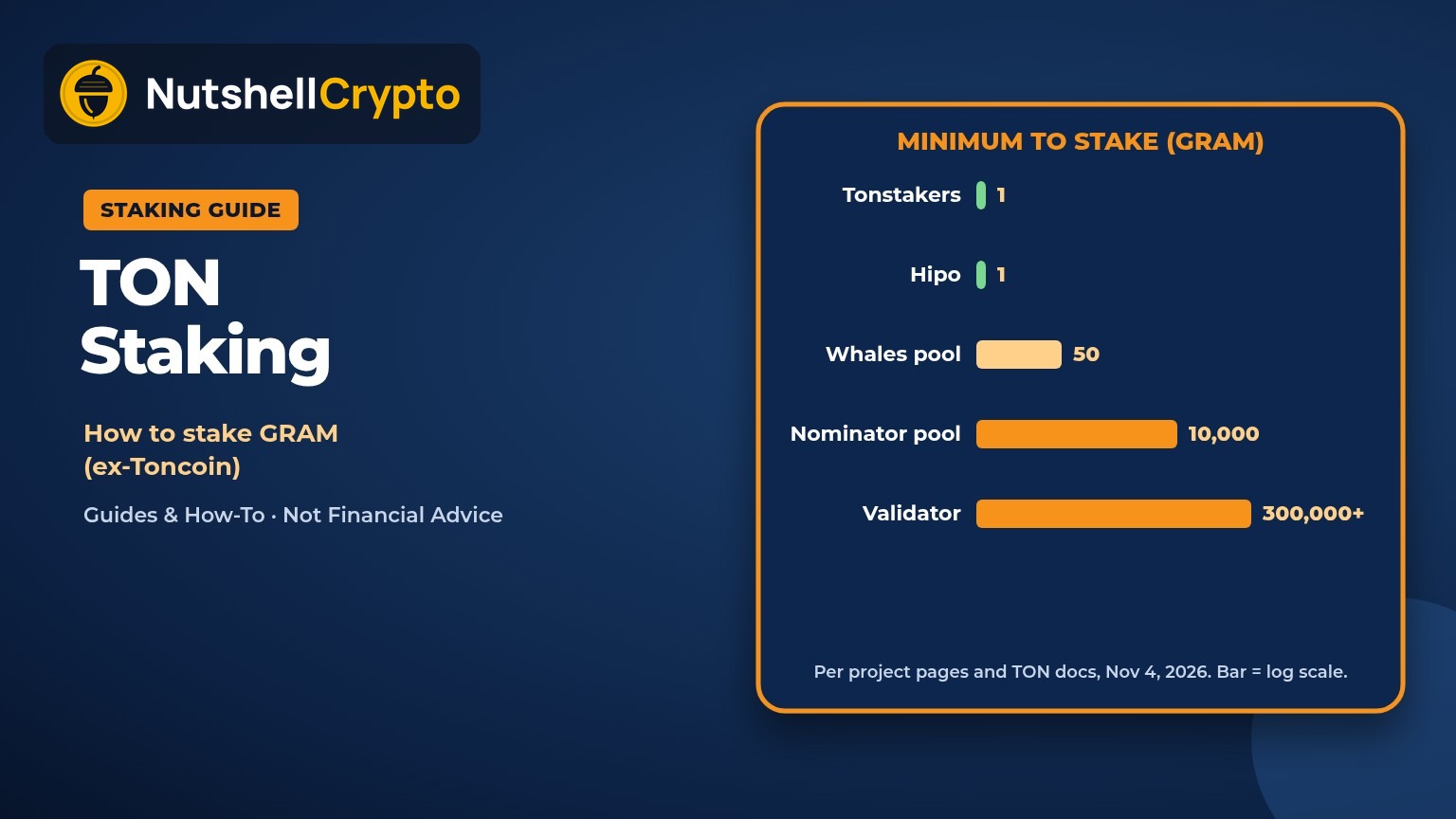
Running a validator yourself is out of reach for most people. The same docs say the technical minimum stake to validate is 300,000 GRAM, and that the real minimum is typically higher, about 1,000,000 GRAM. Everyone else stakes through someone else’s validators.
Ways to Stake TON
| Option | What it is | What the TON docs say |
|---|---|---|
| Liquid staking | You deposit GRAM and get a token such as tsTON that represents your stake and can be used in DeFi | Meant for staking providers serving retail users, with low minimum deposits and liquidity through wrapped tokens (liquid staking contracts) |
| Single nominator | One owner stakes their own funds through a validator operated by someone else | The recommended solution for large holders staking only their own funds (staking overview) |
| Nominator pool | A small group delegates to one validator | Described as deprecated and not recommended: up to about 40 nominators, a recommended minimum of 10,000 GRAM, and full withdrawals only (nominator pool docs) |
The docs’ advice for small holders is to use a third-party staking service rather than run contracts directly. In practice that means the liquid protocols below, or a pool such as the one Tonkeeper users can reach through TON Whales.
Tonstakers, Hipo, Bemo and Whales Compared
All figures below were read from each project’s own pages, the TonAPI public staking endpoint or DefiLlama on November 4, 2026. Total value locked (TVL) figures are from DefiLlama. The comparison is for information only; we are not recommending a provider.
| Provider | Token | Minimum | Fees | TVL (DefiLlama) |
|---|---|---|---|---|
| Tonstakers | tsTON | 1 GRAM (plus enough GRAM for network fees) | Says it collects no fees other than network transaction fees; about 1.1 GRAM is held temporarily and refunded (Tonstakers FAQ) | About $176.0M |
| Hipo | hGRAM | “As low as 1 GRAM” per its site | 0% governance fee on rewards, set by its DAO; small gas prepayment of about 0.1 GRAM, mostly refunded (Hipo docs) | About $11.7M |
| Bemo | bmGRAM | 1 GRAM per its site | Not checked | About $2.0M |
| Tonkeeper Pool (TON Whales) | None; pool balance | 50 GRAM including the deposit fee | 25% pool fee, 0.2 GRAM deposit fee, 0.2 GRAM withdraw fee, per the pool page | Not listed |
KTON is another liquid staking protocol on TON, with about $7.2M of TVL on DefiLlama; we did not read its docs, so it is not compared above. Tonstakers is by far the largest of these: its app showed about 148.4 million GRAM staked on November 4, 2026, and the TonAPI staking endpoint listed 1,080 pools in total, most of them old-style nominator pools that it did not mark as verified.
Tonkeeper’s help center says the wallet offers liquid staking through Tonstakers (Tonkeeper help, last updated September 15, 2026).
How to Stake TON Step by Step
These steps use Tonkeeper and Tonstakers, as described in Tonkeeper’s help center. Other wallets and providers work in a similar way, but check each one’s own instructions.
- Get GRAM. Buy it on an exchange that lists GRAM and withdraw it on the TON network to a wallet you control. Because of the rename, exchanges handled deposits and withdrawals on different dates, so check that your exchange supports GRAM withdrawals first.
- Keep a fee reserve. Tonkeeper recommends at least 1.1 GRAM in your balance to cover network fees, and Tonstakers says to have at least 1.2 GRAM available before unstaking. Most of the reserve comes back.
- Open the wallet and tap Stake. Enter an amount (minimum 1 GRAM) and confirm the transaction.
- Check the token. The staked coins appear in your token list as tsTON. Its value rises against GRAM as rewards build up, so you don’t get separate payouts. On November 4, 2026 the Tonstakers app showed 1 tsTON = 1.17518 GRAM.
- Check the rate before you confirm. The app shows a projected APY. Read the lines under it carefully, as explained in the APY section below.
- Unstake when you need to. Open the Staking tab and tap Unstake. Details on timing follow in the next section.
Staking is done with smart contracts by third parties, and Tonkeeper says it is not responsible for the staking experience. To see how an annual rate turns into earnings, our Chainlink staking calculator shows the same math for another coin, and our staking APR guide explains APR versus APY.
Validation Cycles and How Long Unstaking Takes
TON validators work in rounds. The TON docs on network configuration list the mainnet values: a validation round lasts 65,536 seconds (18.2 hours), and a validator’s stake is held for another 32,768 seconds (9.1 hours) after the round ends. Rounds alternate between even and odd, so a full cycle of one parity is 131,072 seconds, or about 36.4 hours.
What that means for you depends on the provider:
- Tonstakers. Two unstake types. Instant pays out right away, but only if the pool has enough idle GRAM. Maximum rewards, the default, creates an NFT receipt and finishes about 18 hours after the validators return the stake at the end of the cycle. Do not sell or transfer that NFT. If instant liquidity runs out, you can swap tsTON for GRAM on a DEX, with price impact (Tonstakers FAQ).
- Hipo. Instant unstakes only work when the protocol holds enough free GRAM. A full unstake always goes through but settles after the current validation round, and the Hipo docs say the wait can reach about 36 hours in the worst case (Hipo risks page).
- TON Whales pools. The pool page describes two queues and roughly 34 hours of staking plus 2 hours back in the harbor, so deposits and withdrawals are tied to cycle changes (Tonkeeper Pool page).
- Standard nominator pools. Per the docs, a withdrawal is paid at once if the pool has enough balance; otherwise a request is created and paid after the current round ends. Only full withdrawals are possible.
For how this compares with other coins, see our guide to the unbonding period by coin.
TON Staking APY on November 4, 2026
Staking yields on TON were roughly in the low-to-mid teens on November 4, 2026, depending on where you looked:
- Tonstakers’ app showed a projected APY of 12.64% at about 6:45 PM PKT; its public endpoint on TonAPI listed 12.52% at about 6:42 PM PKT.
- The Tonkeeper and Whales Nominators queues were listed at 12.32% on TonAPI.
- Hipo’s site showed 16.71% as the yearly rate over its last two rounds, with a 0% staking fee.
- DefiLlama’s yield data listed KTON at about 13.3%.
These numbers come from different sources and are calculated differently: some show a projected rate, others the last few rounds. Rates move with validator bids and network conditions, and no provider promises a fixed return. Check the live figure in the app before you stake, and read our staking APR guide for how providers advertise rates.
One thing to watch: Tonstakers’ app also shows an “up to 62.4% APY” headline on its deposit screen. That figure adds 12.64% for staking to 49.76% for “Tonstakers Earn”, which is a separate set of DeFi products. Its website describes those as leveraged staking, collateral staking and DEX liquidity, which carry extra risks on top of plain staking.
Risks of TON Staking
- Smart-contract risk. Funds sit in contracts. Hipo says bugs or vulnerabilities in smart contracts may affect funds, and lists four independent audits of its contracts. Tonstakers says its contract was audited by CertiK. An audit lowers the risk but doesn’t remove it.
- Validator risk. Rewards depend on validators taking part correctly. Hipo says a validator must lock collateral covering the maximum penalty before it can borrow staked GRAM, but underperformance can still lower a round’s reward. On TON, the stake held for 9.1 hours after a round exists to handle complaints.
- Liquidity and depeg risk. A liquid staking token is worth its share of the pool, but if instant liquidity is short you may have to wait for the cycle or sell on a DEX at a discount. Our liquid staking guide covers this risk in general.
- Waiting time. Up to about a day and a half in the worst case, during which you can’t use the staked GRAM. If you need cash fast, flexible options trade yield for access; see flexible vs locked staking.
- Price risk. The price of GRAM can fall by more than the staking rewards you earn, and rewards are paid in the same coin.
- Old pool contracts. The TON docs warn that standard nominator pools are deprecated and that a message sent to one without a bounce flag can lock funds. Avoid them as a beginner.
- Scams. Fake GRAM tokens, “swap TON for GRAM” offers and lookalike staking sites are common after a rename. Use only links from official sources and never share your recovery phrase.
If you prefer to keep your keys on a hardware device, our Ledger staking guide shows how staking from a hardware wallet works in general. We did not check which hardware wallets support TON staking.
US, Canada and Australia Tax Notes
This section is general information, not tax advice. We found no IRS, CRA or ATO page that deals with TON, with tsTON-style liquid staking tokens, or with whether swapping GRAM for a liquid token is a taxable disposal, so please confirm with a qualified tax professional. For the full picture, see our crypto staking taxes guide.
United States: the IRS says to answer “Yes” to the digital asset question on your return if you received digital assets from staking, and that income from staking is reported on Schedule 1 (IRS digital assets). Revenue Ruling 2023-14 says validation rewards are included in gross income in the year you gain dominion and control, meaning the ability to sell, exchange or otherwise dispose of them (Rev. Rul. 2023-14). With liquid tokens, where rewards raise the token’s value instead of arriving as separate payments, how and when that income is counted is a question for your tax professional.
Canada: the CRA says rewards from staking on a centralized exchange are generally income when they are credited to your wallet on the platform, and that business income from staking has its own rules (CRA: mining and staking income). That page does not address on-chain liquid staking. More in our Canada crypto tax guide.
Australia: the ATO says the money value of the additional tokens you receive for staking is ordinary income at the time you receive them, declared as other income in your return, and that the tokens’ market value then becomes their cost base; when you later dispose of them, you work out a capital gain or loss (ATO: staking rewards and airdrops). The ATO site blocked our automated page fetch on November 4, 2026, so that wording comes from the page’s search listing; read the page itself before relying on it. Values are recorded in Australian dollars (AUD). For upcoming changes to the CGT rules, see our guide to Australia’s CGT indexation changes.
FAQ
What is TON staking?
It is locking GRAM, the native coin of The Open Network formerly called Toncoin, with validators to help secure the network and earn rewards. Most people do it through a pool or a liquid staking protocol.
Is Toncoin the same as GRAM?
Yes. Toncoin (TON) was renamed Gram (GRAM) on June 15, 2026. The network is still called TON, and balances carried over with no swap.
What is the minimum to stake TON?
1 GRAM on Tonstakers, according to its FAQ and Tonkeeper’s help center, and “as low as 1 GRAM” on Hipo’s site. The Tonkeeper Pool page lists 50 GRAM. A recommended nominator pool minimum is 10,000 GRAM and the technical validator minimum is 300,000 GRAM, per the TON docs.
How long does it take to unstake TON?
It depends on the provider. Instant unstaking is possible on Tonstakers and Hipo when the pool has spare GRAM. Otherwise the request settles after the current validation cycle, which is about 18 hours on Tonstakers and up to about 36 hours in Hipo’s worst case.
What is the APY for TON staking?
On November 4, 2026, Tonstakers showed 12.64% projected, TonAPI listed 12.32% to 12.52% for the Tonstakers and Whales pools, and Hipo showed 16.71% over its last two rounds. Rates change every cycle.
Is TON staking safe?
No staking is risk-free. Smart-contract bugs, validator problems, liquidity limits and price drops can all cost you money. Audits and larger pools reduce some risks, not all.
Are TON staking rewards taxable?
In the US, Canada and Australia, staking rewards are generally treated as income, and selling later can trigger gains or losses. Check the country sections above and confirm with a tax professional.
Sources: TON docs (staking overview, nominator pools, liquid staking, network configuration), Tonstakers app and FAQ, Hipo site and docs, Bemo site, Tonkeeper help center, TON Whales Tonkeeper Pool page, TonAPI staking endpoint, DefiLlama, Investing.com, Blockchain.com support, TON Community, IRS, CRA and ATO, all checked on November 4, 2026. Rates, fees and minimums change. This article is for education only and is not financial or tax advice.