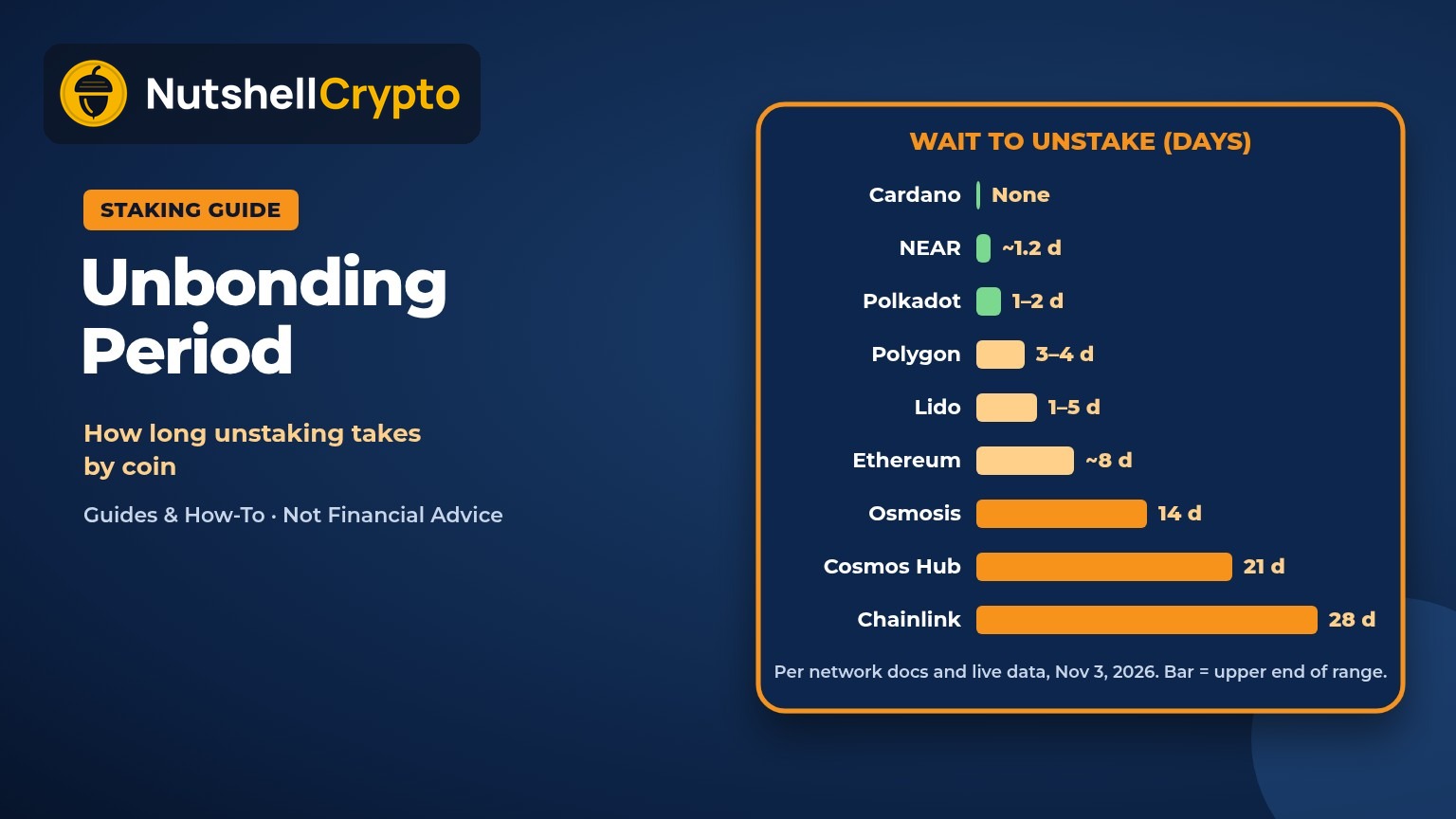
In a nutshell: The unbonding period is the wait between telling a proof-of-stake network you want to unstake and being able to move your coins. It runs from none on Cardano to about a day or two on NEAR, Polkadot nominators and Solana, 14 days on Osmosis, 21 days on the Cosmos Hub and 28 days for Chainlink’s cooldown, and exchanges can add their own processing time. During the wait you usually can’t sell or send the coins, and on many networks you earn no rewards. Check the exact figure for your coin and provider before you stake. Educational only; not financial advice.
Last updated: November 3, 2026.
You tap “unstake” and the coins don’t show up. That is usually the unbonding period at work, and it is the most common surprise for new stakers, especially when the price moves while the coins are stuck.
This guide explains what unbonding is and why networks have it, how it differs from an exit queue, a lock-up or a cooldown, and what the wait is on eleven networks and protocols and three exchanges, using each network’s own docs or help pages checked on November 3, 2026, between about 3:40 PM and 3:45 PM PKT. It then covers how to check any coin yourself, ways around the wait, the risks, and short tax notes for the US, Canada and Australia.
Table of contents
- What is the unbonding period?
- Why networks make you wait
- Unbonding, exit queue, lock-up and cooldown: what the words mean
- Unbonding time by coin
- Unstaking times on exchanges
- Do you earn rewards while unbonding?
- Can you cancel or rebond?
- How to check a coin’s unbonding time before you stake
- Ways around the wait
- Risks during unbonding
- US, Canada and Australia tax notes
- FAQ
What Is the Unbonding Period?
Staking means locking coins on a proof-of-stake network to help secure it. Coinbase’s help center defines the other side of it simply: unbonding is telling the network you want to unlock your tokens, and the unbonding period is the time you wait before you can move or sell them (Coinbase Help). It can be a few days or a few weeks, and the length is set by the blockchain, not by your wallet or exchange.
The wait is separate from the time it takes to start staking. If you are new to the basics, start with our guide to what staking in crypto is.
Why Networks Make You Wait
The wait exists mostly for safety. Crypto.com’s help center says unbonding helps stop bad actors from quickly withdrawing their stake in response to a market shift or unforeseen event, and protects the stability of the network (Crypto.com Help). Polkadot’s team made the link to slashing explicit: nominator slashing was turned off in 2026, and the 28-day unbonding period “previously existed largely to keep funds available in case slashing needed to be applied” (Polkadot Forum). If a validator misbehaves, the network needs a window in which it can still penalize the stake that backed it.
Some networks also limit how fast stake can leave at once. Ethereum caps how much ETH can exit per epoch, which creates a queue when many people leave together (validatorqueue.com).
Unbonding, Exit Queue, Lock-Up and Cooldown: What the Words Mean
Different networks and apps use different words for waits that look alike. Here is how we use them in this guide.
| Term | Plain meaning | Where you see it |
|---|---|---|
| Unbonding period | A fixed wait set by the protocol after you unstake | Cosmos Hub, Osmosis, NEAR, Polkadot |
| Cooldown | The same idea, often counted in epochs or days | Solana (stake cools down over epochs), Chainlink (28 days) |
| Exit queue | A line that depends on how many others are leaving; the wait varies | Ethereum validators |
| Withdrawal delay or sweep | An extra step after you exit, before funds reach your address | Ethereum |
| Lock-up or minimum staking period | A fixed term you pick up front, with no early exit | Avalanche delegation (2 weeks to 1 year) |
| Provider processing time | Extra time an exchange or liquid staking protocol adds on top | Coinbase, Kraken, Lido |
The Chainlink and Avalanche cases are not “unbonding” in the strict sense, but the effect on you is the same: coins you can’t spend for a known stretch.
Unbonding Time by Coin
These figures are the network-level waits as of November 3, 2026, between about 3:40 and 3:45 PM PKT. Exchanges and liquid staking tokens can differ; see the next section. Rows marked “live” were read from the network’s public data that day.
| Coin or network | Typical wait | Source and what we checked |
|---|---|---|
| Ethereum (ETH) | Exit queue about 1 day 4 hours plus a sweep delay of about 7.1 days, so roughly 8 days at the time (varies) | validatorqueue.com live figures: 3,384 ETH in the exit queue, 256 ETH per epoch churn. Process per ethereum.org |
| Cosmos Hub (ATOM) | 21 days | Live: staking params show unbonding_time 1,814,400 seconds; also Cosmos Hub docs |
| Osmosis (OSMO) | 14 days | Live: staking params show unbonding_time 1,209,600 seconds |
| Solana (SOL) | Deactivation takes effect at the next epoch boundary; an epoch is 432,000 slots, about 26 hours on recent data | Live Solana RPC: epoch 1076, 432,000 slots per epoch; the last hour of performance samples averaged about 0.214 seconds per slot, or about 25.7 hours per epoch. Cooldown over epochs per Anza docs; see our SOL staking guide |
| Cardano (ADA) | None; ADA stays spendable while delegated | Cardano Developer Portal: “No lock-up”; see our ADA staking guide |
| Polkadot (DOT) | 1 to 2 days for nominators and pool members | Polkadot Wiki and Polkadot Forum (2 eras, down from 28 days; applies to requests made after the change). We did not read the chain’s constants ourselves today |
| NEAR | 4 epochs, about 29 hours if each epoch lasts the ideal 7.2 hours | NEAR docs (4-epoch unbonding) and the epoch page (43,200 blocks, ideally 7.2 hours). Real epochs can run slightly shorter or longer |
| Avalanche (AVAX) | No unbonding, but delegation is time-locked for 2 weeks to 1 year with no early exit | Avalanche docs (2-week minimum for delegation); see our AVAX staking guide. BENQI’s sAVAX: 15-day unlock plus a 2-day redemption window per BENQI docs |
| Polygon (POL) | 82 checkpoints, about 3 to 4 days | Polygon support (page modified April 29, 2025); see our Polygon staking guide |
| Chainlink (LINK) | 28-day cooldown, then a 7-day claim window | Chainlink staking v0.2 overview parameter table; see our Chainlink staking guide |
| Lido (stETH) | Usually 1 to 5 days through its withdrawal queue, sometimes longer | Lido Help Center; see our Lido staking guide |
The Polkadot row shows how fast these numbers can change. Many older articles still say 28 days for DOT, but the network’s current guidance is 1 to 2 days for nominators, so always check the date on any guide you read, including this one.
Unstaking Times on Exchanges
An exchange follows the network’s wait but may add processing time, offer a faster paid option, or run its own product rules. The estimates below come from each platform’s help pages as read on November 3, 2026.
| Platform | What the help page says |
|---|---|
| Coinbase | Estimated standard unstaking waits: ATOM about 25 days, ETH about 10, AVAX about 9, POL about 8, SOL about 5, DOT about 4, ADA about 2, XTZ about 2 and SUI about 24 hours. These include network wait plus Coinbase’s processing. Coinbase lists earning during unstaking for these assets and offers optional instant unstaking for a fee |
| Kraken | Bonded staking waits “can last 3 or more days, depending on the asset” and stops earning rewards until the wait ends. Flexible staking has no unbonding period, but for assets with an unbonding period rewards are paid on up to 50% of the amount staked, with a 30% commission |
| Crypto.com | Estimated unbonding: ETH “depending on network conditions (days to weeks)”, SOL 5 days, POL 5 days, DOT 29 days, CRO 29 days. Its separate CRO article says 28 days. Unstake requests are irrevocable, and the asset stops earning |
Providers do not agree with each other or with the network. Crypto.com’s page lists 29 days for DOT while the Polkadot Wiki says 1 to 2 days, and POL is about 8 days at Coinbase but 5 at Crypto.com. Help pages can lag behind a protocol change, so check the number your own app shows at the moment you unstake.
Do You Earn Rewards While Unbonding?
It depends on the chain and provider, so read the fine print.
- Usually no: Kraken says assets with an unbonding period stop earning until it ends; Crypto.com says the same, and the Polkadot Wiki says you won’t receive rewards while unbonding.
- Sometimes yes: Coinbase lists earning during unstaking for its assets, BENQI says sAVAX keeps accruing during the 15-day unlock, and Chainlink’s stake keeps accruing through the cooldown and claim window per our Chainlink guide.
Solana is in between: its docs describe a stake that cools down over epochs, with the still-active portion earning. Our staking APR guide shows how to count the missing rewards when you compare options.
Can You Cancel or Rebond?
Sometimes. The Polkadot Wiki says that if you change your mind after starting to unbond, you can rebond your funds. Chainlink’s design lets you restake during the cooldown, per our Chainlink guide. On Crypto.com an unstake request is irrevocable. Coinbase, for its part, lets you convert a pending standard unstake into an instant one for a fee. If cancelling matters to you, find out before you press unstake whether your provider supports it.
How to Check a Coin’s Unbonding Time Before You Stake
- Look at the network’s own docs. Search “[coin] unstake” on its official documentation, as with NEAR or the Cosmos Hub.
- Read the chain parameters. On Cosmos SDK chains, the public staking params endpoint shows unbonding_time in seconds, which is how we got the Cosmos and Osmosis figures above.
- Check the queue if one exists. For Ethereum, a public tool like validatorqueue.com shows the current exit wait and sweep delay.
- Read your provider’s page. Exchanges, wallets and liquid staking apps each publish their own estimate, as in the table above.
- Look at the countdown in your wallet. Many wallets show the time remaining on an unbonding balance.
- Test with a small amount if you plan to stake a lot, so you see the real wait once.
On a hardware wallet, the wait is the network’s own, with no exchange in between; our Ledger staking guide shows how that works. To see how the wait affects what you earn, try our Chainlink staking calculator.
Ways Around the Wait
- Flexible staking. The platform keeps part of the pool unstaked so you can leave at once, usually for a lower rate. Kraken’s page above shows the trade-off in numbers. See our guide to flexible vs locked staking.
- Liquid staking tokens. You hold a token such as stETH that you can sell, instead of waiting for the protocol. Some can also be redeemed through a queue, as Lido’s 1 to 5 days shows. See our liquid staking guide and our guide to staking Ethereum.
- Instant unstaking. Coinbase offers it for a fee, and Solflare’s instant unstake charges a fee as covered in our SOL staking guide.
- Pick a coin with a short wait. Cardano has none, and Polkadot nominators are down to 1 to 2 days.
Each workaround costs something: a lower rate, a fee, or extra smart-contract or counterparty risk.
Risks During Unbonding
- Price risk. Kraken warns that the market price of staked assets may significantly increase or decrease by the time the wait ends. You can’t sell during it.
- Missing rewards. On many chains the stake stops earning on day one.
- Slashing can still apply. The Cosmos Hub docs say staked ATOM can be slashed for the faults of the validator it is bonded to, and our Cosmos staking guide notes this continues for faults committed before unbonding started. Polkadot nominators, by contrast, can no longer be slashed.
- Waits that stack up. An exchange’s processing time or Ethereum’s queue plus sweep can be longer than the headline number.
- Limits on requests. Crypto.com says an eighth unstake from the same CRO validator within 28 days fails until an earlier one finishes.
- Fake “unlock” scams. Don’t click links in messages offering to “speed up” or “release” your unbonding funds, and never enter your recovery phrase to “unlock” coins. Real unbonding finishes on its own; you only sign a withdraw transaction in your own wallet app.
US, Canada and Australia Tax Notes
This section is general information, not tax advice. We found no tax authority statement that specifically covers the unbonding wait itself, so please confirm with a qualified tax professional. For the full picture, see our crypto staking taxes guide.
United States: the IRS says to answer “Yes” to the digital asset question on your return if you received digital assets from staking, and that income from staking is reported on Schedule 1 (IRS digital assets). Revenue Ruling 2023-14 says validation rewards are included in gross income in the year you gain dominion and control, meaning the ability to sell, exchange or otherwise dispose of them (Rev. Rul. 2023-14). The ruling does not mention unbonding, so how the wait affects the timing of rewards is a question for your tax professional.
Canada: the CRA says rewards from staking on a centralized exchange are generally income when they are credited to your wallet on the platform, and that business income from staking has its own rules (CRA: mining and staking income). That page does not discuss unbonding either. More in our Canada crypto tax guide.
Australia: the ATO says the money value of staking rewards is ordinary income when you receive them, converted to Australian dollars (AUD) at that time, and that disposing of the reward tokens later is a CGT event (ATO: staking rewards and airdrops). Note that the ATO site blocked our automated page fetch on November 3, 2026, so that wording comes from the page’s search listing; read the page itself before relying on it. An ATO legal database entry also says rewards that are locked and not accessible until conditions are met are not treated as received until you can withdraw or access them, which may matter if your rewards are held back during unbonding.
FAQ
What is the unbonding period in crypto?
It is the wait between asking a proof-of-stake network to unstake and being able to move or sell your coins. It is set by the protocol and can range from none to 28 days or more.
How long does it take to unstake?
It depends on the coin and provider. As of November 3, 2026: Cardano none, NEAR about 29 hours at the ideal epoch length, Polkadot nominators 1 to 2 days, Polygon about 3 to 4 days, Osmosis 14 days, Cosmos Hub 21 days, Chainlink 28 days plus a 7-day claim window, and Ethereum roughly 8 days on the day we checked.
Why is the unbonding period so long?
Mostly for security. A delay keeps stake in place long enough for the network to penalize misbehavior and prevents a sudden mass exit. Polkadot shortened its nominator wait after removing nominator slashing.
Do I earn rewards during the unbonding period?
Often not, but it varies. Kraken, Crypto.com and the Polkadot Wiki say no; Coinbase, BENQI and Chainlink describe continued earning.
Can I cancel unbonding?
On some networks, yes, through a rebond or restake option, as with Polkadot. Other providers treat the request as final. Check before you confirm.
Is unstaking a taxable event?
We found no IRS, CRA or ATO page that says unbonding on its own is taxable, but rewards are generally income, and selling after the wait can trigger gains or losses. Confirm your case with a tax professional.
Sources: Cosmos and Osmosis public staking parameters, Solana public RPC and Anza docs, ethereum.org, validatorqueue.com, Polkadot Wiki and Forum, NEAR docs, Cardano Developer Portal, Avalanche docs, BENQI docs, Polygon support, Chainlink, Lido Help Center, Coinbase Help, Kraken Support, Crypto.com Help Center, IRS, CRA and ATO, all checked on November 3, 2026. Waits change with network conditions and protocol upgrades. This article is for education only and is not financial or tax advice.