In a nutshell: Crypto exchange fees are the costs a platform charges when you fund an account, buy or sell, and move coins out. The big ones are trading fees (maker and taker), the spread built into “instant buy” prices, card or bank funding fees, and withdrawal or network fees. Educational only; not financial advice.
Last updated: October 8, 2026.
Two people can buy the same $1,000 of bitcoin on the same day and pay very different amounts, just because of the button they pressed and how they paid. Below: every common fee type for US and Canadian readers, how volume tiers work, a worked example and ways to pay less. If you are still picking a platform, read our guide to centralized exchanges (CEXs) first.
Table of contents
The Main Types of Crypto Exchange Fees
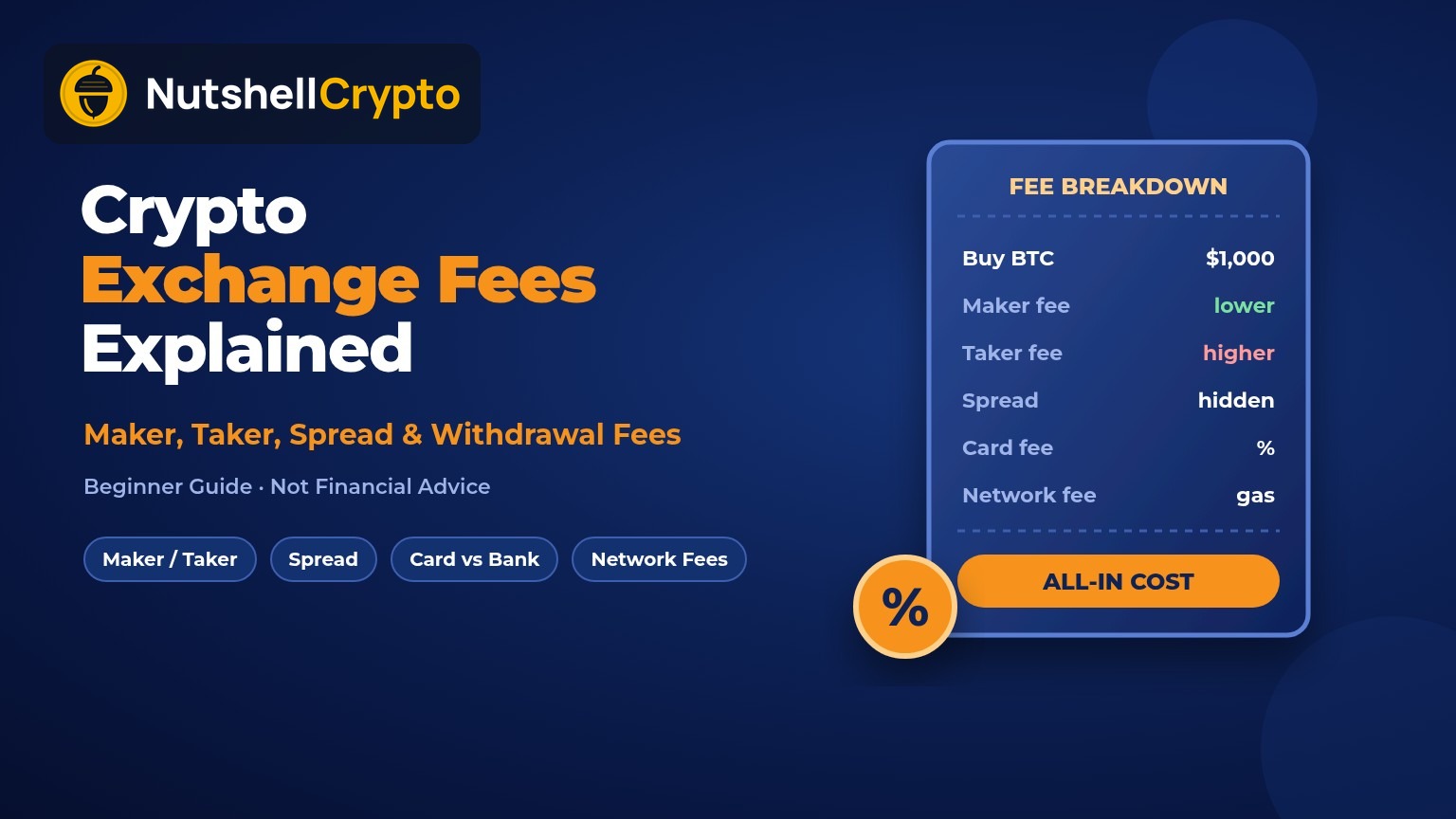
Most crypto exchange fees fall into a handful of buckets. Not every platform charges all of them, and names vary:
| Fee type | When you pay it |
|---|---|
| Trading fee (maker/taker) | Each buy or sell on an order-book screen |
| Instant-buy or convenience fee | Simple “Buy” button trades |
| Spread | Built into the quoted price |
| Funding fee | Adding cash by card, bank, wire or PayPal |
| Withdrawal fee | Cashing out or sending crypto off the platform |
| Network (gas) fee | Any on-chain transfer |
| Conversion or FX fee | Swapping coins, or trading in a foreign currency |
| Other fees | Staking, limit orders, small orders, inactivity |
Maker vs Taker: How Crypto Trading Fees Work
On “advanced” or “pro” trading screens, crypto trading fees usually follow a maker-taker model. Investopedia explains that maker-taker pricing rewards traders who post resting orders (makers) with lower fees or rebates, while traders who fill existing orders (takers) pay more.
Kraken’s support page says an order gets the maker fee if it is not matched immediately with an order already on the book, and the taker fee if it is. All market orders pay the taker fee. Coinbase Advanced uses the same logic and notes that a partially matched order pays the taker fee on the part that fills right away and the maker fee on the rest.
Real numbers from official fee pages, checked October 8, 2026:
- Kraken Pro (fee schedule): Tier 1 ($0+ in 30-day spot volume) is 0.40% maker and 0.80% taker.
- Gemini ActiveTrader (fee schedule dated September 1, 2026): the starting tier is 0.600% maker and 1.200% taker.
Coinbase says you can see your Advanced rates and tier after signing in.
The Spread: The Crypto Exchange Fee You Don’t See
The bid-ask spread is the difference between the highest price a buyer will pay and the lowest price a seller will accept. On simple “Buy” screens, exchanges usually bake a spread into the price they quote you, on top of any visible fee.
- Coinbase says it includes a spread in the quoted price for simple buy and sell orders and in crypto-to-crypto conversions, while Coinbase Advanced includes no spread because you trade directly on the order book.
- Kraken says it charges a 1% trading fee on instant and recurring trades and a 1.5% fee on custom orders in its main app, plus a spread in the price, and that payment fees may apply depending on how you pay.
- Gemini says Instant and Recurring orders in its simple mode include a spread in the quoted price.
This is why “simple vs advanced trade” matters. The simple screen is easier, but you usually pay a convenience fee plus a spread. The advanced screen shows a plain maker or taker percentage. Either way, check the order preview before you confirm.
Deposit and Funding Fees: Card vs Bank vs Interac
How you add money can cost more than the trade itself. Gemini’s transfer fee schedule lists ACH and wire deposits as free, a debit card at 3.49% of the total purchase amount and PayPal at 2.50% of the deposit. Coinbase says you may be charged a fee to add cash or cash out depending on the payment method.
As a rule, a bank transfer (ACH in the US, Interac e-Transfer in Canada) is the cheapest way in, and a card is the most expensive. Gemini also lists a $25 fee for a USD wire withdrawal, while ACH withdrawals are free.
Withdrawal and Network Fees (Crypto Transaction Fees)
When you send coins off an exchange, say to your own wallet, there are two pieces. The network fee (called gas on Ethereum) goes to the blockchain, and some exchanges add their own processing fee. These crypto transaction fees vary by coin and by how busy the network is.
- Gemini says it charges a dynamic withdrawal fee meant to cover network fees, that it “does not pocket the fee,” and that crypto deposits are free.
- Coinbase says it charges a fee based on its estimate of current network fees when you send crypto off the platform, a 0.2% processing fee for bitcoin sent over the Lightning Network, and a USDT processing fee of 0.01% (max 20 USDT) plus the network fee.
Looking for the crypto with the lowest transaction fees? There is no permanent answer, because network fees change with demand. Check the fee your exchange shows on the withdrawal screen, send a small test amount first, and make sure you pick the right network. Moving coins into self-custody is covered in our hot wallet vs cold wallet guide and our custodial wallet explainer.
How Crypto Exchange Fee Tiers Work
Advanced trading fees usually drop as you trade more. Your tier is based on your trailing 30-day volume, and sometimes on your balance:
- Kraken Pro: tiers are based on the best of your 30-day spot volume or your assets on platform. At $10K+ in volume the rate drops to 0.22% maker and 0.38% taker. Kraken says volume from Instant Buy does not count toward these tiers.
- Gemini ActiveTrader: the tier uses your trailing 30-day volume or your total asset balance, whichever gives the lower fee. Stablecoin pairs don’t count toward volume.
- Coinbase Advanced: the tier uses whichever volume or USDC balance criterion is most favorable to you.
Beginners buying a few hundred dollars a month will usually stay in the starting tier, so don’t over-trade chasing a discount.
Worked Example: What a $1,000 Buy Might Cost
Illustrative math only. The percentages come from the fee pages cited above. The spread and network figures are made-up assumptions, because exchanges don’t publish fixed numbers for them.
| Scenario ($1,000 buy) | Trading fee | Assumed extras | Approx. total |
|---|---|---|---|
| Kraken Pro, Tier 1 limit order that rests (maker 0.40%) | $4.00 | None (bank deposit) | $4.00 |
| Kraken Pro, Tier 1 market order (taker 0.80%) | $8.00 | None (bank deposit) | $8.00 |
| Kraken instant buy (1% fee) | $10.00 | Assumed 0.5% spread = $5.00 | $15.00 + any payment fee |
| Gemini ActiveTrader, starting tier taker (1.200%), paid by debit card (3.49%) | $12.00 | Card fee $34.90 | $46.90 |
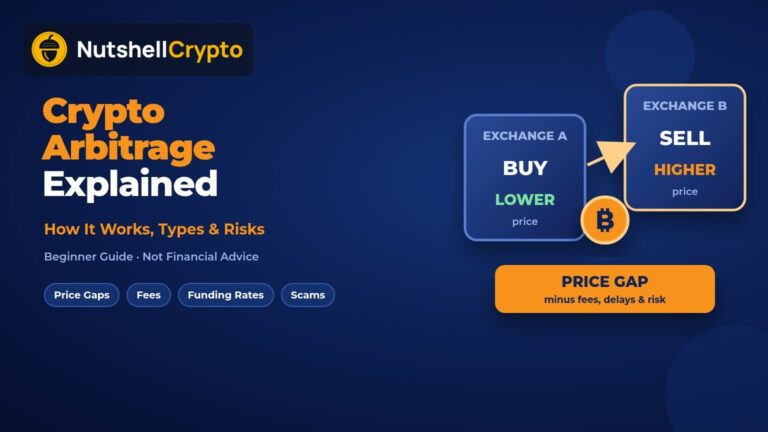
Now add a withdrawal to your own wallet with an assumed $2 network fee, and remember that selling later is charged again. A round trip costs at least twice the trading fee, which is also why most small price gaps between exchanges disappear once you try crypto arbitrage. Small differences add up if you buy every week, which is worth knowing before you set up dollar cost averaging.
Crypto Exchange Fees in Canada
Canadian platforms use the same building blocks, with a few local twists. Start with the Canadian Securities Administrators’ list of crypto platforms authorized to do business with Canadians; a listing is not a recommendation.
- Bitbuy (fee page) lists Interac e-Transfer deposits at 0%, says its Express Trade uses a spread instead of trading fees, lists Pro Trade at 0.50% maker and 0.50% taker, and charges no fee to deposit crypto. Bitcoin withdrawals use a dynamic fee.
- Wealthsimple (crypto page) says all crypto trades pay a flat 0.5% fee plus a spread, limit orders are spread-free, and orders under $100 carry a $1 small-order surcharge. It also says trading crypto in USD brings a 1.5% foreign exchange (FX) fee.
That FX point is the key Canada note: if you fund in CAD but trade a USD pair, a currency conversion fee can stack on top of the trading fee.
How to Compare and Reduce Crypto Exchange Fees
Instead of hunting for the “cheapest crypto exchange,” compare the all-in cost for the way you will actually use it:
- Fund by bank, not card. ACH or Interac is usually free; cards often cost several percent.
- Use the advanced screen if you’re comfortable with it, and use limit orders that rest on the book to pay the maker rate.
- Batch withdrawals. One larger transfer beats many small ones, since network fees are per transaction.
- Avoid unnecessary conversions, such as CAD to USD or coin-to-coin swaps with a spread.
- Check the “other” fees: limit-order fees on simple screens (Coinbase lists a 1% limit order execution fee for simple limit orders), staking commissions and any account or inactivity charges.
- Keep records. Fees can affect your cost basis; see our guides to US crypto capital gains tax and cryptocurrency tax in Canada.
Brand new? Our step-by-step how to buy bitcoin guide walks through the first purchase.
FAQ
What are typical crypto exchange fees?
It depends on the screen and payment method. On official pages checked October 8, 2026, starting-tier taker fees were 0.80% on Kraken Pro and 1.200% on Gemini ActiveTrader, and Kraken’s instant buy fee was 1% plus a spread.
What is the difference between maker and taker fees?
A maker order rests on the order book and adds liquidity; a taker order fills immediately against an existing order. Makers usually pay less.
Are crypto transaction fees the same as exchange fees?
Not quite. Network (transaction) fees go to the blockchain when coins move on-chain; exchange fees are what the platform charges. A withdrawal can include both.
Which exchange has the lowest fees?
There is no single answer, since rates change and depend on volume, payment method and order type. Compare the current fee pages using your own trade size.
Sources
- Coinbase Help: Pricing and fees disclosures
- Coinbase Help: Coinbase Advanced fees
- Kraken: Fee schedule
- Kraken Support: What are maker and taker fees?
- Gemini: ActiveTrader fee schedule
- Gemini: Gemini mode fees
- Gemini: Transfer fee schedule
- Bitbuy: Fee schedule
- Wealthsimple: Crypto
- CSA: Crypto platforms authorized to do business with Canadians
- Investopedia: Maker-taker fees
- Investopedia: Bid-ask spread
Educational content only. This is not financial or investment advice. Fees change often, so confirm current rates on each platform before you trade. Crypto is volatile and you can lose money.