In a nutshell: Margin trading in crypto means borrowing money or coins from an exchange to open a bigger position than your own cash would allow, using your deposit as collateral. It lets you go long or short with leverage, such as 5x, but it multiplies losses as fast as gains. At 5x, a 20% move against you can wipe out your whole deposit, and the platform will usually liquidate you before that. You also pay borrowing fees for as long as the position stays open. Rules differ by country: Kraken now offers US retail spot margin through a CFTC-registered firm, while Canadian crypto trading platforms have committed not to offer margin or leverage. Educational only; not financial advice.
Last updated: October 16, 2026.
Margin trading crypto is one of the most searched advanced trading topics, and also one of the fastest ways beginners lose money. This guide explains what margin trading is, how leverage, collateral, margin calls and liquidation work, what it costs, how it differs from spot trading and futures, where it is allowed in the US and Canada, and the risks you should understand before you ever turn on a margin toggle.
If you are still learning where trades happen, start with our explainer on what a centralized exchange is, since that is where most margin trading takes place.
Table of contents
- What is margin trading in crypto?
- How crypto margin trading works
- Leverage explained (with a table)
- Margin calls and liquidation
- What margin trading costs
- Margin vs spot vs futures vs perpetuals
- Margin trading rules in the US and Canada
- Risks of margin trading crypto
- A safety checklist before you start
- Taxes on margin trades
- FAQ
What Is Margin Trading in Crypto?
Margin trading means trading with borrowed funds. You put up some of your own money or crypto as collateral, the platform lends you more, and you open a position larger than your deposit. The idea comes from stock brokerage accounts: FINRA’s guide to margin accounts describes margin as borrowing from your broker to buy securities, with those securities serving as collateral for the loan.
Crypto platforms work in a similar way. Kraken’s Kraken Pro margin page describes spot margin as trading with leverage using your existing crypto as collateral, going long or short, with up to 20x leverage on selected assets. With margin you can:
- Go long: borrow cash (for example USD or a stablecoin) to buy more of a coin than you could afford, hoping the price rises.
- Go short: borrow a coin and sell it, hoping to buy it back cheaper later and return the loan.
The key point: the loan has to be repaid no matter what the price does. That is why margin magnifies both gains and losses.
How Crypto Margin Trading Works
A typical margin trade on a centralized exchange follows these steps:
- Enable margin. Most platforms keep margin switched off until you accept extra terms and risk disclosures. Kraken’s guide on how to unlock US margin trading says you need a verified account, and you must accept a margin loan agreement and related terms before trading.
- Post collateral. Your cash or crypto balance backs the loan. Kraken says it accepts 48+ crypto assets as collateral on Kraken Pro spot margin.
- Choose leverage and direction. Pick long or short and a leverage level, such as 2x or 5x.
- Open the position. The platform lends you the extra funds and the trade executes.
- Monitor it. Your equity rises or falls with the price. Borrowing fees build up over time.
- Close it. You sell (or buy back, for a short), repay the loan plus fees, and keep what is left, which can be a profit, a loss, or nothing.
Leverage Explained
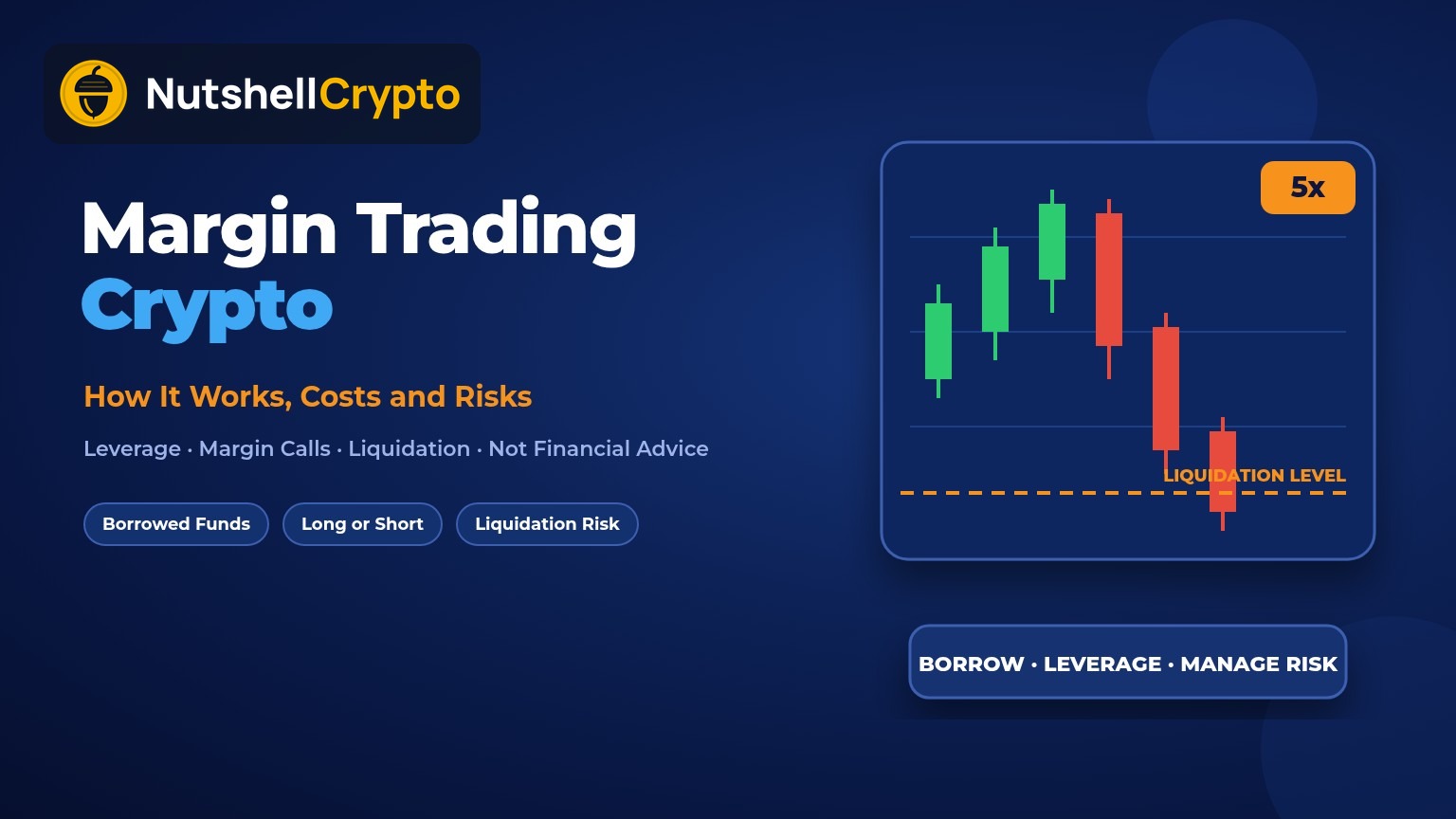
Leverage is the ratio between your position size and your own money. With $1,000 of collateral at 5x leverage, you control a $5,000 position: $1,000 is yours and $4,000 is borrowed.
Here is the simple math, before fees. If that $5,000 position rises 10%, it is worth $5,500. After repaying $4,000, you have $1,500, a 50% gain on your $1,000. If it falls 10%, it is worth $4,500, and you are left with $500, a 50% loss. If it falls 20%, it is worth $4,000, exactly the loan, and your $1,000 is gone.
The table shows how far the price has to move against you before your own collateral is fully used up. These are our own calculations (100% divided by the leverage), ignoring fees, slippage and liquidation penalties, which make the real number smaller.
| Leverage | Position size per $1,000 collateral | Move against you that wipes out collateral (before fees) |
|---|---|---|
| 1x (no margin) | $1,000 | 100% (the coin goes to zero) |
| 2x | $2,000 | 50% |
| 5x | $5,000 | 20% |
| 10x | $10,000 | 10% |
| 20x | $20,000 | 5% |
Crypto prices can easily move 5% to 20% in a day. Our daily coverage of coins such as the Zcash price drop shows how quickly single coins swing, which is why high leverage is so dangerous in this market.
Margin Calls and Liquidation
Because the platform lent you money, it protects itself by watching your equity (your collateral plus or minus open profit and loss). When your equity gets too low compared with what you borrowed, two things can happen:
- Margin call: a warning to add funds or shrink the position. Investor.gov’s margin call entry explains that when the value of what you bought on margin falls, your firm can require you to deposit more cash or securities immediately, or sell your holdings to cover the shortfall without telling you in advance.
- Liquidation: the platform closes some or all of your positions for you to repay the loan.
Kraken’s support page on liquidations for US margin trading gives real numbers. When your margin level drops to 80%, you get a margin call notification. At 40%, automated liquidation is triggered, and once it starts it cannot be stopped. Kraken says liquidation trades are executed at the CF Benchmarks index price with a 2% spread, and if your collateral has to be converted to cover the debt, conversion fees of 1.5% to 5% may apply. It also warns that rapid price moves can push your margin level down quickly, even if your position was fine earlier in the day.
Liquidations can happen across the whole market at once. On October 10, 2025, more than $19 billion of leveraged crypto positions were liquidated in 24 hours, which Reuters reported was the largest liquidation in crypto history. CNBC, citing CoinGlass data, put the total at $19.37 billion across more than 1.6 million traders.
What Margin Trading Costs
Borrowed money is not free. On top of normal trading fees (see our guide to crypto exchange fees), margin usually adds interest-like charges. Kraken’s US margin fees page lists three:
- Opening fee: charged when you open a margin position, based on the value of the margin extended.
- Trade fee: the standard maker or taker fee, charged on both opening and closing volume.
- Rollover fee: charged every 4 hours while the position stays open. Rates change with market conditions, and your rate is locked in when the order executes.
When we checked Kraken’s fee schedule on October 16, 2026 at about 2:15 PM PKT, BTC showed an opening fee of 0.01% to 0.02% and a rollover fee of 0.01% to 0.02% per 4 hours, while ETH and many other assets showed 0.02% to 0.04% for each. That sounds small, but the rollover fee repeats six times a day. Kraken’s own fee example shows a $20,000 margin position paying $24 in rollover fees over 24 hours at 0.02%, plus a $4 opening fee, before trading fees. Hold a leveraged trade for weeks and these costs add up.
Margin vs Spot vs Futures vs Perpetuals
People often mix these up. Here is how they differ:
| Type | What you trade | Borrowing or leverage? | Main extra cost |
|---|---|---|---|
| Spot trading | The actual coin, paid in full | No | Trading fees and spread |
| Spot margin | The actual coin, partly with borrowed funds | Yes | Opening and rollover (borrowing) fees |
| Futures | A contract on the price, with an expiry date | Yes, through margin deposits | Fees and price differences at roll |
| Perpetual contracts | A contract on the price, with no expiry | Usually, but not required | Funding-rate payments |
Kraken describes its spot margin as trading actual underlying assets, not financial contracts. Perpetuals are different: the CFTC’s one-page explainer on crypto asset perpetual contracts says they have no fixed expiration date and use a funding rate, a periodic payment between longs and shorts, to stay close to the spot price. It also notes that leverage is not inherent to perpetuals, and that under CFTC oversight leverage is set by a platform’s risk framework.
If you only want to own a coin, spot buying is the simpler path. Our guide to dollar cost averaging crypto shows a lower-stress way to build a position over time without borrowing.
Margin Trading Rules in the US and Canada
United States
Leveraged crypto trading for retail customers falls under the Commodity Futures Trading Commission (CFTC). The CFTC’s 2020 actual delivery guidance said leveraged, margined or financed retail crypto deals were treated like futures unless the customer got actual delivery of the coins within 28 days. After that guidance, Coinbase Pro disabled margin trading in November 2020.
In December 2025, the CFTC withdrew that 2020 guidance as outdated, effective December 10, 2025, and said it would consider whether updated guidance or FAQs are appropriate. Today, Kraken’s page on getting started with US margin trading says US retail margin is offered, executed and cleared through Kraken Derivatives US (NinjaTrader Clearing LLC), a CFTC-registered futures commission merchant and NFA member. Kraken lists exclusions too, such as NFA members, CFTC registrants and certain related employees.
The CFTC’s perpetuals explainer advises traders to only trade on CFTC-registered exchanges and avoid offshore venues outside its jurisdiction. Using an offshore exchange through a VPN to get higher leverage can break that platform’s terms and leave you with little protection if something goes wrong.
Canada
Canada is stricter. Under CSA Staff Notice 21-332, crypto trading platforms operating in Canada while they pursue registration must commit not to offer margin, credit or other forms of leverage to any client, retail or permitted, for crypto trades on their platform. The Ontario Securities Commission announced these enhanced undertakings in February 2023. Kraken’s margin eligibility page also lists Canada among regions where its standard margin service is not offered.
Rules change, so always check your platform’s current eligibility page for your province or state.
Risks of Margin Trading Crypto
- Losing more than you deposit: Kraken’s US margin risk disclosure says you may lose all or more than your initial investment and may remain responsible for any deficiency after liquidation.
- Fast liquidation: crypto trades 24/7, so a sharp move at 3 a.m. can liquidate you while you sleep.
- Whole-account risk: Kraken warns your full Kraken balance may be at risk if a position is liquidated, because other collateral can be converted to cover the debt.
- Fees that never stop: rollover fees keep charging every 4 hours, so a sideways market still costs you money.
- Short squeezes: when you are short, losses are in theory unlimited, because a coin’s price has no ceiling.
- Platform risk: your collateral sits with the exchange. Our custodial wallet guide explains why that matters.
- Emotional trading: leverage makes every move feel bigger, which pushes people to chase losses.
The CFTC’s advisory on the risks of virtual currency trading warns that when markets go against leveraged positions, traders can be forced to refill their margin accounts or close out their positions, and may lose more than their initial investments.
A Safety Checklist Before You Start
- Use only money you can afford to lose. Kraken calls this “risk capital.”
- Keep leverage low. At 2x, the coin has to fall about 50% before fees to wipe out your collateral; at 20x, only about 5%.
- Know the margin call and liquidation levels on your platform before you trade.
- Set a stop-loss so you exit on your terms, not the liquidation engine’s.
- Keep a buffer of extra collateral instead of using the maximum.
- Add up the fees, including rollover costs for the time you plan to hold.
- Stick to regulated platforms available where you live.
- Practice on spot first. If you cannot make spot trades work, leverage will only make losses faster.
Taxes on Margin Trades
In the US, the IRS treats digital assets as property, and its digital assets page explains that selling or exchanging them can create a taxable gain or loss. Closing a margin position, including a forced liquidation, is generally a sale, so it can trigger a capital gain or loss. Our guide to crypto capital gains tax covers short-term vs long-term rates. Active margin traders can end up with hundreds of taxable events. The IRS also lists transactions described as short sales of digital assets among those brokers do not yet have to report on Form 1099-DA (Notice 2024-57), so your tax form may not show everything. Keep your own records and export your exchange’s transaction history.
In Canada, the CRA’s guidance for crypto-asset users explains how crypto gains are reported, and depending on how you trade, gains can count as capital gains or business income. Our guide to cryptocurrency tax in Canada explains the difference. This is not tax advice; check with a tax professional.
For a real example of a leverage-fuelled rally reversing, see why LayerZero is dropping today.
FAQ
What is margin trading in crypto in simple terms?
It is trading with money or coins borrowed from the exchange, backed by your own deposit. It makes your position bigger, so gains and losses are both larger.
Is margin trading the same as leverage trading?
They are closely linked. Margin is the collateral and borrowing; leverage is the multiple it gives you, such as 5x. People often use “leverage trading” for futures and perpetual contracts too, which work differently from spot margin.
Can you lose more than you invest with crypto margin trading?
Yes. Kraken’s US risk disclosure says you may lose more than your initial investment and remain responsible for any deficiency after liquidation.
Is crypto margin trading legal in the US?
It can be, through properly registered firms. For example, Kraken offers US retail spot margin through Kraken Derivatives US, a CFTC-registered futures commission merchant. Availability depends on the platform and your eligibility.
Can Canadians margin trade crypto?
Crypto trading platforms operating in Canada under CSA pre-registration undertakings have committed not to offer margin, credit or leverage to any client. Check each platform’s current rules.
What leverage should a beginner use?
Many beginners are better off with none at all. If you do use margin, lower leverage gives you far more room before liquidation, as the leverage table above shows.
What happens when I get liquidated?
The platform closes some or all of your positions to repay the loan, often with extra fees. On Kraken US margin, liquidation is automatic at a 40% margin level and executes with a 2% spread to the index price.
Sources
- FINRA: Margin Accounts
- Investor.gov: Margin Call
- Kraken: Crypto Margin Trading
- Kraken: Getting started with US margin trading
- Kraken: How to unlock US margin trading
- Kraken: Liquidations – US margin trading
- Kraken: US margin fees
- Kraken: Fee schedule, checked October 16, 2026
- Kraken: Client eligibility for margin trading services
- CFTC: Final Interpretive Guidance on Actual Delivery for Digital Assets (2020)
- CFTC: Withdrawal of Outdated Digital Assets Guidance (December 11, 2025)
- CFTC: Crypto Asset Perpetual Contracts
- CFTC: Understand the Risks of Virtual Currency Trading
- Coinbase: Coinbase Pro disables margin trading
- CSA Staff Notice 21-332
- OSC: Canadian securities regulators strengthen oversight of crypto trading platforms
- Reuters: After record crypto crash, a rush to hedge
- CNBC: The biggest crypto wipeout
- IRS: Digital Assets
- CRA: Information for crypto-asset users and tax professionals
This article is for educational purposes only and is not financial, investment or tax advice.