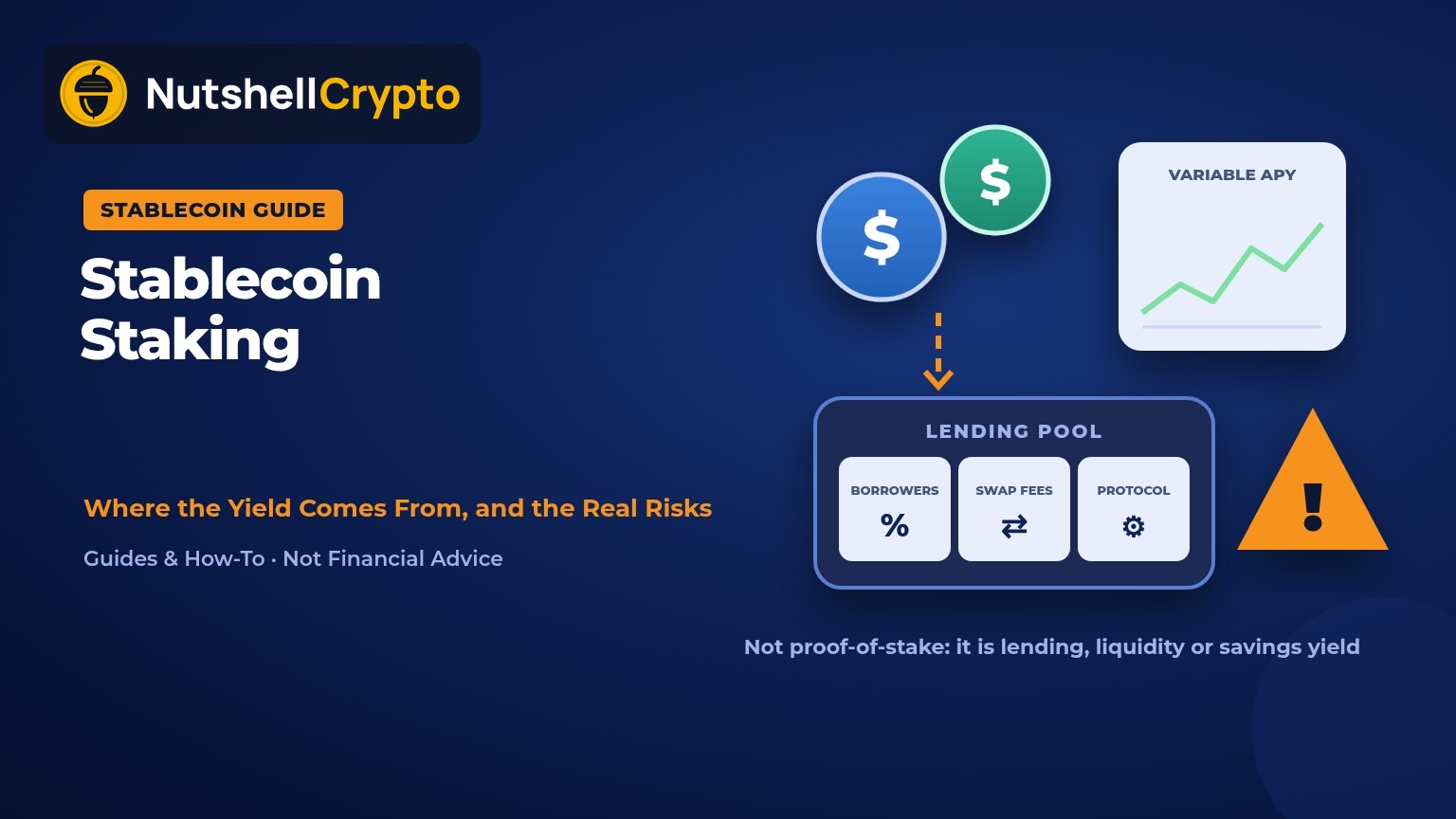
In a nutshell: You cannot really “stake” USDT or USDC the way you stake ETH or SOL, because stablecoins do not secure a proof-of-stake blockchain. What apps call “stablecoin staking” is almost always lending, providing liquidity, or holding a savings-style token. The yield comes from borrowers paying interest, trading fees, a protocol’s revenue, or a platform’s own marketing budget. The main risks are the platform failing, a smart contract getting hacked, the stablecoin losing its peg, rates dropping and lockups. Educational only; not financial advice.
Last updated: October 26, 2026.
Search for ways to “stake” a stablecoin and you will find exchanges, wallets and DeFi apps offering a percentage return on USDT, USDC or other dollar-pegged tokens. The word “staking” makes it sound like the same thing as staking Ethereum. It is not, and that difference decides where the money comes from and what can go wrong.
This guide explains what stablecoin staking really is, the main types of programs, where the yield comes from, what has gone wrong in the past, how the rules look in the US and Canada, and the questions to ask before you deposit a single dollar.
Table of contents
What Is Stablecoin Staking?
“Stablecoin staking” is a marketing term for any program that pays you a return for depositing a stablecoin. You hand over USDC, USDT, USDS or a similar token, and you get more of it back over time, usually shown as an annual percentage yield (APY).
Behind that label sit very different products. Some are run by a company that holds your coins, some are open-source smart contracts you use from your own wallet, and some are tokens that grow in value by themselves. The return can look similar on the screen while the risk underneath is completely different.
If you are new to the basics, start with what stablecoins are and how they keep their $1 value.
Why It Is Not Real Staking
Real staking is part of how a proof-of-stake blockchain stays secure. Validators lock up the network’s own coin, such as ETH or SOL, check transactions and add new blocks, and the network pays them rewards for that work. Our guide to staking in crypto covers how that works.
USDT and USDC are tokens that run on top of blockchains like Ethereum and Tron. They are not used to choose validators, so there is no block reward to earn by locking them. When a platform pays you for “staking” a stablecoin, the money has to come from somewhere else, almost always from someone who wants to borrow or use your dollars.
That is why “stablecoin staking” behaves much more like lending than like staking. Your main question is not “how secure is this network?” but “who is using my money, and what happens if they cannot pay it back?”
The Main Types of Stablecoin “Staking”
1. Centralized earn programs
Exchanges and crypto apps offer “earn,” “savings” or “rewards” products. You keep the stablecoin in your account and the platform credits a return. Some platforms lend the coins to traders or institutions; others pay rewards from their own budget. Coinbase, for example, describes its USDC Rewards as a loyalty program funded by Coinbase and says it does not use or lend your USDC without your instruction. Its help page also says US customers must be Coinbase One members to be eligible (checked October 26, 2026, about 10:05 PM PKT). Because the company holds the coins, these are custodial products.
2. DeFi lending protocols
On lending protocols such as Aave and Compound, you supply stablecoins from your own wallet into a shared pool. Borrowers post crypto collateral, usually worth more than the loan, and pay interest. The interest rate moves up and down with demand: when many people want to borrow USDC, suppliers earn more. If a borrower’s collateral falls too far in value, the protocol sells it automatically, a process explained in our liquidation guide. For the bigger picture, see what DeFi is.
3. Liquidity pools
On a decentralized exchange, you can deposit a pair of tokens, such as USDC and USDT, into a pool that traders swap against. You earn a share of the trading fees and sometimes extra reward tokens. Pools of two stablecoins move less than pools with volatile coins, but if one of the two loses its peg, the pool tends to fill up with the weaker coin.
4. Yield-bearing stablecoins and savings tokens
Some protocols give you a separate token that slowly grows in value. Sky (the project formerly known as MakerDAO) lets you deposit USDS and receive sUSDS, whose redemption value grows at the Sky Savings Rate, a variable rate set by Sky governance. The older sDAI token works the same way for DAI. Other “yield-bearing” dollars pass through income from Treasury bills or trading strategies. These look simple, but you are trusting the protocol’s design, its governance and whatever assets back it.
5. Locked or fixed-term products
Some platforms offer a higher rate if you lock coins for 30, 60 or 90 days. You give up the right to withdraw early, which matters most exactly when something goes wrong and everyone wants out.
Where the Yield Comes From
A simple rule: if you cannot explain who is paying you, you do not understand the product. The usual sources are:
- Borrower interest. Traders borrow stablecoins to buy crypto with leverage or to short. Their interest flows to lenders, minus a cut for the protocol or platform.
- Trading fees. Liquidity pools pay out part of the fee charged on every swap.
- Reserve income passed along. Big stablecoin issuers hold reserves in cash and short-term US government debt that earn interest. Some of that income reaches users indirectly, for example through payments from issuers to exchanges that then fund rewards. The Congressional Research Service describes this “three-party model,” in which Circle shares part of its reserve income with Coinbase in proportion to the USDC held there.
- Protocol revenue. Savings rates like Sky’s are funded by the protocol’s income, not by a fixed promise.
- Token incentives. Some programs top up the rate with their own governance tokens. That part of the yield is only worth what the token sells for, and it often shrinks over time.
Rates that sit far above what borrowers or Treasury bills would normally pay deserve suspicion. In its 2023 complaint against Terraform Labs, the SEC said Terra marketed its UST stablecoin as “yield-bearing,” advertised as paying as much as 20 percent interest through the Anchor Protocol. UST lost its peg in May 2022 and fell close to zero.
What Rates Looked Like When We Checked
Stablecoin rates change constantly, sometimes hour to hour, so treat these only as a snapshot, not as an offer or a forecast. On DefiLlama’s yields page, checked October 26, 2026 at 9:59 PM PKT:
- sUSDS (Sky Savings Rate) on Ethereum showed an APY of about 3.8%.
- Aave v3 USDC and USDT supply pools on Ethereum ranged from roughly 2.5% to 5.5%, depending on the market.
At the same time, DefiLlama’s stablecoin dashboard put the total supply of stablecoins at about $303 billion. To see which coins make up most of that, check our list of the largest stablecoins.
The Real Risks
Platform failure
Centralized crypto lenders paid high rates on stablecoins in 2021 and early 2022, and several then collapsed. Celsius froze withdrawals in June 2022 and filed for bankruptcy on July 13, 2022. Voyager Digital filed in July 2022, and BlockFi filed on November 28, 2022, citing its exposure to FTX. Customers who had deposited coins to earn interest became creditors and waited a long time for partial recoveries. Our list of failed crypto exchanges covers what happened at each.
Before it failed, BlockFi had already settled with the SEC. In February 2022 the SEC said BlockFi’s interest accounts were securities that should have been registered, and BlockFi agreed to pay $100 million in total penalties to the SEC and 32 states.
Smart contract hacks
With DeFi, there is no company to go bankrupt, but there is code that can be exploited. In March 2023 the lending protocol Euler Finance lost about $197 million in a flash loan attack, including DAI and USDC that users had supplied. The attacker later returned most of the funds, but that was luck, not a safety feature. Audits lower the odds of a bug; they do not remove them.
Depegs
Earning 4% does not help if the coin itself drops 10%. Besides UST, even a large, fully reserved stablecoin can wobble: USDC fell below 87 cents in March 2023 after Circle said $3.3 billion of its reserves sat at the failed Silicon Valley Bank, before recovering once US regulators stepped in. Our guide are stablecoins safe? goes deeper into how depegs happen.
Rate changes and lockups
Advertised rates are variable unless the terms say otherwise. Platforms can lower or end rewards with short notice, and DeFi rates fall when borrowing demand fades. Locked products add a second problem: you may not be able to leave when you most want to.
No deposit insurance
A stablecoin balance is not a bank deposit. Coinbase’s USDC Rewards help page states that USDC balances are not insured by the FDIC or SIPC in the US, or by CDIC or CIPF in Canada.
US and Canada Rules
United States
The GENIUS Act, the US federal stablecoin law passed in July 2025, bans issuers from paying yield directly. Section 4(a)(11) of the law’s text says no permitted payment stablecoin issuer “shall pay the holder of any payment stablecoin any form of interest or yield (whether in cash, tokens, or other consideration) solely in connection with the holding, use, or retention of such payment stablecoin.”
That rule covers issuers like Circle, not exchanges or DeFi protocols, which is why third-party rewards on USDC still exist. Congress tried to tighten this in the CLARITY Act market structure bill, but on September 15, 2026 the Senate failed to advance it. The rules may still change, so check the current status before relying on any program.
Canada
Canada passed its own Stablecoin Act, which received royal assent on March 26, 2026 but was not yet in force when we checked. Section 32 says an issuer “must not, directly or indirectly, grant or pay” any interest or yield to holders of its stablecoin. Proposed regulations published in the Canada Gazette on October 24, 2026 would also bar issuers from funding interest paid by other parties, such as income-sharing deals, while still allowing rewards tied only to using a stablecoin, not holding it.
Separately, Canadian securities regulators require crypto trading platforms to sign pre-registration undertakings that bar them from pledging, re-hypothecating or otherwise using client crypto, and from offering margin or other leverage. In practice, the high-yield lending accounts that were common before 2022 are hard to find on Canadian-registered platforms. To check whether a platform is registered, see our guide to regulated crypto exchanges in Canada.
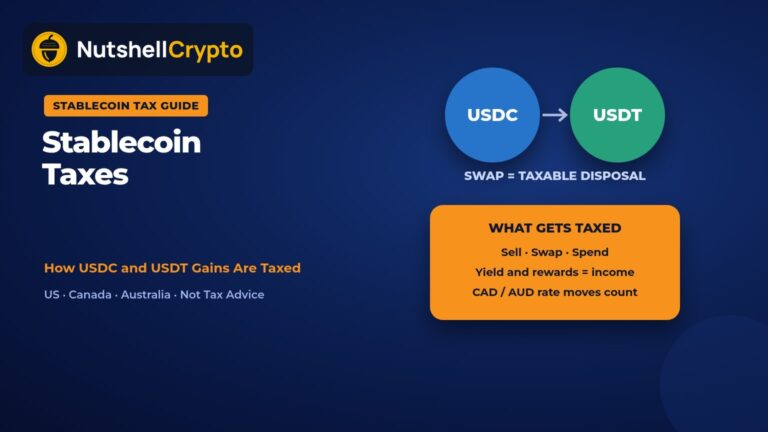
How Stablecoin Rewards Are Taxed
US: The IRS says in Revenue Ruling 2023-14 that staking rewards count as gross income at their fair market value when you gain control of them. Interest and rewards from stablecoin programs are generally treated as income too, and the IRS digital assets page says you must answer “Yes” to the digital asset question if you received digital assets as a reward. Coinbase says US customers who get more than $600 in USDC rewards receive a Form 1099-MISC.
Canada: The CRA says rewards from staking on a centralized platform are generally income when they are credited to your account. Lending-style rewards are generally income as well; how they are classified depends on your situation.
For more detail, see our guides to crypto staking taxes and cryptocurrency tax in Canada.
How to Evaluate a Stablecoin Staking Program
Use these questions before you deposit:
- Who pays the yield? Borrowers, traders, reserve income, a marketing budget or new tokens? If the platform cannot say clearly, walk away.
- Who holds the coins? A company (custodial) or a smart contract you control from your own wallet? Each brings different risks: insolvency versus code.
- What happens if the platform fails? Read the terms. Do you still own the coins, or do they become the platform’s property that you have a claim against?
- Which stablecoin is it? Check how it is backed and whether it publishes reserve reports. Our USDT vs USDC comparison shows the kinds of differences that matter.
- Is the rate fixed or variable, and can you withdraw at any time? Look for lockups, withdrawal limits and notice periods.
- Has the code been audited, and how long has it run? Older protocols with large deposits and public audits have had more testing, though that is still no guarantee.
- Is it allowed where you live? Many products block US or Canadian users for regulatory reasons. Using a VPN to get around that can break the terms and leave you with no protection.
- How much can you afford to lose? Keep only money you could live without in any yield product, and spread it out rather than putting everything on one platform.
If you decide to hold stablecoins yourself instead, our stablecoin wallet guide covers storage options.
FAQ
Can you stake USDT or USDC?
Not in the proof-of-stake sense. You can lend them, add them to a liquidity pool or put them in an earn program, which some apps call “staking.”
Is stablecoin staking risk-free because the price is stable?
No. The coin is designed to hold $1, but you still face platform failure, hacks, depegs, rate cuts and lockups.
Is stablecoin staking the same as liquid staking?
No. Liquid staking gives you a token for coins that really are staked on a proof-of-stake network, such as ETH. Stablecoin yield comes from lending, fees or protocol income.
Why do some apps offer much higher rates than others?
Higher rates usually mean higher risk: riskier borrowers, longer lockups, newer code or temporary token rewards. Very high, steady rates on a stablecoin are a warning sign.
Do I pay tax on stablecoin rewards?
In the US and Canada, rewards are generally taxable income when you receive them. Keep records of the date and value of every payout.
Sources
- Congress.gov: GENIUS Act text (S.1582)
- Congressional Research Service: The Stablecoin Yield Debate
- CNBC: Senate cloture vote on Clarity Act fails
- Justice Laws Website: Stablecoin Act (Canada)
- Canada Gazette, Part I: Proposed Stablecoin Regulations
- CSA Staff Notice 21-332 (OSC)
- SEC: Charges against Terraform and Do Kwon
- SEC: BlockFi settlement
- Reuters: Celsius files for bankruptcy
- Reuters: Voyager Digital files for bankruptcy
- Reuters: BlockFi files for bankruptcy
- Chainalysis: Euler Finance flash loan attack
- CNBC: USDC breaks dollar peg
- Coinbase Help: USDC Rewards overview
- Sky Protocol Docs: sUSDS
- DefiLlama: Yields
- IRS: Revenue Ruling 2023-14
- IRS: Digital assets
- CRA: Income from crypto-asset mining and staking
This article is for education only and is not financial, legal or tax advice. Stablecoin yields and rules change often; check current terms and get professional advice for your situation.