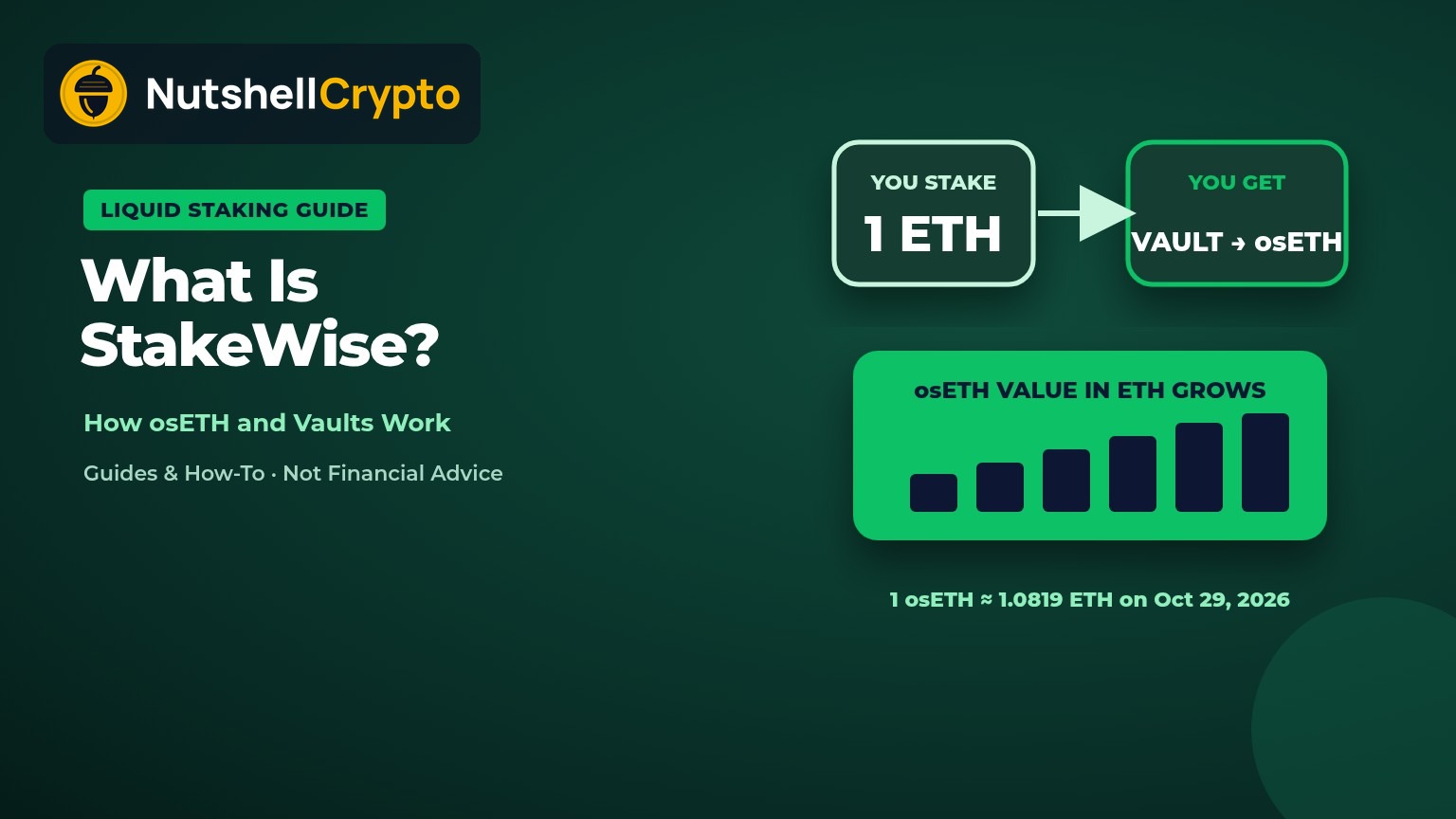
In a nutshell: StakeWise is a non-custodial liquid staking protocol for Ethereum and Gnosis Chain. You deposit ETH into a “Vault” run by a node operator, and you can mint osETH, a token that keeps earning staking rewards while you hold it or use it in DeFi. Each osETH slowly becomes worth more ETH: on October 29, 2026, 1 osETH was worth about 1.0819 ETH according to StakeWise’s own contract. You pay the Vault’s fee (set by each operator) plus a 5% StakeWise DAO fee on rewards if you mint osETH. The main risks are smart contract bugs, osETH trading below fair value, liquidation if you mint near the limit, and leverage risk if you use Boost. Educational only; not financial advice.
Last updated: October 29, 2026.
Most liquid staking protocols put everyone’s ETH into one big pool. StakeWise works differently: it is a marketplace of separate staking pools, called Vaults, each with its own operator, fee and track record. Its liquid staking token, osETH, sits on top of those Vaults.
Below: what StakeWise is, how Vaults and osETH work, fees, how to stake and unstake, Boost, the SWISE token, security, risks, and tax notes for the US, Canada and Australia. Live figures were pulled on October 29, 2026, at about 5:00 PM PKT.
Table of contents
- What is StakeWise?
- How StakeWise Vaults work
- What is osETH?
- StakeWise by the numbers
- How to stake ETH with StakeWise
- How to unstake
- StakeWise fees
- What is StakeWise Boost?
- StakeWise V2 (sETH2 and rETH2) is retired
- What is the SWISE token?
- StakeWise vs Lido vs Rocket Pool
- Security, oracles and the Balancer incident
- Risks of StakeWise staking
- US, Canada and Australia notes
- FAQ
What Is StakeWise?
StakeWise describes itself as “a non-custodial liquid staking protocol on Ethereum and Gnosis Chain” (StakeWise docs). Stakers deposit ETH (or GNO on Gnosis Chain) into Vaults, which are staking pools run by node operators, and can mint osToken: osETH on Ethereum and osGNO on Gnosis Chain.
The protocol has three parts: Vaults, where the staking happens; osToken, which gives you a liquid token; and Oracles, which report what is happening on Ethereum’s Beacon Chain back to the contracts. It is governed by holders of the SWISE token. If liquid staking is new to you, start with our guide to liquid staking or what staking is.
StakeWise offers three ways in, according to its docs:
- Simple Staking: deposit ETH in the app and osETH is issued to you automatically.
- Vault Staking: pick a specific Vault from the marketplace, based on its fee, MEV strategy and performance, then mint osETH if you want.
- Run your own Vault: for people and companies that want to stake for themselves or offer staking to others.
How StakeWise Vaults Work
A Vault is an isolated staking pool. When you deposit, the Vault gives you shares that represent your slice of its assets, and those shares grow in value as rewards come in. The shares themselves can’t be transferred, except in special ERC-20 Vaults (StakeWise docs: How Vaults Work).
Once a Vault collects 32 ETH, its operator registers a new validator. Each registration needs approval from 6 of the 11 StakeWise Oracles before the ETH goes to Ethereum’s deposit contract. New validators then wait in Ethereum’s own activation queue, which can take weeks or months when demand is high.
The key design point: “Each Vault stands on its own, so poor performance or a penalty in one Vault has no effect on stakers in the others” (StakeWise docs). That is different from Lido, where everyone shares the results of one large set of operators. The flip side is that your Vault choice matters: a poorly run Vault earns less, and its penalties hit its own stakers.
StakeWise has several Vault types: Standard, ERC-20, Private (whitelisted depositors only), Blocklist, and MetaVaults, which spread deposits across several sub-vaults (StakeWise docs: Vault Types).
What Is osETH?
osETH is the liquid token you can mint against ETH staked in a StakeWise Vault. It does not grow in number in your wallet. Instead, each osETH becomes worth more ETH over time as rewards build up, the same “value-accruing” design used by rETH and cbETH.
Three things make osETH different from most liquid staking tokens:
- It is minted like a loan. When you mint osETH, you take on a debt against your stake in the Vault. You can burn osETH at any time to repay that debt and withdraw your ETH (StakeWise docs: osToken Redemptions).
- It is overcollateralized. A Loan-to-Value (LTV) cap limits how much osETH you can mint. Standard Vaults allow up to 90% LTV, which leaves a 10% buffer. DAO-approved Vaults that meet strict performance rules and post a 5 million SWISE operator bond can go up to 99.99% (StakeWise docs: How osToken Works).
- Positions can be redeemed or liquidated. StakeWise grades each minting position as Healthy, Moderate, Risky or Unhealthy. A Risky position can be redeemed and an Unhealthy one liquidated. These grades don’t apply in DAO-approved Vaults.
The docs give a worked example: with 100 ETH staked in a 90% LTV Vault and an exchange rate of 1.05, you can mint at most 100 × 0.9 ÷ 1.05 = 85.71 osETH. With today’s rate of about 1.0819 ETH per osETH, the same 100 ETH would allow about 83.2 osETH in a Standard Vault.
The peg. osETH’s fair value is the protocol exchange rate. On the open market it can drift. StakeWise says it keeps osETH “soft-pegged” from both sides: if osETH trades at a premium, people can mint and sell it; if it trades at a discount, holders can redeem it for ETH at the exchange rate through an exit queue.
StakeWise by the Numbers (October 29, 2026)
| Metric | Value | Source |
|---|---|---|
| osETH exchange rate | 1 osETH ≈ 1.0819 ETH | OsTokenVaultController contract |
| osETH supply | ≈ 147,162 osETH | osETH token contract |
| osETH market price | ≈ $2,504.67 (ETH ≈ $2,322.75) | CoinGecko |
| osETH market value | ≈ $369 million | CoinGecko |
| StakeWise V3 total value locked | ≈ $892 million (Ethereum and Gnosis) | DefiLlama |
| osETH yield (DefiLlama pool) | ≈ 2.19% | DefiLlama Yields |
| osETH fee to StakeWise DAO | 5% of osETH rewards (500 basis points on-chain) | StakeWise docs, contract |
The market price implies about 1.078 ETH per osETH, slightly below the 1.0819 contract rate, so osETH was trading at a small discount (roughly 0.3%) at the time these prices were taken. Prices move constantly, and the CoinGecko and contract readings were taken a few minutes apart. Sources: Etherscan: OsTokenVaultController, CoinGecko, DefiLlama.
For scale, DefiLlama showed Lido at about $22.5 billion and Rocket Pool at about $1.13 billion at the same time. StakeWise is a mid-sized player. For how staking yields are quoted, see our explainer on staking APR vs APY.
How to Stake ETH With StakeWise
- Use the official app. Go to app.stakewise.io (linked from the StakeWise docs). Type the address yourself or use a bookmark; fake staking sites are a common scam.
- Connect a self-custody wallet such as a browser wallet or a hardware wallet. Keep some extra ETH for gas.
- Choose how to stake. On the main stake page, your ETH goes through a MetaVault that spreads deposits across sub-vaults (the docs say this is currently just the Genesis Vault), and osETH is minted for you automatically. Or pick a Vault from the marketplace and decide whether to mint osETH.
- Check the Vault details before confirming: its fee, its performance grade, and whether it is a Standard or DAO-approved Vault.
- Confirm the transaction and save a record of the date, the amount and the ETH price for tax purposes.
You can also skip the Vaults entirely and buy osETH on a decentralized exchange. In that case you pay the market price, which may be slightly above or below the exchange rate. For other ways to stake ETH, see how to stake Ethereum.
How to Unstake
If you minted osETH, you burn it to repay your debt and then withdraw your ETH from the Vault. The StakeWise SDK even has a single “burn and withdraw” action for this (StakeWise SDK docs). If the Vault doesn’t have enough idle ETH, your withdrawal joins the Vault’s exit queue and validators are exited to pay it, so the wait depends on Ethereum’s validator exit queue at that time. When it is ready, you claim the ETH.
If you only hold osETH that you bought, you can sell it on a DEX for an instant exit (at the market price) or enter the redemption exit queue to get ETH at the protocol exchange rate.
StakeWise Fees
StakeWise has two layers of fees (StakeWise docs: Fees):
- Vault fee: set by each Vault operator and taken from staking rewards. It can be anywhere from 0% to 100%. Operators can raise it only by 20% at a time (for example from 5% to 6%), with a 3-day delay between increases.
- osETH fee: the StakeWise DAO charges 5% of the rewards earned by osETH. It is added to the amount of osETH you owe back to the Vault, so it only applies if you mint.
The docs’ own example: Alice stakes 10 ETH in a Vault with a 5% fee and earns 0.4 ETH in a year. The Vault fee is 0.02 ETH, leaving her 0.38 ETH. If she also minted osETH, the extra 5% DAO fee brings her net rewards to 0.361 ETH. Compare that with Lido’s flat 10% fee in our Lido staking guide.
What Is StakeWise Boost?
Boost is a leveraged staking strategy built into StakeWise. It deposits your osETH as collateral on Aave, borrows ETH, stakes that ETH in the Vault, mints more osETH, and repeats. StakeWise says the loop reaches about 6x in Vaults with 90% osETH LTV and about 14x in Vaults with 100% LTV, and that over periods of 6+ months Boost has historically added about 1 to 3 percentage points on top of the base staking rate (StakeWise docs: How Boost Works).
Boost only pays when Ethereum staking yields are higher than Aave’s ETH borrowing rate. When borrowing costs more, the Boost APY turns negative and your debt grows faster than your collateral. StakeWise says Aave values osETH using StakeWise’s own price feed rather than market prices, and that Boost keeps a buffer between a 93% maximum LTV and a 95% liquidation threshold on Aave, with an automatic unboost at 94.5%. That lowers some risks, but it is still leverage. Historical returns don’t guarantee future ones.
StakeWise V2 (sETH2 and rETH2) Is Retired
If you staked with StakeWise before its current version, you may hold sETH2 and rETH2. StakeWise deprecated V2 and StakeWise Solo starting June 1, 2025: V2 stakes stopped earning rewards from then, though you can still withdraw (StakeWise blog). The fix is to connect your wallet to the app and use the Migrate button, which burns sETH2 and rETH2 and gives you osETH. To get ETH back, you migrate first and then unstake.
What Is the SWISE Token?
SWISE is StakeWise’s governance token. Holders vote on StakeWise Improvement Proposals, osETH fees, Oracle membership, the treasury and upgrades. Total supply is 1,000,000,000 SWISE: 510 million for the community, 251.5 million for investors, 217 million for the team and 21.5 million for future fundraising, with emissions starting April 1, 2021 (StakeWise docs: Tokenomics). You don’t need SWISE to stake. It is a separate, much riskier asset than osETH.
StakeWise vs Lido vs Rocket Pool
| StakeWise | Lido | Rocket Pool | |
|---|---|---|---|
| Token | osETH (minted against a Vault stake) | stETH / wstETH | rETH |
| Pool design | Many separate Vaults; you can choose one | One shared pool | One shared pool with bonded node operators |
| Protocol fee | Vault fee (0–100%) plus 5% on osETH rewards | 10% of rewards | Commission on rewards (14% max for rETH holders, per our guide) |
| TVL (DefiLlama, Oct 29, 2026) | ≈ $892 million | ≈ $22.5 billion | ≈ $1.13 billion |
More detail in our guides to Lido staking, Rocket Pool and Stader Labs.
Security, Oracles and the Balancer Incident
Audits. StakeWise lists audits of its V3 contracts by Halborn (May and August 2023), Sigma Prime (August 2023, June 2024 and September 2024), Consensys Diligence (March 2024), ABDK (September 2025) and Statemind (April 2026) (StakeWise docs: Audits). Audits reduce risk but never remove it.
Oracles. Each chain has 11 Oracles run by independent organizations approved by the DAO, and updates need 6 of 11 signatures. On Ethereum, the list includes Chorus One, Stake.fish, Telekom, Finoa Consensus Services, Bitfly, SenseiNode, Gateway.fm, the Gnosis Chain team, P2P, DSRV and StakeWise Labs (StakeWise docs: Oracles).
The Balancer exploit. On November 3, 2025, an attacker drained Balancer V2 pools, including the osETH-ETH pool. StakeWise said its DAO emergency multisig recovered about 5,041 osETH (about $19 million) and 13,495 osGNO (about $1.7 million), or 73.5% of the roughly 6,851 osETH stolen; the rest had already been swapped to ETH (DL News). StakeWise then proposed returning the funds pro rata to affected liquidity providers (StakeWise forum). The bug was in Balancer, not StakeWise. But the recovery worked because the DAO could mint and burn osETH, which StakeWise itself called a centralization risk and proposed removing in SWIP-37 (StakeWise forum: SWIP-37).
Risks of StakeWise Staking
- Smart contract risk: a bug in StakeWise, Aave (for Boost) or any DeFi app you use osETH in could lose funds.
- Vault and operator risk: because Vaults are isolated, a badly run Vault’s penalties and downtime fall on its own stakers.
- Liquidation and redemption risk: if you mint close to the LTV limit in a Standard Vault, your position can be redeemed or liquidated.
- Depeg risk: osETH can trade below its exchange rate on the market, especially in a sell-off.
- Leverage risk: Boost can lose money when Aave’s borrow rate is above the staking yield.
- Governance and oracle risk: the DAO and the 11 Oracles have real power over the protocol, as the Balancer recovery showed.
- Price risk: osETH tracks ETH. If ETH falls, your position falls in dollars no matter what the yield is.
US, Canada and Australia Notes
United States. The SEC’s Division of Corporation Finance said in August 2025 that, in its view, certain liquid staking activities and the receipt tokens they create are not securities offerings, based on specific facts (SEC). That is a staff statement, not a law. For taxes, IRS Revenue Ruling 2023-14 says staking rewards are income when you gain control of them (IRS). How that applies to a value-accruing token like osETH isn’t spelled out, so ask a tax professional.
Canada. The CRA says staking income may be business income or other income depending on your activity (CRA). Keep records of every deposit, mint, swap and withdrawal.
Australia. The ATO says staking rewards are generally ordinary income at the time you receive them, valued in Australian dollars, and reported as other income; when you later dispose of those tokens, capital gains tax can apply (ATO). Swapping ETH for a liquid staking token can also be a disposal, so check how your situation is treated. For the bigger picture, see our crypto staking taxes guide.
FAQ
Is StakeWise safe?
No staking protocol is risk-free. StakeWise has been running since 2021, has had several audits, and isolates each Vault. But smart contract bugs, osETH depegs, liquidations and governance decisions can still cost you money.
What is the difference between StakeWise and osETH?
StakeWise is the protocol. osETH is the liquid token you can mint against ETH staked in a StakeWise Vault on Ethereum.
Does osETH increase in my wallet?
No. Your osETH balance stays the same, but each osETH is worth more ETH over time. It was about 1.0819 ETH on October 29, 2026.
What happened to sETH2 and rETH2?
They are StakeWise V2 tokens, which stopped earning rewards on June 1, 2025. You can migrate them to osETH in the StakeWise app.
How much does StakeWise charge?
The Vault’s own fee (0% to 100%, set by each operator) plus 5% of osETH rewards to the StakeWise DAO if you mint osETH.
Sources
- StakeWise Docs: What is StakeWise
- StakeWise Docs: How Vaults Work
- StakeWise Docs: Vault Types
- StakeWise Docs: How osToken Works
- StakeWise Docs: osToken Redemptions
- StakeWise Docs: Fees
- StakeWise Docs: How Boost Works
- StakeWise Docs: Oracles
- StakeWise Docs: Tokenomics
- StakeWise Docs: Audits
- StakeWise blog: Deprecation of StakeWise V2 and Solo
- Etherscan: OsTokenVaultController
- Etherscan: osETH token
- CoinGecko: StakeWise Staked ETH (osETH)
- DefiLlama: StakeWise V3
- DefiLlama: Lido
- DefiLlama: Rocket Pool
- DL News: StakeWise recovers funds from Balancer hacker
- StakeWise forum: SWIP-37
- SEC: Statement on Certain Liquid Staking Activities
- IRS: Revenue Ruling 2023-14
- CRA: Income from crypto mining and staking
- ATO: Staking rewards and airdrops
This article is for education only and is not financial, tax or legal advice. osETH rates, yields, StakeWise fees and Vault terms can change; check StakeWise’s official app and docs before staking.