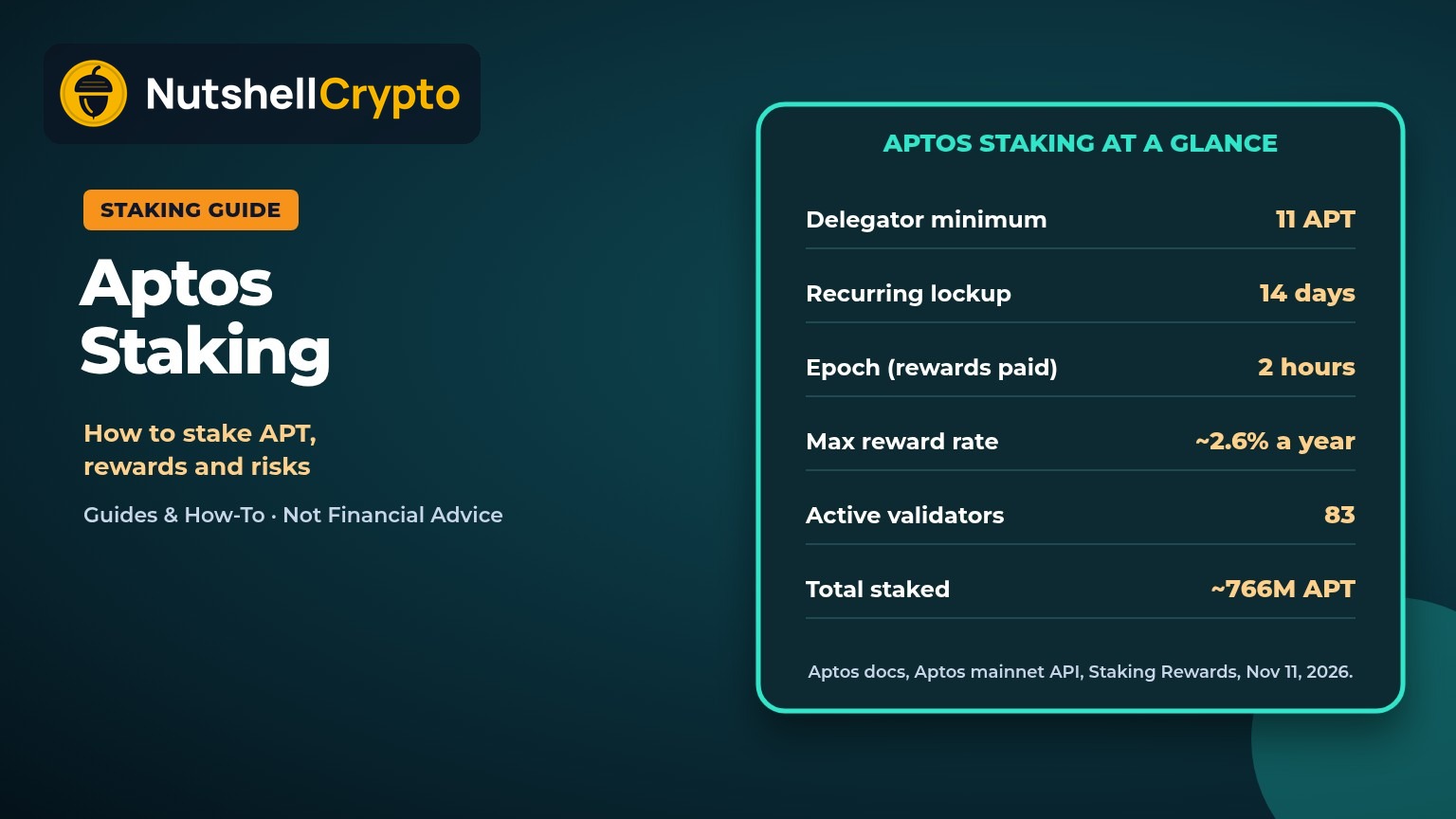
In a nutshell: Aptos staking means delegating APT to a validator’s delegation pool, usually from 11 APT, to earn a share of the network’s rewards minus the validator’s commission. On November 11, 2026, the live Aptos chain showed a maximum reward rate of about 2.6% a year, a 14-day recurring lockup and 2-hour epochs, so unstaked APT can take up to 14 days to come back. Educational only; not financial advice.
Aptos staking is simpler than it looks. You never hand your APT to anyone: the coins stay tied to your own wallet address, a validator does the work, and rewards are added to your stake every two hours. The catch is the lockup cycle, which decides when you can actually withdraw.
This guide covers how Aptos staking works, the live numbers we pulled from the Aptos mainnet API on November 11, 2026 (checked between about 6:34 and 6:40 PM PKT), how to stake APT with Petra and the Aptos Explorer, liquid staking with Amnis and Thala, the unlock and withdraw steps, risks, and short tax notes for the US, Canada and Australia.
Table of contents
What Is Aptos Staking?
Aptos is a proof-of-stake blockchain. Validators lock up APT to take part in consensus, and the Aptos staking docs say each validator’s vote weight, and its reward, is proportional to its stake. The same docs note that slashing is not currently implemented on Aptos. If you are new to the idea, start with our guide to what staking in crypto is.
Running a validator yourself takes at least 1 million APT, which is out of reach for most people. That is why ordinary holders use delegated staking: you add your APT to a pool run by a validator operator, and the pool stakes everyone’s coins together.
How Delegation Pools Work
The Aptos delegated staking docs describe a delegation pool as a smart contract that collects stake from many delegators and adds it to one validator’s stake pool. A few points matter for you as a delegator:
- Minimum stake. The delegation pool operations page says you can delegate as little as 10 APT plus a small add-stake fee that is mostly refunded as rewards at the end of the epoch, and that some apps use 11 APT as a round minimum. The Aptos Foundation’s delegated staking announcement also gives 11 APT.
- Pools must be active. A pool only earns rewards once it holds 1 million APT in total and its validator has joined the active set.
- Four actions. Delegators can add stake, unlock stake, reactivate stake (cancel an unlock) and withdraw stake.
- Commission. Each pool has an operator commission that comes out of your rewards. Owners can change it, but the docs say a change must be requested at least 7.5 days before the current lockup cycle ends and only applies after that cycle.
- Self-custody. The pool is permissionless, and the Aptos Foundation describes delegated staking as keeping ownership of APT in your own wallet.
Aptos Staking Numbers on November 11, 2026
We read these values straight from the Aptos mainnet REST API (the on-chain 0x1::staking_config, 0x1::stake and 0x1::block resources) at about 6:34 to 6:37 PM PKT on November 11, 2026. The docs list the same minimum, maximum, lockup and epoch values.
| Setting | Live value |
|---|---|
| Delegator minimum | 10 APT plus add-stake fee (apps often say 11 APT) |
| Validator minimum stake | 1,000,000 APT |
| Validator maximum stake | 50,000,000 APT |
| Recurring lockup | 1,209,600 seconds (14 days) |
| Epoch length | 7,200 seconds (2 hours) |
| Maximum reward rate | about 2.6% a year (also the current floor) |
| Active validators | 83 |
| Active stake (voting power) | about 766.3 million APT |
Of the 83 active validators, 49 were delegation pools that anyone can join. We queried each pool’s commission on-chain: it ranged from 2% to 12% for all but one pool, which charged 100% (meaning delegators there get no rewards), and 10% was the most common rate, used by 18 pools. You can browse the pools, their commission and delegator counts on the Aptos Explorer delegation nodes page.
Staking Rewards showed the same 766.29 million APT staked on November 11, which it put at a 63.26% staking ratio, with a 2.6% reward rate and 1.97% inflation. CoinGecko priced APT at about $0.574 (C$0.818, A$0.838) at about 6:34 PM PKT.
Aptos Staking Rewards and APY
The staking docs give the reward formula: staked amount times the reward rate per epoch, times the share of the validator’s block proposals that succeeded. Rewards are paid every epoch (every 2 hours) and added to your stake, so they compound automatically. For a delegator, the pool’s commission is taken off before your share is added.
The rate itself has fallen a lot since launch. AIP-30 described a starting maximum of 7% a year with a yearly 1.5% decrease, and AIP-119 (2025) cut it faster, from 6.79% toward about 5.2%. On November 11, 2026, the chain’s live rewards config worked out to about 2.6% a year, with the minimum rate set to the same value. Coinbase’s Aptos page and Staking Rewards both showed 2.60%. Some older guides, such as StakeAptos.com‘s FAQ, still say about 7%, so check the date on anything you read.
As a rough example, 1,000 APT in a pool charging 10% commission, with a validator that lands all its proposals, would earn about 2.6% × 0.9 = 2.34%, or about 23.4 APT in a year if nothing changed, which is worth roughly $13 at the November 11 price. To try your own figures, enter the Aptos rate into our Chainlink staking calculator, which works for any yearly rate, and see our guide to staking APR vs APY for why the headline numbers differ.
How to Stake APT Step by Step
Option 1: Petra wallet and the Aptos Explorer
Petra is the wallet built by Aptos Labs, and its site says it lets you stake and manage APT rewards through native staking. The Aptos Foundation says you can stake directly in the Aptos Explorer. The usual flow:
- Install Petra and fund it with more than 11 APT, so you have a little left over for gas.
- Open the Delegation Nodes tab in the Aptos Explorer and compare pools by commission, rewards earned and delegators.
- Open a pool, click Connect Wallet and pick Petra.
- Click Stake, enter the amount and approve the transaction in Petra.
- Your stake becomes active from the next epoch, within about 2 hours, and rewards are added each epoch after that.
Validator sites run the same contract with their own front end. For example, Stakin’s Petra guide walks through the same steps with an 11 APT minimum (its note about a 30-day lock is out of date; the live lockup is 14 days). Other providers such as Figment and nodes.guru also run Aptos validators.
Option 2: A Ledger
If you keep APT on a hardware wallet, you can connect it through a wallet that supports Ledger and sign the stake on the device. Our Ledger staking guide explains how staking from a hardware wallet works in general.
Option 3: An exchange
Exchange support varies by country and changes often. When we checked on November 11, 2026, Coinbase’s Aptos staking page said “Aptos staking is not supported by Coinbase”, although it pointed eligible customers to a separate DeFi yield product. If your exchange offers APT staking, read its terms: the exchange holds your coins, picks the validator and takes its own cut. Our flexible vs locked staking guide explains the trade-off.
Unlocking and Withdrawing: the 14-Day Cycle
Aptos does not have a fixed “unbonding period” that starts when you click unstake. Instead, each pool runs on a recurring lockup cycle, which was 14 days on November 11, 2026, and renews automatically. The delegated staking docs explain what that means for you:
- You can request an unlock at any time.
- Unlocked APT only becomes withdrawable when the pool’s current lockup cycle ends, so the wait is anywhere from a few hours up to 14 days, depending on where the pool is in its cycle.
- Unlocked APT keeps earning rewards until it becomes withdrawable.
- Once the cycle ends, you send a separate withdraw transaction to move the APT back to your spendable balance.
- Before the cycle ends, you can reactivate the stake to cancel the unlock.
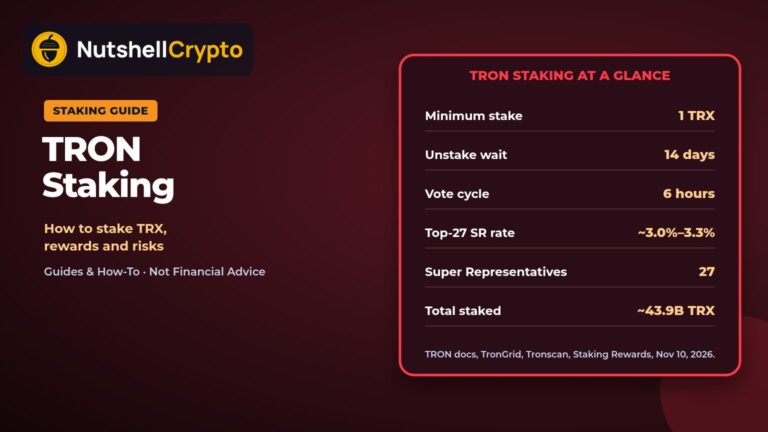
Our explainer on what an unbonding period is compares this wait with other chains, such as Sui, where unstaking is close to immediate, and the 14-day wait in our TRON staking guide.
Liquid Staking on Aptos: amAPT and sthAPT
Liquid staking gives you a token that represents your staked APT, so you can trade it or use it in DeFi instead of waiting for the lockup. Our liquid staking guide explains the general idea and risks. The two largest Aptos options by value locked on DefiLlama were:
- Amnis Finance. The Amnis docs describe two tokens: amAPT, which stays pegged 1:1 to APT, and stAPT, which collects the staking yield. DefiLlama showed about $2.72 million locked on Aptos on November 11, 2026.
- Thala LSD. The Thala docs describe thAPT, a 1:1 deposit receipt, and sthAPT, which accrues validator rewards. DefiLlama showed about $1.31 million locked.
Both totals are small, so selling a liquid staking token quickly may mean accepting a price below 1 APT. Smaller listed protocols, such as TruStake, held about $1.15 million.
Risks of Aptos Staking
- Price risk. A yield of about 2.6% does little if the APT price falls, and you may wait up to 14 days to withdraw.
- Validator performance. Rewards scale with the share of successful proposals, so a poorly run validator pays less. A pool that drops below 1 million APT or leaves the active set earns nothing.
- Commission. Commission takes a slice of every reward. On November 11, one active pool charged 100%, so always check before you stake.
- Falling rates. Governance has already cut the rate from 7% to about 2.6%, and it can change it again.
- Smart-contract and depeg risk. Liquid staking adds protocol risk and the chance that the token trades below APT.
- Wallet risk. Anyone with your recovery phrase can unlock and withdraw your stake. Never share it, and ignore anyone offering to “speed up” a withdrawal.
Slashing is not implemented on Aptos according to the official docs, but rewards are never guaranteed.
US, Canada and Australia Tax Notes
This section is general information, not tax advice. We found no IRS, CRA or ATO page that deals with Aptos specifically, so please confirm with a qualified tax professional. For the full picture, see our crypto staking taxes guide.
United States: the IRS says to answer “Yes” to the digital asset question on your return if you received digital assets from staking, and that staking income is reported on Schedule 1 (IRS digital assets). Revenue Ruling 2023-14 says validation rewards are included in gross income in the year you gain dominion and control over them, meaning the ability to sell, exchange or otherwise dispose of them (Rev. Rul. 2023-14). Aptos rewards are added to your stake every epoch but stay subject to the lockup, so when you gain control is a question for your tax professional.
Canada: the CRA says rewards from staking on a centralized exchange are generally income when they are credited to your wallet on the platform, and that business income from staking has its own rules (CRA: mining and staking income). That page does not address delegating from your own wallet. More in our Canada crypto tax guide.
Australia: the ATO’s crypto asset guidance, in its section on acquiring and disposing of crypto assets, treats the value of tokens you receive as staking rewards as ordinary income when you receive them, and that value becomes their cost base for capital gains when you later dispose of them. Values are recorded in Australian dollars; at about 6:34 PM PKT on November 11, 2026, CoinGecko priced APT at about A$0.84.
FAQ
What is the minimum to stake APT?
10 APT plus a small add-stake fee for a delegation pool, according to the Aptos docs. Most apps ask for 11 APT. Running your own validator needs 1 million APT.
How long does it take to unstake APT?
Up to 14 days. Unlocked APT becomes withdrawable at the end of the pool’s current 14-day lockup cycle, then you send a withdraw transaction. You can reactivate it before then.
What is the Aptos staking APY?
On November 11, 2026, the on-chain maximum was about 2.6% a year before commission, and Staking Rewards and Coinbase also showed 2.60%. What you actually get depends on the pool’s commission and validator performance.
How often are Aptos staking rewards paid?
Every epoch, which is 2 hours on mainnet. Rewards are added to your stake and compound automatically.
Can I stake APT on Coinbase?
Not when we checked on November 11, 2026: Coinbase’s page said Aptos staking is not supported. Petra with the Aptos Explorer, or a validator’s own staking page, are the main routes.
Is Aptos staking taxable?
In the US, Canada and Australia, staking rewards are generally treated as income, and selling later can trigger gains or losses. Check the country sections above and confirm with a tax professional.
Sources: Aptos docs, Aptos mainnet REST API, Aptos Explorer, Aptos Foundation, Aptos Improvement Proposals, Petra, Coinbase, Staking Rewards, DefiLlama, Amnis, Thala, CoinGecko, IRS, CRA and ATO, all checked on November 11, 2026. Rates, fees and rules change. This article is for education only and is not financial or tax advice.