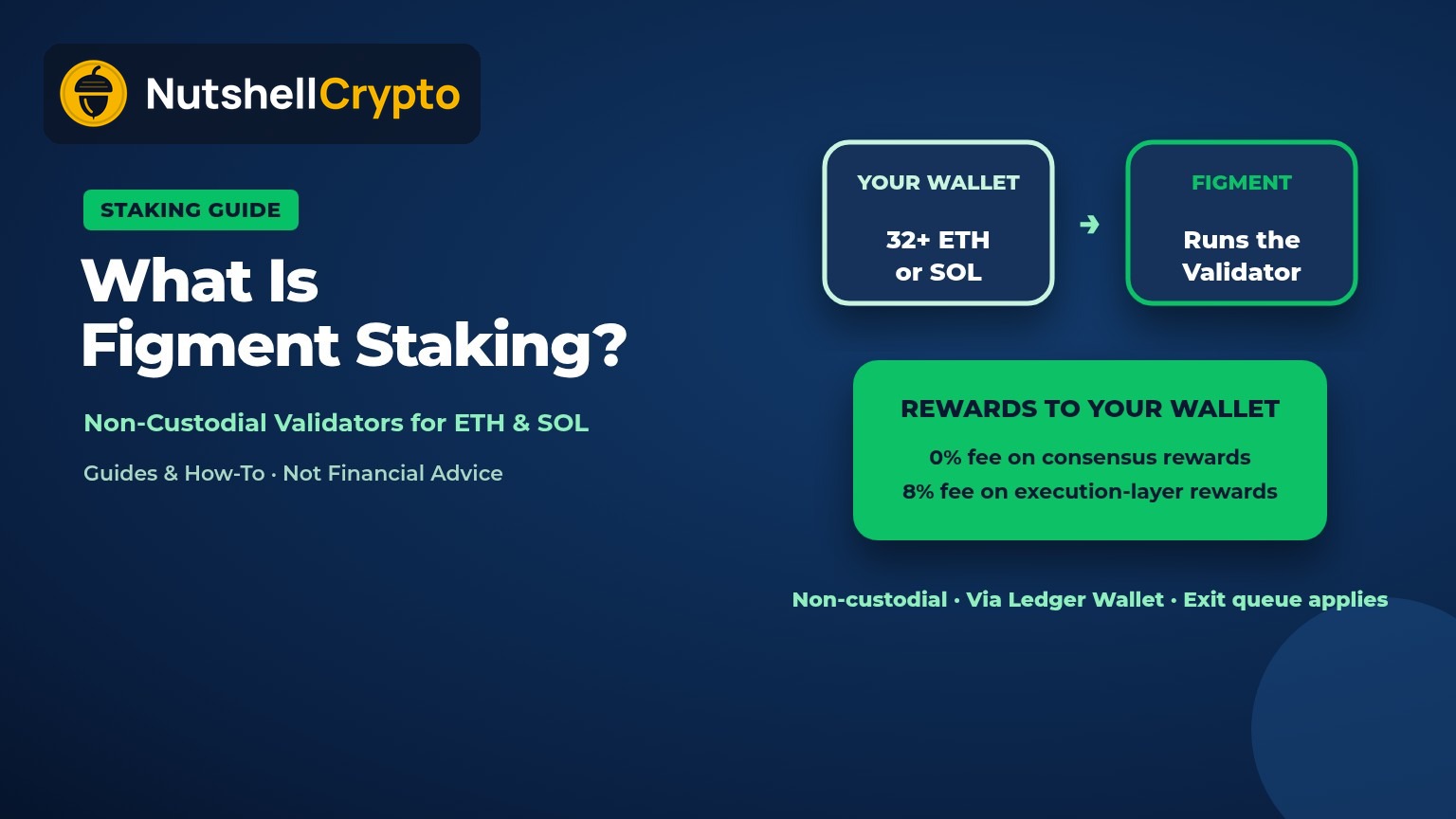
In a nutshell: Figment is a Toronto-founded staking infrastructure company, not a coin or a token. It runs validators on 30+ proof-of-stake networks for more than 1,500 institutional clients, and says it never takes custody of their assets. Retail users mostly meet it inside Ledger Wallet (formerly Ledger Live), where you can stake ETH with Figment from 32 ETH into your own validator, with Figment taking 8% of execution-layer rewards only, and stake SOL with the “Ledger by Figment” validator. Rewards are not guaranteed, and exits depend on Ethereum’s queue. Educational only; not financial advice.
Last updated: November 2, 2026.
“Figment staking” is a search that usually starts inside another app. You open Ledger Wallet, tap Stake on your Ethereum or Solana account, and Figment shows up as one of the providers. Or you read that an ETF or a bank stakes through Figment and want to know what that company actually does with the coins.
This guide covers what Figment is, how its validators work, how ETH staking with Figment through Ledger works step by step, what Figment charges, how unstaking works, the risks, how it compares with Kiln, stakefish and Lido, and short tax notes for the US, Canada and Australia. Figures come from Figment’s website, docs and reports and from Ledger’s support pages, checked on November 2, 2026, at about 1:50 PM PKT.
Table of contents
What Is Figment?
Figment is a company that runs validators, the always-online servers that propose and check blocks on proof-of-stake blockchains, on behalf of token holders. Its home page calls it the “largest non-custodial staking provider globally” and says more than 1,500 institutional clients across 30+ protocols use it “without ever transferring custody of their assets” (Figment). Those clients are asset managers, exchanges, wallets, custodians, foundations and large holders. If the idea of staking is new, read what staking in crypto is first.
Figment launched in 2018 and is based in Toronto (Forbes). Its co-founders include CEO Lorien Gabel. In December 2021 it raised a $110 million Series C led by Thoma Bravo at a $1.4 billion post-money valuation, with backers such as Morgan Stanley’s Counterpoint Global, Franklin Templeton and Two Sigma (Business Wire). Figment does not have its own token.
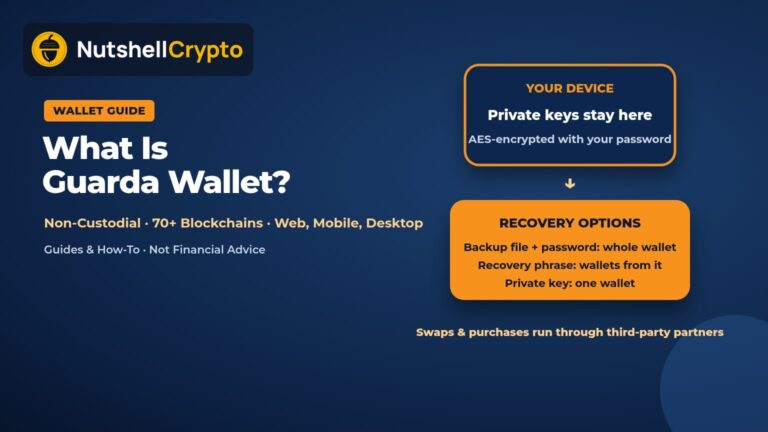
The word that matters most for users is non-custodial. Figment’s FAQ says: “Your tokens remain on the blockchain, under the control of your private key. Figment never takes custody of your tokens.” Delegated tokens are bonded to a Figment-run validator, but the keys that move the coins stay with you or your custodian. That is the opposite of staking on an exchange, where the platform holds your coins (compare custodial wallets).
Figment by the Numbers
These are company-reported figures except where noted, as of the dates shown.
| Metric | Figure | Source |
|---|---|---|
| Assets under stake | Over $18 billion (as of October 28, 2025) | Figment press release |
| Institutional clients | 1,500+ (as of November 2, 2026) | Figment home page |
| Protocols supported | 30+ | Figment home page |
| Share of all staked ETH on Figment validators | 6.53% in Q3 2026 (Q2 2026: 6.26%) | Figment Q3 2026 report |
| Average ETH staking reward rate | 2.69% in Q3 2026 vs 2.63% network average | Figment Q3 2026 report |
| Validator participation rate | 99.99% in Q3 2026 vs 99.66% network | Figment Q3 2026 report |
| Double-sign slashing events | 0 in Q3 2026 (network: 21) | Figment Q3 2026 report |
| Ledger Wallet ETH fee | 8% of execution-layer rewards | Figment docs |
The $18 billion figure comes from Figment’s October 2025 Coinbase Prime announcement, which also said the Coinbase Prime integration alone had enabled over $2 billion in staked assets (Figment). The Ethereum figures are from Figment’s own Q3 2026 Ethereum validator report, published October 15, 2026, which uses internal analytics. Treat reward rates as past results; they change every quarter.
How Figment Validators Work
On any proof-of-stake chain, a validator locks up coins as a bond and earns rewards for doing its job correctly. Figment runs the hardware, software and keys for the validator, while the staker keeps control of the funds. On Ethereum, that means the validator’s withdrawal address is set to your wallet; on networks like Solana, Cosmos or Cardano, you delegate from your own wallet and can undelegate later.
Figment describes a “Safety Over Liveness” approach: it prefers a validator going briefly offline to the risk of signing twice, because double signing is what gets validators slashed (Figment Q3 2026 report). Its validator page says clients are covered against slashing, missed rewards and downtime through “multi-tiered coverage, including insurance and Figment’s balance sheet” (Figment Validators). The exact terms depend on the client agreement.
Figment also leans on outside audits. In February 2026 it announced Full Certification under the Node Operator Risk Standard (NORS) for Ethereum, an independent framework covering slashing prevention, validator diversity and key management, and said it was the first entity in North America and Europe to complete it. The same release lists SOC 1 Type I, SOC 2 Type II and ISO 27001 among its other certifications (Business Wire, February 4, 2026). The NORS directory lists Figment’s certification date as January 16, 2026 (NORS).
Most of Figment’s business is behind the scenes. Through its Coinbase Prime integration, Figment says it supported Grayscale’s launch of the first US ETH exchange-traded product with staking (Figment). In Canada, Figment was picked as the primary staking provider for the 3iQ Solana Staking ETF on the TSX (Business Wire, April 15, 2025). Institutions without 32 ETH chunks can use Figment Vaults, which Figment’s support center says have no minimum but are for institutions only (Figment support).
Staking ETH With Figment in Ledger Wallet
Figment joined Ledger Live in March 2024, with a 32 ETH minimum and an 8% fee on rewards from May 1, 2024 (Ledger blog). Ledger says each user gets a dedicated smart contract rather than a shared pool, and the validator’s address stays set to your wallet. Ledger’s current tutorial (updated May 13, 2026) lists the steps (Ledger support):
- Open Ledger Wallet and connect your Ledger device.
- Go to Discover and pick Figment, or open your Ethereum account, tap Stake and choose Figment.
- Pick the Ethereum tab and enter the amount (at least 32 ETH).
- Sign an off-chain message to prove you own the address. Ledger says this message is not broadcast and costs no network fee.
- Review the details, open the Figment app on your device, and confirm the deposit on the device screen.
After that, your ETH waits in Ethereum’s activation queue, which Ledger says “can span days to weeks,” and earns nothing until the validator is active. Figment’s queue data shows how long that can be: about 2 million ETH were waiting to activate in early September 2026, roughly a 35-day wait.
Two details are easy to miss. First, since November 6, 2025, Figment deposits into the newer Pectra (0x02) validators, which compound consensus rewards up to 2,048 ETH and let you top up or withdraw part of the balance once active. Any amount above 32 ETH works, not only multiples of 32 (Figment Ledger FAQ). Ledger’s tutorial still describes multiples of 32, so check what the app shows. Second, US users who don’t have 32 ETH can’t fall back on Ledger’s pooled option: Ledger says “for legal reasons, US-based users cannot use the pool staking service through Ledger Wallet.” Our Ledger staking guide covers all the Ledger options, and how to stake Ethereum covers the routes outside Ledger.
Figment Fees
Figment’s fee works differently from a flat cut of all rewards. Ethereum validators earn two kinds of reward: consensus-layer (CL) rewards issued by the protocol for attesting and proposing, and execution-layer (EL) rewards from priority fees and MEV when the validator proposes a block. According to Figment’s docs, it takes “no cut from CL rewards” and only takes a fee on EL rewards, through a smart contract unique to your wallet that splits EL payments between you and Figment (Figment Ledger FAQ).
Figment says the split is set so its fee works out to 8% over time, but at any moment it can look different: 0% if your validator hasn’t proposed a block yet, or above 8% right after a lucky block. Figment explains that it avoids taking a cut of CL rewards because doing so would mean pointing your withdrawal credentials at its contract, which would give it control of your funds.
For scale, Figment’s Q3 2026 report says about 95% of validator rewards came from the consensus layer and 5% from the execution layer. Institutional clients negotiate their own terms, and Figment’s white-label product lets partners set their own fees, so the fee you see in a partner app may differ.
Solana and Other Networks
On Solana, Ledger Wallet lists a “Ledger by Figment” validator: you open your Solana account, choose Earn Rewards, select Ledger by Figment and delegate an amount from your wallet (Ledger). Your SOL stays in a stake account controlled by your wallet. The app shows the validator’s commission before you confirm. Figment’s own home page says institutions trust it with “the largest share of staked ETH and SOL of any non-custodial provider.”
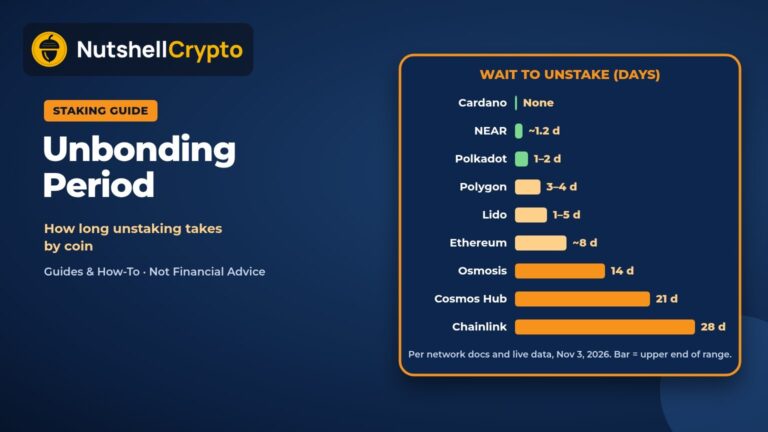
Beyond ETH and SOL, Figment’s October 2025 announcement listed networks such as Sui, Aptos, Avalanche, Cardano, Celestia, Cosmos, NEAR and Polkadot for Coinbase Prime clients. Unbonding times differ by network; Figment’s FAQ puts them at “0-28 days.”
How Unstaking Works
Figment’s docs split Ethereum unstaking into two parts (Figment Ledger FAQ):
- Exit. The validator enters Ethereum’s exit queue and keeps earning while it waits. Usually a few days, but up to a few weeks when many validators leave at once. You can’t exit until about 27 hours after the validator activates.
- Withdrawal. The validator has stopped earning and waits for the protocol to sweep its balance back to your wallet, which takes 1 to 10 days.
Queues can move fast. Figment’s Q3 2026 report says Ethereum caps entries and exits at roughly 57,600 ETH a day each, and that after MetaMask’s staking security incident at the end of September 2026, the exit queue peaked near 851,000 ETH on October 2, with waits going from under four days to nearly two weeks. Figment says its own validators were not affected. On Solana, deactivation happens at the end of an epoch, then you withdraw.
Figment vs Kiln, stakefish and Lido
| Figment | Kiln | stakefish | Lido | |
|---|---|---|---|---|
| What it is | Validator operator, institution-focused | Validator operator and staking API | Validator operator | Liquid staking protocol |
| Retail ETH route | Ledger Wallet, 32 ETH+ | Ledger pool from 0.05 ETH (not for US users) or 32 ETH | Own app, 32 ETH validators | Any amount, get stETH |
| Fee model | 8% of EL rewards only | 12% of pooled rewards on Ledger | Takes a share of EL rewards (see guide) | 10% of rewards |
| Liquid token? | No | Optional, depends on partner | No | Yes (stETH) |
The short version: Figment and Kiln both sell infrastructure to institutions and both appear in Ledger Wallet, but Kiln also runs the small-amount pool there. Our stakefish guide explains its execution-layer fee in detail. Lido and other liquid staking protocols such as StakeWise give you a tradable token instead of a dedicated validator, which adds smart contract and depeg risk but avoids the 32 ETH minimum. Fee figures for the other providers come from our earlier guides and can change.
Risks
- Slashing. Figment’s FAQ says most networks slash validators for double signing, “sometimes permanently in the case of Ethereum,” and that long downtime can cost missed rewards. Figment reports zero double-sign slashing in Q3 2026, but past results don’t guarantee the future.
- Lockups and queues. Your ETH earns nothing while waiting to activate, and exits can take weeks when the queue is full. Unbonding on other networks can run up to 28 days.
- Provider and signing risk. Non-custodial doesn’t mean risk-free. Read what you sign on your device screen, and only reach Figment through Ledger Wallet or figment.io, not links from ads or messages.
- Smart contract risk. The EL fee-split contract is small, but it is still a contract.
- Price risk. Rewards are paid in ETH or SOL, so a price fall can outweigh the yield. Compare reward figures on our staking APR explainer.
- Concentration. Figment’s validators held 6.53% of staked ETH in Q3 2026. Large shares held by a few operators are a known decentralization concern.
US, Canada and Australia Tax Notes
United States: the IRS says staking rewards count as gross income in the year you gain “dominion and control” over them (IRS Rev. Rul. 2023-14). With Pectra validators, consensus rewards compound on the validator until you withdraw, so ask a tax professional when that counts as income.
Canada: the CRA treats crypto received from staking as income, either business income or other income depending on your situation (CRA).
Australia: the ATO says staking rewards are ordinary income when received, valued in AUD, and selling them later is a CGT event (ATO). Figment’s rewards chart can export history as CSV or JSON, which helps you record the AUD value of each reward.
More detail is in our crypto staking taxes guide. This is general information, not tax advice.
FAQ
Is Figment staking safe?
Figment is non-custodial, has run validators since 2018, holds NORS, SOC 2 Type II and ISO 27001 certifications, and offers slashing coverage. Slashing, queue delays, signing mistakes and price swings are still real risks.
Does Figment have a token?
No. Figment is a company that runs staking infrastructure; it has no coin of its own.
What is the minimum to stake ETH with Figment?
32 ETH through Ledger Wallet or the Figment app. Figment Vaults have no minimum but are only for institutions.
How much does Figment charge?
Through Ledger Wallet, 8% of execution-layer rewards and nothing on consensus-layer rewards, per Figment’s docs. Institutional terms vary.
Is Ledger by Figment the same as Figment?
Ledger by Figment is a Solana validator offered in Ledger Wallet through Ledger’s collaboration with Figment. Figment runs the validator; your SOL stays in your wallet’s stake account.
Sources: Figment website, docs and Q3 2026 report (checked November 2, 2026), Ledger blog and support, Business Wire, Forbes, NORS, IRS, CRA, ATO. Staking involves risk; this article is for education only and is not financial or tax advice.