In a nutshell: Everstake is a staking provider that runs validators on more than 130 networks. You delegate coins like ETH, SOL, ADA or ATOM to its validators, and it takes a cut of your rewards: 10% on ETH, 7% on SOL, 4% on ADA and 8% on ATOM. Wallets like Trezor Suite and Exodus use Everstake behind the scenes. Educational only; not financial advice.
Everstake staking means delegating your proof-of-stake coins to validators run by Everstake, a company founded in 2018, so you earn staking rewards without running a node yourself. You can stake directly through Everstake’s dashboard or through a wallet that partners with it, such as Trezor Suite or Exodus. Everstake’s fee comes out of your rewards, never your principal.
This guide covers what Everstake is, how staking with it works, the fees and minimums for ETH, SOL, ADA and ATOM (checked on November 20, 2026, on Everstake’s own pages), how unstaking works, the risks people raise on Reddit, and short tax notes for the US, Canada and Australia.
Table of contents

What Is Everstake?
Everstake is a staking infrastructure company. Its About page says it was founded in 2018 by blockchain engineer Sergii Vasylchuk, supports more than 130 networks, secures more than $7 billion in staked value and has paid out more than $700 million in rewards. It lists 99.98% observed uptime and certifications including SOC 2 Type II and ISO 27001. The Everstake homepage claims more than 1.6 million delegators.
Everstake serves both big institutions and regular holders. Most retail users never visit its site: they stake from a wallet that sends their coins to Everstake’s validators. If you’re new to the idea, our guide to what staking in crypto is explains validators, rewards and lock-ups first.
How Everstake Staking Works
On proof-of-stake blockchains, validators confirm transactions and earn rewards. Running one takes hardware, uptime and, on Ethereum, 32 ETH per validator. Everstake runs the validators, and you “delegate” your stake to them. The network pays rewards, and Everstake keeps a percentage as its fee.
How your coins are held depends on the chain:
- Solana, Cardano and Cosmos: you delegate from your own wallet. Everstake’s Cardano page says the ADA “never leaves the delegator’s wallet”, and its Cosmos and Solana pages say Everstake “can never access or move the funds”.
- Ethereum: amounts below 32 ETH go into Everstake’s staking smart contract, which pools deposits and launches a new validator each time 32 ETH is reached. Everstake calls this non-custodial, but your ETH sits in its contract rather than in your wallet. More on that in the risks section.
Everstake Fees, Minimums and Rewards
Each network has its own fee and rules. These figures come from Everstake’s network pages, checked on November 20, 2026. APR figures move with network conditions, so treat them as a snapshot, not a promise.
| Coin | Everstake fee | Minimum | APR shown | Unstaking |
|---|---|---|---|---|
| ETH | 10% of rewards | 0.01 ETH | 3.4% to 10% | Exit and withdrawal queues (table shows 11 days) |
| SOL | 7% of rewards | 1 SOL per stake account | 4.87% | Next epoch (about 1 day) |
| ADA | 4% margin | 2 ADA plus fees (4 ADA suggested) | 1.84% | No lock-up |
| ATOM | 8% of rewards | Not stated | 15.43% | 21 days |
Sources: Everstake’s Ethereum, Solana, Cardano and Cosmos staking pages.
A few details matter more than the headline APR:
- Fees come from rewards only. Everstake says its commission is never taken from the coins you delegate.
- ETH’s 10% fee is charged at withdrawal. Everstake’s ETH page says the APR shown doesn’t include the fee, which “applies to staking rewards only at the time of withdrawal”. Rewards are re-staked automatically, so they compound.
- Solana has a small setup cost. A new stake account needs a network fee of about 0.000005 SOL and a refundable rent reserve of about 0.00167 SOL.
- Cardano is slow to start. Rewards are paid every 5-day epoch, but the first one arrives about 20 days after you delegate.
- Cosmos rewards need claiming. You claim ATOM rewards in your wallet or set up auto-compounding with Restake.app, according to Everstake.
To see what an APR means in coins, try our staking rewards calculator, and read how staking APR works to see why APR and APY differ.
Staking ETH with Everstake
Ethereum is Everstake’s biggest retail product. Its ETH page showed 1,204,771 ETH delegated on November 20, 2026, and three plans: from 0.01 ETH for anyone, from 320 ETH on custom terms, and from $500,000 for institutions with a lower fee.
Unstaking ETH takes two steps. First your share leaves the active validator set through Ethereum’s exit queue, which still earns rewards while you wait. Then it passes a fixed protocol delay before the ETH is withdrawn to your address. How long the exit takes depends on how much ETH is leaving the whole network at that time. Our guide to the unbonding period explains why these waits exist.
Everstake says its ETH staking contract has been audited by ChainSecurity, by Ackee twice and by Trail of Bits. The Trail of Bits review from January 2025 lists seven findings, all rated informational, such as outdated dependencies and documentation gaps. For other ways to stake ETH, compare our guides on how to stake Ethereum and liquid staking.
Staking with Everstake Through Trezor and Exodus
Many people use Everstake without knowing it. Two common examples:
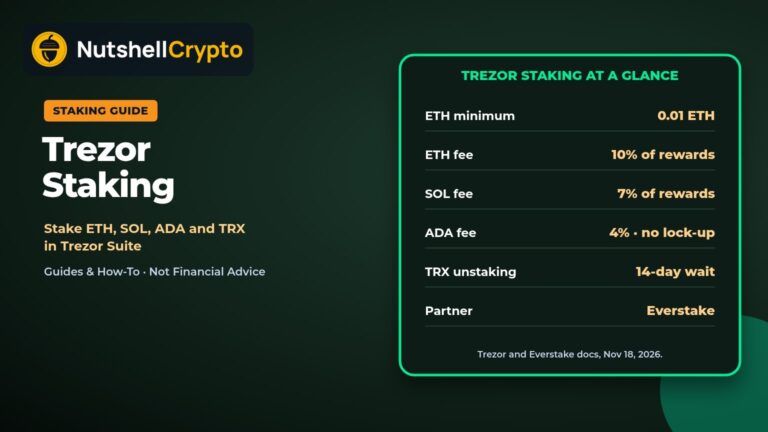
- Trezor Suite. Trezor’s ETH staking page says staking is “powered by Everstake”, starts at 0.01 ETH, shows “up to 3% APY” and charges a 10% commission on rewards. Withdrawals take “around 9 days”, and it works on all Trezor models. See our full Trezor staking guide.
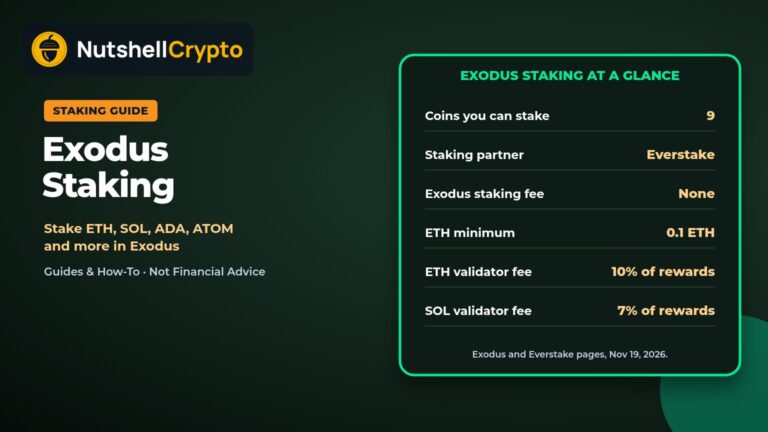
- Exodus. Every coin you can stake in Exodus, including ETH, SOL, ADA and ATOM, is delegated to Everstake. Our Exodus staking guide lists the minimums and unstaking times.
Everstake’s Cosmos page also names Keplr, Trust Wallet, Exodus and Ledger as wallets you can use to manage ATOM staked with it. Going through a wallet you already use is usually simpler than connecting to a new dashboard.
How to Stake with Everstake
- Pick the coin and check its page. Read the fee, minimum and unstaking time on Everstake’s page for that network.
- Choose your route. Use a partner wallet (Trezor Suite, Exodus and others) or connect your own wallet to Everstake’s staking dashboard.
- Check the validator address. For Solana, Everstake lists its validator address as 9QU2QSxhb24FUX3Tu2FpczXjpK3VYrvRudywSZaM29mF. Make sure your wallet shows the right one before signing.
- Keep coins for fees. Leave enough of the coin to pay network fees for staking and, later, unstaking.
- Sign and wait. SOL activates at the next epoch (about a day), ADA pays its first reward after about 20 days, and ETH waits for the pool and Ethereum’s entry queue.
Hardware wallet owners can also read our Ledger staking guide, and Solana or Cardano holders can compare options in our SOL staking and ADA staking guides.
Is Everstake Safe? The Risks
Everstake is one of the largest staking providers, and Staking Rewards’ Everstake profile repeats its claim of “zero material slashing events since inception”. Still, staking with any provider carries risks:
- Smart contract and provider risk on ETH. Trezor’s ETH page says the staked ETH “is fully maintained by Everstake” and warns that “in the event that Everstake ceases operations, there is a risk that you may not recover your staked funds”. Trezor also says it assumes no liability. This is the main concern in Reddit threads such as “Can we analyze the risks of staking ETH through Everstake with Trezor?” on r/TREZOR.
- Slashing. On networks like Ethereum and Cosmos, validators that misbehave or double-sign can lose part of the stake. Everstake notes that Solana has no slashing for now but says this “might change in the future”.
- Lock-ups. ATOM takes 21 days to unbond and earns nothing in that time. ETH exits depend on the network queue. Prices can fall while you wait.
- Rewards aren’t fixed. APR changes with total stake, network inflation and validator performance.
- Phishing. Only stake from Everstake’s real site or your wallet’s built-in staking menu, and never share your seed phrase. Our guide to self-custody covers the basics.
Everstake’s delegated model on Solana, Cardano and Cosmos keeps the coins in your wallet, which is a different risk profile from handing them to an exchange. Our guide to custodial wallets explains that difference.
US, Canada and Australia Tax Notes
United States. The IRS ruled in Revenue Ruling 2023-14 that staking rewards are income at their fair market value when you gain the ability to sell or transfer them. Selling them later can create a capital gain or loss. See the IRS digital assets page.
Canada. The CRA’s page on income from crypto mining and staking says rewards from staking on a centralized platform are generally income when credited to your account. It doesn’t give a separate rule for delegating from your own wallet, so ask a tax professional how it applies to you. Our Canada crypto tax guide has more.
Australia. The ATO’s staking rewards page says the value of staking rewards is ordinary income when you receive them. When you later sell or swap them, capital gains tax rules apply.
For a wider look, read our guide to crypto staking taxes. This is general information, not tax advice.
FAQ
What does Everstake do?
Everstake runs validators on proof-of-stake blockchains so holders can earn staking rewards without running their own node. It serves retail users through its dashboard and partner wallets, and institutions through custom setups. It keeps a share of the rewards as its fee, such as 10% on ETH.
Is Everstake safe?
Everstake is large, audited and reports no material slashing since it started, but it isn’t risk-free. For ETH, your coins sit in Everstake’s smart contract, and Trezor warns you may not recover them if Everstake stops operating. On Solana, Cardano and Cosmos, your coins stay in your own wallet while delegated.
Can I lose my ETH if I stake it?
Yes, it’s possible, though uncommon. Validators can be slashed for serious faults, smart contracts can have bugs, and a provider can fail. ETH’s price can also fall while your stake waits in the exit queue.
How many ETH is required to stake?
Running your own Ethereum validator takes 32 ETH. Through Everstake’s pooled contract you can start with 0.01 ETH, and the same 0.01 ETH minimum applies when you stake through Trezor Suite.
Can you sell your crypto if it’s staked?
Not while it’s locked. You must unstake first and wait out the network’s unbonding time, such as 21 days for ATOM or the exit queue for ETH. Cardano is the exception: delegated ADA is never locked, so you can spend it any time.
Is staking taxable?
In the US, Canada and Australia, staking rewards are generally taxed as income when you receive them, and selling them later can trigger capital gains tax. The exact rules differ by country, so check the IRS, CRA or ATO guidance linked above.
This article is for education only and isn’t financial or tax advice. Fees, APRs and terms change; check Everstake’s and your wallet’s current pages before you stake.