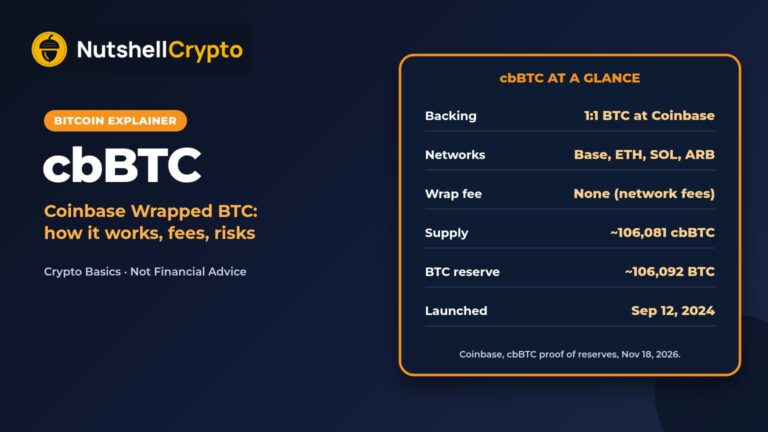
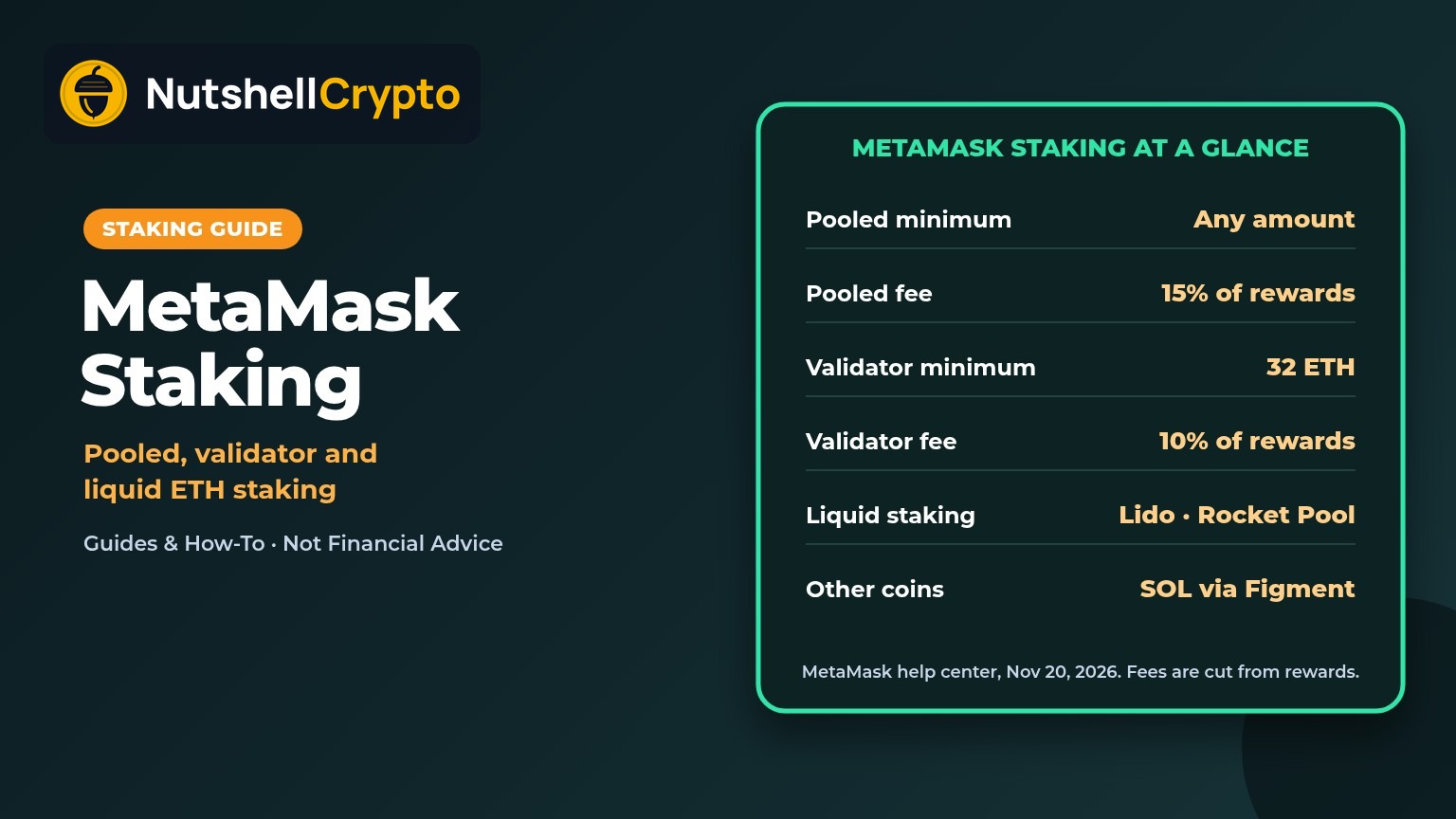
In a nutshell: MetaMask staking lets you stake ETH from your own MetaMask wallet in three ways: Pooled Staking with any amount (MetaMask keeps 15% of rewards), Validator Staking for 32 ETH or more (10% fee), or liquid staking through Lido or Rocket Pool. You can also stake SOL through Figment. Educational only; not financial advice.
MetaMask staking is the built-in way to earn Ethereum staking rewards without leaving the MetaMask wallet. You pick an option, sign one transaction, and MetaMask’s staking infrastructure or a partner protocol runs the validators for you. Its fee comes out of your rewards, not your ETH.
This guide covers the three ETH options, the fees and minimums (checked on November 20, 2026, on MetaMask’s own help pages), how to stake and unstake, the September 2026 security incident that hit MetaMask’s validators, and short tax notes for the US, Canada and Australia.
Table of contents
What Is MetaMask Staking?
MetaMask is a self-custody crypto wallet, and “MetaMask Staking” is both its staking feature and the team that runs the validators behind it. Lido’s forum calls that team MetaMask Staking (ex Consensys Staking), the staking arm of the company that builds MetaMask.
Ethereum normally needs 32 ETH to run one validator. MetaMask’s staking explainer says you can get around that with pooled staking (any amount), liquid staking with Lido or Rocket Pool, or validator staking if you have 32 ETH or more. On its Earn page, MetaMask says it has over $3 billion of ETH staked, 99.99% validator participation and zero ETH slashed.
If you’re new to the idea, start with our guide to what staking in crypto is and how to stake Ethereum in general.
The Three Ways to Stake ETH in MetaMask
1. MetaMask Pooled Staking
Your ETH goes into a pool with other users’ ETH until there’s 32 ETH to start a validator. You get a share of the pool, and rewards are split by that share. MetaMask’s help page on what happens to your tokens says the MetaMask Staking infrastructure then sends the pooled ETH to the Beacon Chain. MetaMask also says it stakes 1,000 ETH of its own in this pool.
There’s no token to trade. Rewards are restaked automatically, so they compound, and you only receive them when you unstake.
2. MetaMask Validator Staking
If you have 32 ETH or more, MetaMask runs one or more full validators for you. Its validator staking page says the setup is self-custodial: your ETH sits in Ethereum’s deposit contract, and MetaMask does not take custody of it. The Earn page lists deposits of 32 to 2,048 ETH per validator node, rewards every 10 days, and MEV rewards when your validator proposes a block.
3. Liquid staking with Lido or Rocket Pool
MetaMask’s stake screen can also send your ETH to a liquid staking protocol. You get a token back, such as Lido’s stETH or Rocket Pool’s rETH, that you can hold, send or use in DeFi while it earns. These are separate protocols with their own fees and rules; see our guides to Lido staking and Rocket Pool.
MetaMask Staking Fees and Minimums
All figures below come from MetaMask’s help center and Earn page, checked on November 20, 2026. You also pay Ethereum gas for every stake, unstake and claim.
| Option | Minimum | Fee | What you get |
|---|---|---|---|
| Pooled Staking | No minimum | 15% of rewards | A share of the pool; rewards auto-restaked |
| Validator Staking | 32 ETH (32 to 2,048 ETH per validator) | 10% of rewards | Your own validator, run by MetaMask |
| Rocket Pool (via MetaMask) | Any amount | 0.05% deposit fee, plus Rocket Pool’s own reward cut | rETH |
| Lido (via MetaMask) | Any amount | Lido’s own reward cut | stETH |
Pooled Staking. MetaMask’s rewards page says the fee is 15% of staking rewards, so you keep 85%. The rate shown in the app is the pool’s last seven days of rewards, minus that fee, turned into a yearly figure. Your staked balance updates every 12 hours.
Validator Staking. The validator rewards page says every rate shown is already net of a 10% MetaMask fee.
Rocket Pool. MetaMask’s Rocket Pool page says Rocket Pool takes 0.05% when you deposit, then converts the rest to rETH. On 1 ETH that’s a 0.0005 ETH fee.
To see how a fee changes your yearly return, read how staking APR works or try our staking rewards calculator.
How to Stake ETH in MetaMask
MetaMask’s pooled staking how-to gives these steps.
In the mobile app:
- Open the Tokens screen and tap Earn next to your ETH.
- Enter how much ETH to stake (or pick a percentage, like 25%). The estimated yearly rewards update as you type.
- Tap Review, check the details and confirm.
- Your staked ETH then shows in the Tokens tab, with your balance, rewards and rate.
On the web (MetaMask Portfolio): go to Move Crypto, then Stake, pick the MetaMask Pool tab, enter an amount, click Continue and sign the transaction. For Lido or Rocket Pool, pick the provider on the same Stake page.
Keep a little extra ETH in the account. MetaMask recommends it so you can pay gas later to unstake and claim.
Hardware wallets. MetaMask says you can use Pooled Staking with a hardware wallet account imported into MetaMask. If you’d rather stake straight from the device’s own app, see our Ledger staking guide and Trezor staking guide.
How Unstaking Works
MetaMask’s unstaking page says you can unstake all or part of your stake at any time, in two steps: request the unstake, then claim your ETH once the Ethereum protocol has processed it. It usually takes a few days, and the app shows the estimated wait and gas fee before you confirm. You keep earning rewards until the ETH is ready to claim.
The wait comes from Ethereum’s queues, not from MetaMask. Its timings page explains the activation queue, the exit queue and the “sweep” delay before exited ETH becomes claimable. When many people stake or exit at once, these queues can stretch from minutes to days or more. Our unbonding period guide explains why.
Liquid staking is different: you can usually sell or swap stETH or rETH right away instead of waiting in the queue, though the price you get may differ slightly from 1:1.
Other Coins: SOL and MATIC
Solana. MetaMask added SOL staking through Figment. Its Figment announcement (July 24, 2025) says you need a Solana account in MetaMask and that there was no minimum to stake SOL at launch. More on the provider in our Figment staking guide, and on the chain in our SOL staking guide.
MATIC. MetaMask’s staking how-to says MATIC staking through Lido or Stader Labs is only available to users outside the United States. Polygon’s token has been upgraded to POL, but MetaMask notes its providers still use MATIC. See our Polygon staking and Stader Labs guides.
Is MetaMask Staking Safe? The Risks
MetaMask staking is run by a large, experienced operator, but it isn’t risk-free. Here’s what to weigh.
The September 2026 incident. MetaMask’s user update says it found unauthorized access to part of its infrastructure on September 28, 2026. An attacker briefly changed the addresses that receive execution-layer rewards for some validators, and about 0.385 ETH in rewards was diverted. MetaMask says it found no evidence that staked principal, withdrawal keys or users’ Secret Recovery Phrases were compromised. As a precaution, it exited the affected Ethereum validators, and by its November 5 update all of them had exited.
The exits had a cost. MetaMask says some customers saw temporary withdrawal delays and may have missed rewards. CoinDesk reported a security researcher’s estimate of about 17,000 validators holding roughly 523,000 ETH, which MetaMask had not confirmed. Lido said ETH from those validators could take up to about 45 days to come back through the exit and entry queues, and its contributors put a proposal to an on-chain vote to stop sending new deposits to MetaMask Staking’s operators.
Slashing. Validators can lose part of their stake for serious faults. MetaMask says its validators have never been slashed, but that’s a track record, not a guarantee.
Smart contract risk. Pooled and liquid staking rely on smart contracts, which can have bugs.
Price and queue risk. ETH’s price can fall while your stake waits to exit. Liquid staking tokens can also trade below the ETH they represent.
Your own wallet. MetaMask is self-custody, so if someone gets your Secret Recovery Phrase, they can unstake and move your ETH. MetaMask’s help pages link to its full MetaMask Staking Risk Disclosures, which are worth reading before you stake.
US, Canada and Australia Tax Notes
United States. The IRS ruled in Revenue Ruling 2023-14 that staking rewards are income at their fair market value when you gain the ability to sell or transfer them. Selling them later can create a capital gain or loss. With Pooled Staking, rewards are restaked automatically and only reach your account when you unstake, so ask a tax professional when that counts as receiving them. See the IRS digital assets page.
Canada. The CRA’s page on income from crypto mining and staking says rewards from staking on a centralized platform are generally income when credited to your account. It doesn’t give a separate rule for staking from your own wallet, so check with a tax professional. Our Canada crypto tax guide has more.
Australia. The ATO’s staking rewards page says the value of staking rewards is ordinary income when you receive them. When you later sell or swap them, capital gains tax rules apply.
For a wider look, read our guide to crypto staking taxes. This is general information, not tax advice.
FAQ
Can I lose my ETH if I stake it?
Yes, though it’s uncommon. Validators can be slashed for serious faults, smart contracts can have bugs, and an operator can have problems, as MetaMask’s September 2026 incident showed. In that case MetaMask says staked principal wasn’t affected, but some rewards were diverted or missed.
How much ETH is needed for staking?
Running your own Ethereum validator takes 32 ETH. In MetaMask, Pooled Staking and liquid staking with Lido or Rocket Pool have no minimum, while Validator Staking needs 32 ETH per validator.
Can you sell crypto after staking?
Not while it’s staked in the pool. You have to unstake, wait for Ethereum’s exit queue (usually a few days) and then claim your ETH. If you used liquid staking, you can sell or swap your stETH or rETH instead of waiting.
How much can I earn by staking ETH?
It depends on Ethereum’s network reward rate, which changes over time, minus the provider’s fee. MetaMask shows the current rate in the app, already net of its fee. As an example only: if the pool earned 3% a year, Pooled Staking’s 15% fee would leave you about 2.55%.
How risky is staking crypto?
Staking adds a few risks on top of price risk: slashing, smart contract bugs, operator problems and waiting times when you want out. Using a large operator lowers some of these, but no option removes them entirely.
This article is for education only and isn’t financial or tax advice. Fees, rates and terms change; check MetaMask’s current help pages and the app before you stake.