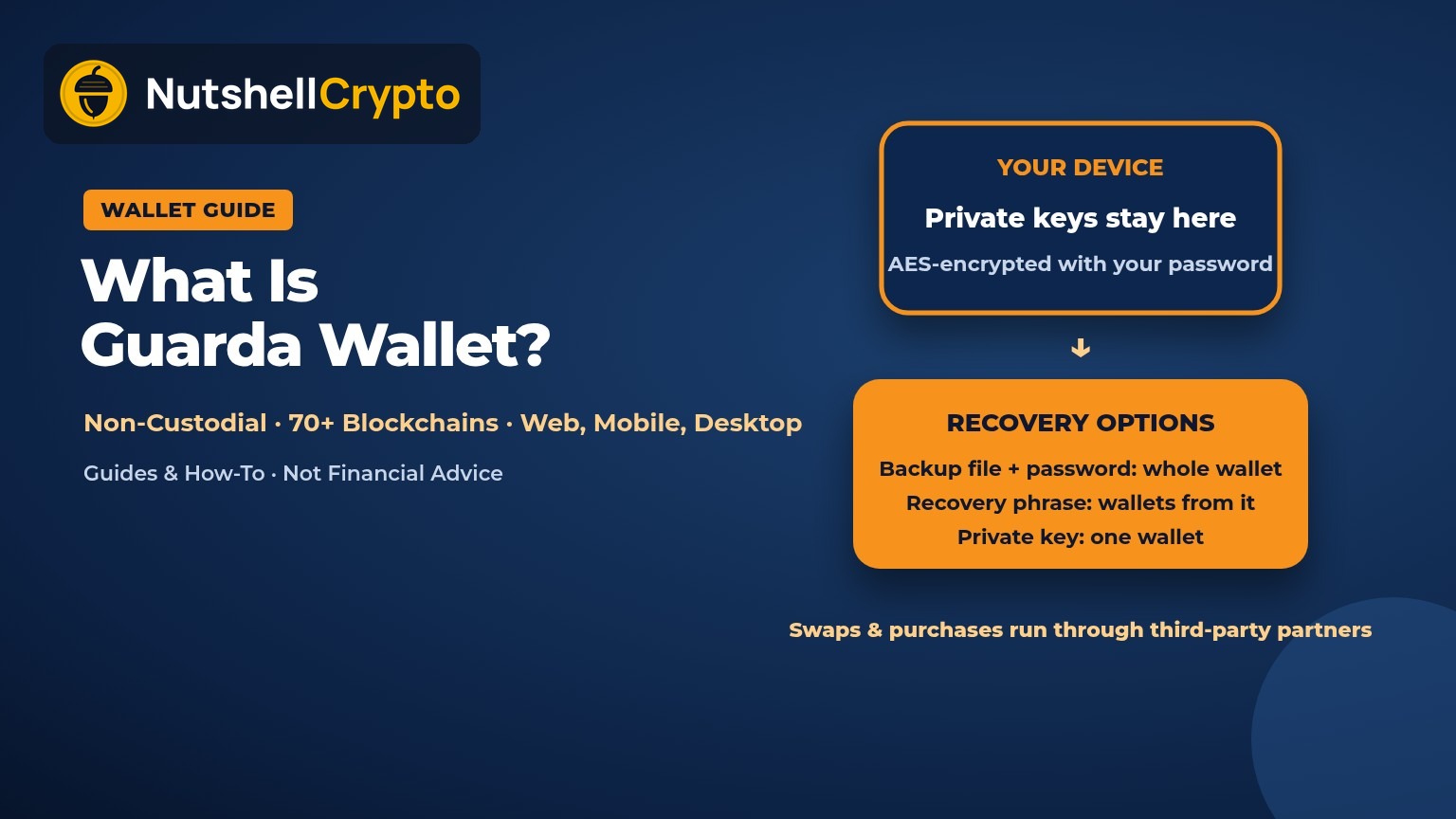
In a nutshell: Guarda Wallet is a free, non-custodial software wallet that has been around since 2017. It works on the web, on desktop, on iOS and Android, and as a Chrome extension. Guarda says it supports 70+ blockchains and over 1 million tokens. Your private keys are created and stored on your device, encrypted with your password, and Guarda can’t recover them for you. The main thing that sets it apart is its encrypted backup file, which can restore every wallet in one go. Swaps, card purchases, staking pools and loans run through third-party partners, each with its own fees. It is a hot wallet, so larger balances need extra care. Educational only; not financial advice.
Last updated: November 2, 2026.
Most people find Guarda when they want one app for coins their current wallet doesn’t support, like Monero next to Bitcoin, or Cardano next to TRON. Others land on it from an app store search and want to know who is behind it and whether it is safe before they move funds in.
This guide covers what Guarda is, who runs it, how its keys and backup work, which coins and platforms it supports, what it charges, how staking works in it, its 2020 security incident, and short tax notes for the US, Canada and Australia. Facts come from Guarda’s website, help center and terms, its app store listings and Coin Bureau’s review, checked on November 2, 2026, at about 6:20 PM PKT.
Table of contents
- What is Guarda Wallet?
- Guarda at a glance
- How Guarda Wallet works
- Backup file, recovery phrase and private keys
- How to set up a Guarda wallet
- Guarda fees
- Staking in Guarda
- Swaps, loans, predictions and multisig
- Security record and open-source status
- Pros, cons and trade-offs
- US, Canada and Australia tax notes
- FAQ
What Is Guarda Wallet?
Guarda Wallet is a multi-chain crypto wallet: one app that holds addresses on many different blockchains at once. It is non-custodial, which means the company never holds your coins or your keys. Guarda’s terms say the company “does not store user’s private keys, backup phrases or passwords” and that if you lose them, “it will not be possible for the Company to recover it for you” (Guarda Terms of Service). If that model is new to you, start with our guide to self-custody and how it differs from a custodial wallet.
Guarda started in 2017 as an Ethereum wallet and grew from single-coin “mono wallets” into one app across web, Windows, macOS, Linux, iOS and Android (Guarda About). The same terms name the operating companies as GUARDACO LDA in Lisbon, Portugal, and Guardium LTD in the British Virgin Islands. GUARDACO LDA is also the developer listed on the Apple App Store and Google Play. Card purchases on the web version are handled by Guardarian OÜ, a separate company registered in Estonia.
Guarda is software, not a coin. It has no token of its own; the GETH you may see in the app is a receipt for its Ethereum staking pool, covered below.
Guarda at a Glance
These are company-reported or store-listed figures as of November 2, 2026, unless noted.
| Item | Figure | Source |
|---|---|---|
| Operating since | 2017 | Guarda home page |
| Blockchains supported | 70+ | Guarda home page |
| Tokens supported | 1M+ | Guarda home page |
| Active users | 1M+ (company claim) | Guarda home page |
| Staking networks | 14 | Guarda home page |
| Platforms | Web, desktop, iOS, Android, Chrome extension | Guarda home page |
| Apple App Store rating (US) | 4.0 from 961 ratings | App Store listing |
| Google Play rating (US) | 3.9 from 6.16K reviews; updated October 29, 2026 | Google Play listing |
| Wallet fee for sending | None; network fee only | Guarda help center |
The chain, token and user counts come from Guarda’s home page and are not independently audited. “Supported” also varies: a token can show up and be sendable without being available to swap, buy or stake on every platform.
How Guarda Wallet Works
When you create a wallet, Guarda generates the keys on your device and encrypts them with the password you choose. Guarda’s help center says it uses AES (Advanced Encryption Standard) for this, and that the password “will serve to encrypt your wallet and all of the private keys within” (Guarda help center). There is no sign-up, email or ID check to open a basic wallet.
From there, Guarda acts as a window onto each blockchain. When you send BTC, the app builds the transaction, your key signs it on your device, and the Bitcoin network settles it. Guarda can’t reverse that transaction or freeze the coins. The terms describe the wallet as software that lets users “work with blockchains directly with no interactions from any other counterparties.”
Things change when you use the built-in services. A swap, a card purchase, a loan or a prediction trade goes through an outside provider under its own terms, and that provider may ask for KYC. Guarda’s terms say that for exchange, staking, loans and similar services it “acts as an intermediary” and does not set rates or commissions. For larger balances, Coin Bureau notes that Guarda can be paired with a Ledger hardware wallet, so the signing key stays on the device instead of on your phone or computer (Coin Bureau, updated August 16, 2026). Our hot wallet vs cold wallet guide explains why that split matters.
Backup File, Recovery Phrase and Private Keys
This is where Guarda differs most from wallets that only give you 12 words. Guarda lists three separate recovery credentials (Guarda recovery guide):
| Credential | What it restores | Needs your password? |
|---|---|---|
| Backup file (encrypted .txt) | Your whole Guarda setup, every supported wallet in it | Yes |
| Recovery phrase (usually 12 words) | Most wallets created from that phrase | Yes, inside Guarda |
| Private key | One wallet only | Yes, inside Guarda |
The backup file is the encrypted copy of all your private keys. On its own it is unreadable; your password is what decrypts it. Guarda says: “Backup + password = access to the wallet stored in that backup” (Guarda help center). That leads to two practical rules:
- Store the file and the password in different places. If someone gets both, they get your coins. If you lose the password, the file is useless, and Guarda can’t reset it.
- Download a new backup after every change. Creating, importing or deleting a wallet, or changing your password, produces a new backup. An old file still works but won’t include wallets you added later.
Guarda’s recovery phrases follow the standard BIP-39 word list, and some wallet types use 18 or 24 words with their own separate phrase. Write them down offline, don’t screenshot them, and never type them into a website. Our guide to the seed phrase covers safe storage in more detail.
How to Set Up a Guarda Wallet
These steps follow Guarda’s own web-wallet instructions. The mobile and desktop apps work much the same way.
- Go to guarda.com directly (type it or use a bookmark, not an ad) and click Launch app, or install the app from the official App Store or Google Play listing published by GUARDACO LDA.
- Choose Create a new wallet and set a long, unique password.
- Write the password down somewhere safe and confirm with I’ve written it down.
- Download the backup file when prompted and store it away from the device, for example on an encrypted USB drive.
- Add the coins you want, then send a small test amount in and out before moving larger sums.
- Do a test restore on a second device with the backup and password, so you know recovery works before you need it.
Guarda Fees
Guarda doesn’t charge its own fee to hold or send crypto. What you pay depends on the action (Guarda: What fees am I paying for?):
- Sending: only the blockchain’s network fee. On supported chains you can adjust it, which trades speed for cost.
- Swaps: set by exchange partners, “about 0.5% per transaction” according to Guarda, plus network fees, all built into the quoted rate. The terms name ChangeNOW as the web exchange partner.
- Buying crypto with a card or bank: partner fees that Guarda says “can range from 2% of the transaction and down,” plus any card or currency conversion costs.
Because swap costs sit inside the rate, the honest way to compare is the amount you actually receive, not the headline fee. Coin Bureau’s review makes the same point: a swap with no Guarda fee can still cost more than a trade on a liquid exchange if the rate is worse.
Staking in Guarda
Guarda advertises staking on 14 networks, including Cardano, Cosmos, TRON and Tezos. Some run through validators Guarda operates itself; its staking page says it runs validators for Ethereum and Harmony, a Tezos baker and a FIO block producer (Guarda staking). Rules differ a lot by coin:
| Asset | Minimum | How it works in Guarda | Exit rule |
|---|---|---|---|
| ETH | 0.1 ETH | Deposit into Guarda’s pool and get GETH 1:1; 10% fee on on-chain rewards; you must hold at least 0.1 GETH to earn | GETH swaps back to ETH when withdrawal liquidity is available |
| TRX | 1 TRX | Stake 2.0 with a vote for a Super Representative; you choose Energy or Bandwidth | 14-day wait after unstaking |
| ZIL | 10 ZIL | Delegate to a validator; web and desktop only; rewards claimed by hand | 14-day network lock |
Sources: Guarda ETH staking, Guarda TRX guide, Guarda ZIL guide. The ETH option is worth reading closely. Unlike delegating on Cardano or Cosmos, where coins stay in your address, the ETH pool gives you a GETH receipt token, and getting ETH back depends on Guarda’s pool. Reward rates shown in the app are estimates and change over time; see our staking APR explainer and the basics of staking in crypto.
Swaps, Loans, Predictions and Multisig
Beyond holding coins, the app bundles several partner-run features:
- Loans: borrow stablecoins against your crypto, provided by CoinRabbit. Guarda’s loans page advertises rates “up to 17% APR.” If the collateral falls in value, the loan can be liquidated under the lender’s terms (Guarda Loans).
- Predictions: event markets built on Polymarket. Guarda’s page warns that access “may be restricted in certain jurisdictions (such as the United States)” (Guarda Predictions).
- Perps: the iOS app added long and short perpetual positions in 2026, per its version history. These are leveraged products; read our perpetual futures guide before touching them.
- Multisig: the terms say Guarda’s multisig feature on Ethereum and compatible networks runs through the third-party Safe smart account protocol. Our multisig wallet guide explains how approvals work.
- DApps: the Chrome extension and WalletConnect let you connect to DeFi apps. Every approval you sign can give a contract spending rights, so read prompts carefully. See our DeFi wallet guide.
Security Record and Open-Source Status
Guarda’s internal key storage has not been reported breached, but it did have one serious incident. On December 30, 2020, attackers took over Guarda’s account at its domain registrar, GoDaddy, disabled two-factor authentication and pointed guarda.com and guarda.co to a fake page that asked users to upload their backup. In a post signed by CEO Paul Sokolov, Guarda said its internal resources were not compromised, but users who uploaded a backup on desktop, web or the Chrome extension may have exposed their private keys. Guarda regained control around 9 PM local time (UTC+3) that day and reported the case to Estonian police (Guarda blog, January 2, 2021).
The lesson applies to any wallet: the real Guarda app never needs you to upload your backup or type your recovery phrase into a website. Anyone who asks for either, including “support” in a chat, is a scammer.
On code, Guarda is only partly open source. Its old single-coin Android wallets are on GitHub under GPL-3.0 but are archived and marked deprecated (GitHub). For the main multi-currency app, a Guarda representative wrote on Reddit in 2021 that “our application is not open-source” (Reddit r/GuardaWallet). That means outside developers can’t fully check how the app handles keys. Our open source crypto wallet guide explains why some users weigh this heavily.
Pros, Cons and Trade-offs
| Strengths | Weaknesses |
|---|---|
| Very wide coin coverage, including Monero (XMR) | Hot wallet: keys live on an internet-connected device |
| Same wallet on web, desktop, mobile and extension | Backup file plus password model is easy to get wrong |
| No account or ID needed to open a wallet | Main app is not open source |
| Staking on 14 networks and Ledger pairing | Swap and card costs sit inside partner rates |
| 24/7 live support advertised | Coin Bureau found the public desktop download still at version 1.1.1 from 2021 |
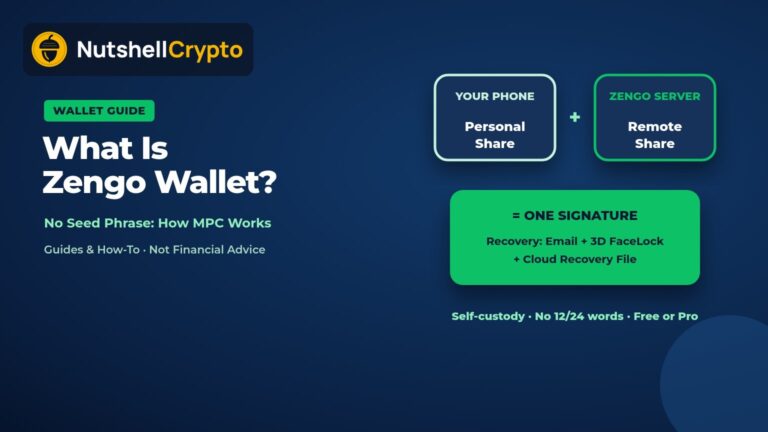
If you’d rather not manage a backup file or seed phrase at all, a different design like the MPC-based Zengo wallet takes the opposite approach. If you only hold Ethereum tokens, see our non-custodial ERC-20 wallet guide. For the bigger picture, read what a crypto wallet is.
US, Canada and Australia Tax Notes
Holding coins in Guarda doesn’t create tax by itself, and Guarda doesn’t send tax forms, so you keep your own records. Swaps inside the app are where most people trip up.
United States: the IRS treats digital assets as property, so a swap inside Guarda is a sale of one coin for another and can produce a gain or loss, while moving coins between wallets you control is not a sale (IRS digital assets). Rewards from Guarda’s staking options count as income once you control them (IRS Rev. Rul. 2023-14).
Canada: the CRA counts trading one crypto for another as a disposition, and staking rewards are income; whether gains are capital or business income depends on your situation (CRA). More in our Canada crypto tax guide.
Australia: the ATO treats each swap or sale as a CGT event, valued in AUD at the time, and expects records for every transaction (ATO crypto assets). With a wallet that bundles swaps, staking and loans, exporting your history regularly saves a lot of work at tax time.
See also: do you pay tax when transferring crypto? and crypto staking taxes. This is general information, not tax advice.
FAQ
Is Guarda wallet legit?
Yes. It has operated since 2017, is published on both major app stores by GUARDACO LDA of Lisbon, and its terms name its operating companies. Being legitimate doesn’t make any hot wallet risk-free.
Is Guarda wallet safe?
Your keys stay on your device and are encrypted with your password, and Guarda can’t access them. The main risks are phishing (as in the December 2020 domain hijack), malware on your device, losing your backup or password, and signing harmful DApp approvals.
Is Guarda custodial?
No. Guarda says it doesn’t store private keys, backups or passwords. Partner services you use inside the app, like loans or card purchases, can involve their own custody or KYC rules.
Does Guarda have a seed phrase?
Yes. Guarda wallets have a recovery phrase, usually 12 words, but Guarda’s main recovery method is the encrypted backup file plus your password, which restores every wallet at once.
Does Guarda charge fees?
Not for holding or sending; you pay the network fee. Swaps (about 0.5% per Guarda) and card purchases (up to about 2%) carry partner fees built into the rate.
Can I use Guarda in the US, Canada and Australia?
The wallet is available on the US App Store and Google Play, but individual features depend on partners and region. Guarda says its Polymarket-based predictions may be restricted in the United States.
Sources: Guarda website, help center, terms and blog (checked November 2, 2026), Apple App Store and Google Play listings, Coin Bureau, GitHub, Reddit, IRS, CRA, ATO. This article is for education only and is not financial or tax advice.