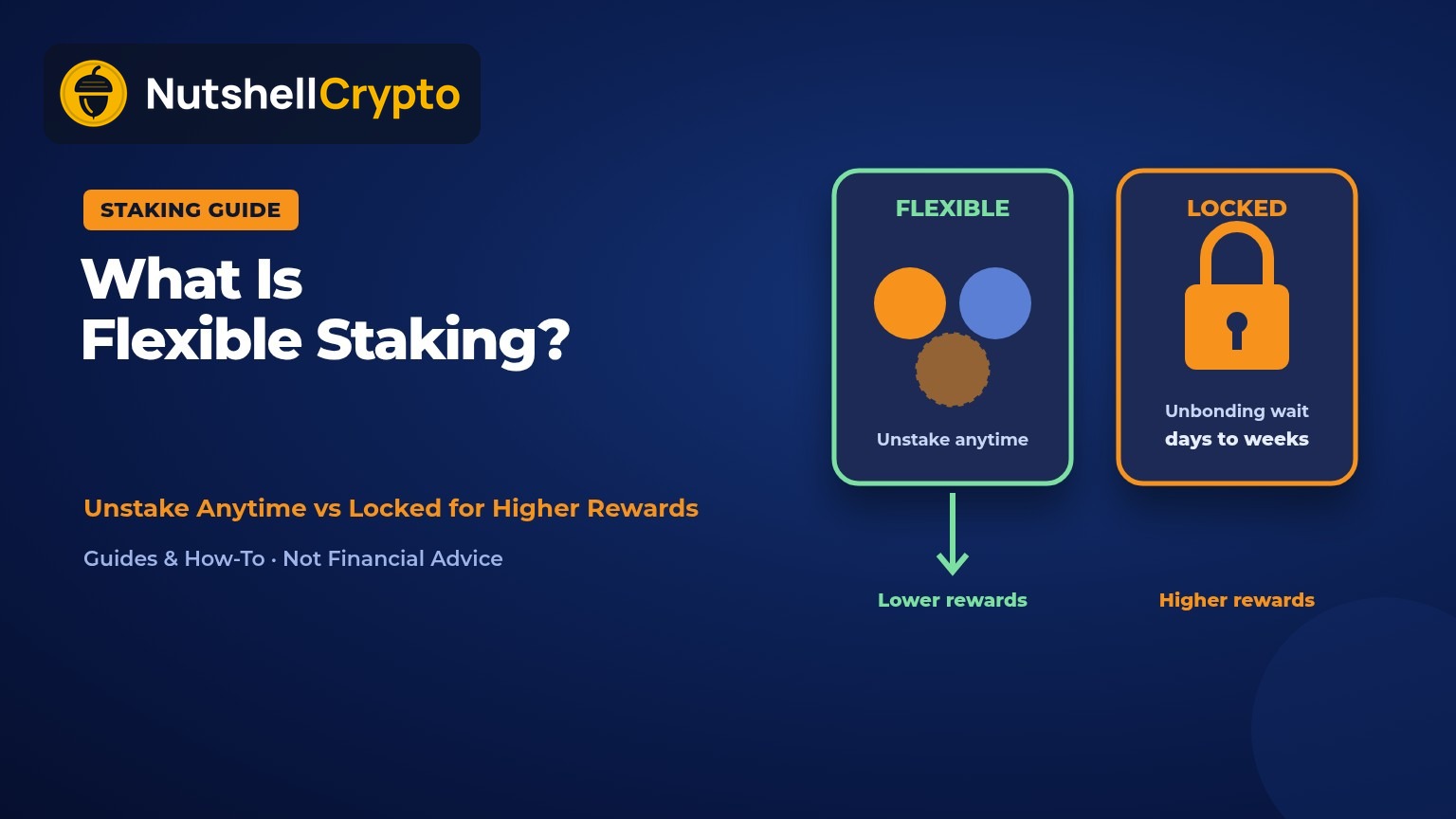
In a nutshell: Flexible staking is an exchange or app product that lets you earn staking rewards while keeping the right to unstake and use your coins at any time, with no unbonding wait. The platform makes that possible by keeping part of everyone’s coins unstaked as a cash-like buffer, so you usually earn less than with locked (also called bonded or boosted) staking. Locked staking pays more but ties your coins up for the network’s unbonding period, which can be days or weeks. Rewards are never guaranteed, and both versions carry platform risk. Educational only; not financial advice.
Last updated: October 27, 2026.
If you open the “Earn” or “Staking” page on a big crypto exchange, you will often see two buttons for the same coin: one marked Flexible and one marked Locked, Bonded or Boosted. The flexible rate is lower, and the platform rarely explains why.
This guide explains what flexible staking is, how a platform can let you unstake instantly when the blockchain itself makes you wait, how it compares with locked staking using real platform terms, and the risks to check before you switch it on.
Table of contents
What Is Flexible Staking?
Staking means committing coins on a proof-of-stake blockchain so they help secure the network, in exchange for rewards. On many networks, once you stake, you cannot get the coins back instantly. You first “unbond,” and the protocol makes you wait before the coins become spendable again.
Flexible staking is a platform feature that hides that wait from you. You keep earning rewards, but you can unstake, trade or withdraw whenever you like. Kraken describes it simply: flexible staking “allows you to unstake your assets at any time without being subjected to an unbonding period” (Kraken Support).
The trade-off is the reward rate. Uphold, which offers both versions, says the instant liquidity of flexible staking “typically results in lower Staking Rewards” than its locked option (Uphold Staking Terms).
How Flexible Staking Works Behind the Scenes
The blockchain does not know your coins are “flexible.” The network’s rules on lock-ups and unbonding still apply to whatever the platform stakes. What changes is how the platform manages its pool of customer coins:
- It keeps a buffer unstaked. Not all of the coins in the flexible pool are actually staked. The unstaked part is ready to pay out anyone who wants to leave. Kraken says that for assets with an unbonding period, flexible stakers earn rewards on “up to 50% of the assets you stake,” with the rest “kept unstaked for liquidity purposes.” Uphold’s terms say “not all Eligible Cryptoassets will be Staked” in flexible mode, “to preserve your trading flexibility.”
- It covers the wait itself. When you unstake, you get coins from the buffer right away, and the platform deals with the network’s unbonding queue in the background.
- It charges for the service. Kraken takes a 30% commission on flexible staking rewards, compared with 25% for bonded staking at the smallest balance tier (under $1 million).
The US Securities and Exchange Commission’s staff has a name for this kind of service. In a May 2025 statement on protocol staking, it described “Early Unbonding,” where a service provider returns staked coins “before the end of the protocol’s unbonding period,” which “merely shortens the protocol’s effective unbonding period as a convenience” (SEC Division of Corporation Finance).
So the lower rate is not a mystery. Fewer of your coins are working, and the platform keeps a bigger cut for carrying the liquidity risk.
Flexible vs Locked Staking
| Flexible staking | Locked / bonded / boosted staking | |
|---|---|---|
| Access to coins | Unstake, trade or withdraw at any time (subject to platform limits) | Locked while staked; after unstaking, wait for the network’s unbonding period |
| Reward rate | Usually lower | Usually higher |
| Why the rate differs | Part of the pool stays unstaked as a buffer; platform fee may be higher | All committed coins are staked |
| Rewards during the wait | No wait to lose rewards on | Kraken and Uphold say no rewards are earned during unbonding |
| Minimum | Often none (Uphold has no minimum for flexible) | May have a minimum or fixed term |
| Price risk | You can sell quickly in a crash | Coins can fall in value while you wait to unbond |
Both versions are usually custodial: the platform holds the coins, as in any custodial wallet. Flexible staking is also different from liquid staking, where you receive a separate token (such as stETH) that you can trade on the open market. With flexible staking, the platform itself promises to give you your coins back.
Real Examples: Kraken, Uphold and Binance
Here is how three well-known platforms describe their products, from their own pages as of October 2026. Terms change often, so check the current page before you stake.
Kraken: Bonded vs Flexible
- Offers both for many assets, including SOL, DOT, ATOM, NEAR and TRX. Some assets are flexible only (ADA, MINA), and some are bonded only (ETH, SUI).
- Bonded staking has an unbonding wait that “can last 3 or more days, depending on the asset,” and assets “stop earning rewards until the unbonding period is complete.”
- Flexible staking and Auto Earn carry a 30% commission on rewards. Bonded commission is tiered, from 25% under $1 million down to 0% above $100 million.
- Kraken says staked assets are not covered by FDIC or SIPC protection.
Uphold: Flexible vs Boosted
- Flexible staking is automatic in eligible places: users are enrolled “with the immediate right to opt-out,” and you cannot pick which assets get staked.
- Boosted staking locks a chosen amount; unbonding is “typically set at up to thirty (30) days, but may be longer,” with no rewards during that time.
- Per the terms, flexible staking is not offered in California, Louisiana or Washington, among other places (Uphold Help Center).
Binance Simple Earn: Flexible vs Locked
- Binance’s “Flexible Products” are a savings-style product, not always on-chain staking. Redemptions usually return assets right away, but Binance says “daily redemption limits apply” and payouts can be delayed during “extreme market volatility” or a rush of withdrawals (Binance Simple Earn).
- Locked Products pay more for a fixed term. If you leave early, accrued rewards are forfeited, rewards already paid are deducted from your principal, and the coins return “within 48 to 72 hours” (Binance Support).
- Binance.com does not serve US residents, so US users would see a different set of products on other platforms.
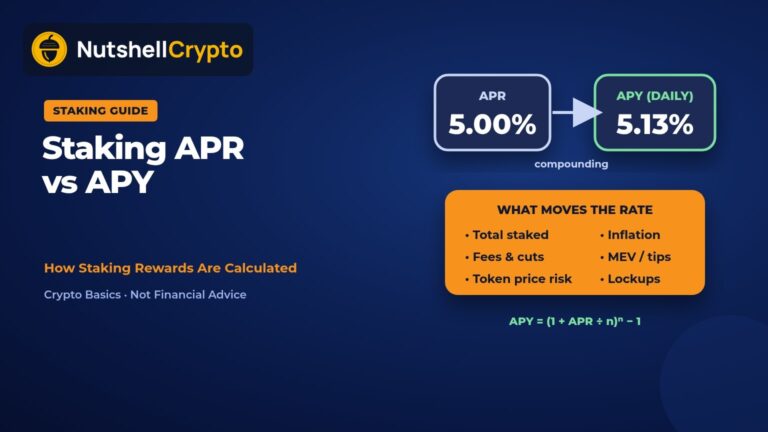
When comparing flexible and locked rates, check whether each is shown as APR or APY and before or after fees; our staking APR guide shows the math.
How Long Unbonding Takes on Popular Coins
The value of flexible staking depends on how long the network would otherwise make you wait. A few examples from our coin guides:
- Cosmos (ATOM): 21 days, with no rewards during the wait (Cosmos Hub delegator FAQ). See our Cosmos staking guide.
- Polkadot (DOT): about 2 days for nominators since 2026, down from 28 days (Polkadot Forum). Many older pages, including some platform help pages, still say 28 days. See our Polkadot staking guide.
- Solana (SOL): deactivation happens at epoch boundaries, so the wait is usually a few days at most (Solana docs). See our SOL staking guide.
- Cardano (ADA): no lock-up or unbonding at all, which is why some platforms only offer it as flexible. See our ADA staking guide.
When a network’s own unbonding is short or zero, the extra cost of flexible staking buys you less. When it is weeks long, flexibility is worth more.
Which One Fits You?
Flexible staking can make sense if:
- You might sell or move the coins soon, or you trade them actively.
- You want to be able to react quickly if the price drops sharply.
- The amount is small, so the gap in rewards is only a few dollars a year.
Locked staking can make sense if:
- You plan to hold for months or years anyway.
- You can live with the coins being stuck for the full unbonding period, even in a crash.
- You want the higher rate and understand it is still not guaranteed.
Some platforms let you split a holding. Uphold, for example, lets you lock part of a coin in boosted staking while the rest earns the flexible rate. If you hold your own keys, staking from a hardware wallet is a third route, with the network’s own unbonding rules and no exchange in the middle.
Risks of Flexible Staking
- “Anytime” has limits. Instant access depends on the platform’s buffer. Binance openly sets daily redemption limits and warns of delays in volatile markets. If many users leave at once, the buffer can run out.
- Platform risk. Your coins sit with the exchange. If it freezes withdrawals or fails, flexible terms do not help. Celsius, which offered yield on deposits, paused withdrawals in June 2022 and filed for bankruptcy that July (Wikipedia). Our list of failed crypto exchanges covers what customers got back.
- Lower and variable rewards. Rates move every week or even every minute. Kraken warns future rewards “may be less than historical rewards, or even drop to zero.”
- Slashing. Networks can penalize validators that misbehave. Kraken and Uphold say they cover certain slashing losses, with exceptions in their terms.
- No deposit insurance. Staked crypto is not a bank deposit. Kraken states staked assets are not covered by FDIC or SIPC.
- Price risk. Rewards are paid in the coin. A 5% yield does not offset a 30% price fall.
- Automatic enrollment. Some platforms switch flexible staking on by default. Check your settings so you know which of your coins are being used.
US and Canada Notes
In the US, the SEC’s Division of Corporation Finance said in May 2025 that certain protocol staking, including custodial staking through a platform and “Early Unbonding” services, does not involve the offer of securities. That is a staff view: the statement itself says it “has no legal force or effect,” and it does not cover liquid staking or restaking. Availability still varies by state, as Uphold’s state exclusions show.
In Canada, crypto platforms must be registered with or have signed commitments with provincial securities regulators, and what each can offer for staking depends on its terms with them. Our guide to regulated crypto exchanges in Canada shows how to check a platform before you use it.
Taxes on Flexible Staking Rewards
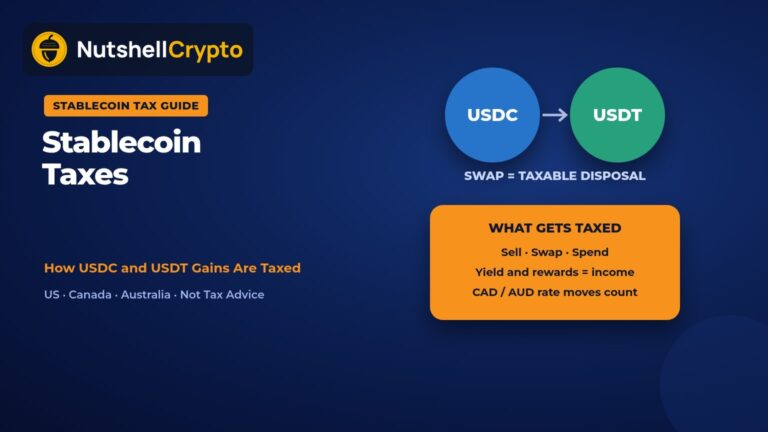
Flexible or locked, the tax rules are the same. In the US, IRS Revenue Ruling 2023-14 says a cash-method taxpayer includes staking rewards in income at fair market value in the year they gain “dominion and control” over them (IRS Rev. Rul. 2023-14). Because flexible rewards can be credited weekly or even every minute, keep good records of each payout’s value. In Canada, the CRA treats staking rewards as income, either business income or other income depending on your situation (CRA). Our crypto staking taxes guide goes into detail.
FAQ
Is flexible staking real staking?
Usually part of it is. On Kraken and Uphold, a portion of the flexible pool is staked on-chain and the rest is held back for withdrawals. Some “flexible earn” products, such as Binance’s Flexible Products, are savings-style products that are not always staking, so read the product terms.
Why is the flexible staking rate lower?
Because not all of the coins are staked (Kraken pays flexible rewards on up to 50% of assets with an unbonding period), and the platform may charge a higher fee for carrying the liquidity risk.
Can I lose money with flexible staking?
Yes. The coin’s price can fall, the platform can limit or freeze withdrawals, and slashing can occur. Rewards are not guaranteed.
Is flexible staking the same as liquid staking?
No. Liquid staking gives you a tradable token that represents your staked coins, usually on-chain. Flexible staking is a promise from a platform to return your coins on request.
Do I get rewards while unstaking from locked staking?
Generally no. Kraken and Uphold both say rewards stop during the unbonding period.
Sources
- Kraken Support: Overview of Staking on Kraken
- Uphold: Staking Program Terms and Conditions
- Uphold Help Center: Flexible Staking
- Binance: Simple Earn
- Binance Support: Simple Earn Locked Products
- SEC: Statement on Certain Protocol Staking Activities (May 29, 2025)
- Cosmos Hub: Delegator FAQ
- Polkadot Forum: Nominators no longer slashable, 2-day unbonding
- Solana Docs: Stake accounts
- Wikipedia: Celsius Network
- IRS: Revenue Ruling 2023-14
- CRA: Income from crypto mining and staking
This article is for education only and is not financial, tax or legal advice. Staking terms, rates and availability change often; check the platform’s current terms before staking.