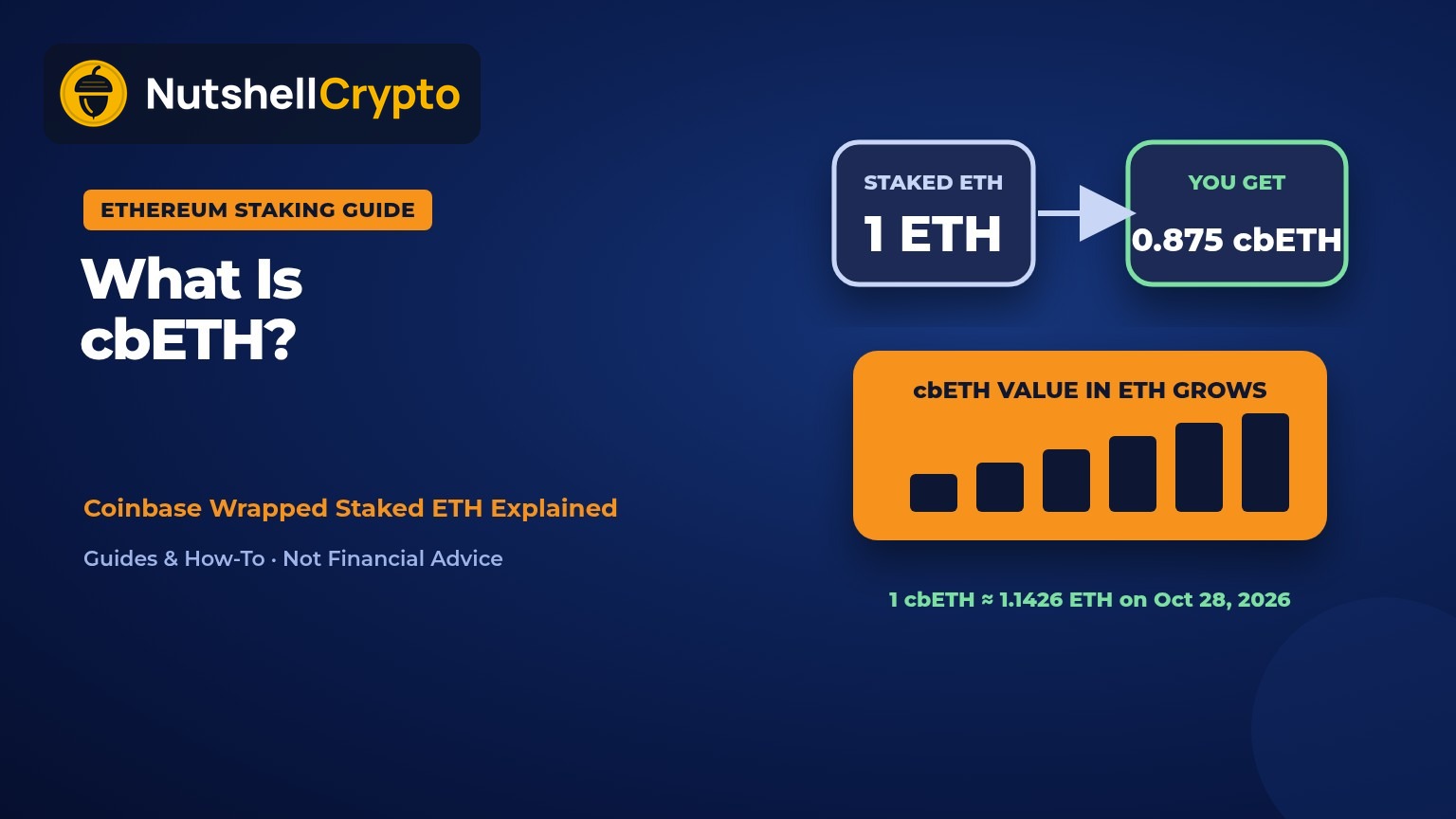
In a nutshell: cbETH (Coinbase Wrapped Staked ETH) is a token that represents ETH staked through Coinbase. You can wrap staked ETH into cbETH on Coinbase, then sell it, send it to your own wallet or use it in DeFi without waiting to unstake. Your cbETH balance does not grow; instead, each cbETH is worth more ETH over time as staking rewards build up. On October 28, 2026, 1 cbETH could be unwrapped for about 1.1426 staked ETH. You are trusting Coinbase, which holds the ETH and keeps a cut of the rewards. Educational only; not financial advice.
Last updated: October 28, 2026.
If you stake ETH on Coinbase, your coins are locked into Ethereum’s staking system. That is fine until you want to sell, move or borrow against them. cbETH is Coinbase’s answer: a tradable token that stands in for your staked ETH while it keeps earning.
This guide explains what cbETH is, why its price is higher than ETH’s, how wrapping and unwrapping work, how it compares with Lido’s stETH and Rocket Pool’s rETH, and the risks that come with it. Figures were pulled on October 28, 2026.
Table of contents
What Is cbETH?
cbETH is an ERC-20 token issued by Coinbase. Each cbETH represents a claim on ETH that Coinbase is staking on Ethereum, plus the rewards that ETH has earned. Coinbase calls it a “liquid representation” of staked ETH (Coinbase Help).
It is one type of liquid staking token. The ETH itself stays staked and keeps earning, while the token can move freely. Coinbase lists what you can do with cbETH: buy it on Coinbase, sell it for cash, convert it to other crypto, send it to a self-custody wallet, or unwrap it back into staked ETH (Coinbase Help).
The key difference from protocols like Lido or Rocket Pool is who is in charge. cbETH is run by one company. Coinbase holds the keys to the wallets that hold the staked ETH behind cbETH, according to its cbETH white paper (Coinbase cbETH white paper).
How the cbETH Conversion Rate Works
cbETH does not add new tokens to your wallet. Instead, its conversion rate goes up. The conversion rate is how much staked ETH one cbETH can be unwrapped for, and Coinbase says it changes over time as the ETH behind cbETH earns rewards (Coinbase Help).
On October 28, 2026 at about 5:55 PM PKT, Coinbase’s public wrapped-assets API showed (Coinbase Developer Docs):
- Conversion rate: 1 cbETH = 1.14257 staked ETH
- Implied APY: 2.31%, which Coinbase describes as the net rewards on the underlying staked ETH, based on the past 7 days and updated daily
- Estimated redemption time: about 9 days
- Circulating supply: about 173,545 cbETH held by customers, out of about 373,334 cbETH minted on-chain
Coinbase’s docs say circulating supply leaves out cbETH it has pre-minted and holds ready for people who wrap, which is why the two supply numbers differ so much (Coinbase Developer Docs).
A simple example
Say you wrap 2 staked ETH when the rate is 1.14257. You receive about 2 ÷ 1.14257 = 1.7504 cbETH. Months later, your wallet still shows 1.7504 cbETH, but if the rate has climbed to, say, 1.16 (an example, not a forecast), unwrapping returns about 1.7504 × 1.16 = 2.0305 staked ETH. The extra ETH is your staking reward. Coinbase’s own help page uses the same math: staked ETH received equals cbETH times the conversion rate (Coinbase Help).
Why cbETH Costs More Than ETH
Because each cbETH is backed by more than one ETH, its market price sits above ETH’s. On October 28, 2026 at about 5:54 PM PKT, CoinGecko showed cbETH at $2,669.81 and ETH at $2,336.87. That put 1 cbETH at about 1.1425 ETH on the market, almost exactly matching Coinbase’s 1.14257 conversion rate (CoinGecko).
The match is not guaranteed. Coinbase warns that cbETH and staked ETH trade on many markets, their prices can drift apart, and “the market may value cbETH less than the underlying staked ETH” (Coinbase Help). If you sell cbETH on a DEX during a rush to exit, you could get less than the ETH it represents.
So a higher cbETH price is not a sign it is “outperforming” ETH. It mostly reflects rewards that have built up since the conversion rate started near 1.0. If ETH falls 20%, cbETH falls about 20% too.
How to Wrap and Unwrap cbETH
Wrapping and unwrapping happen inside a Coinbase account. Coinbase’s help center describes these steps (Coinbase Help):
To wrap staked ETH into cbETH
- Stake ETH on Coinbase first. Only staked ETH can be wrapped.
- Go to My assets, open your Ethereum balance, then your staked (earning) ETH balance.
- Choose unstake, then Wrap ETH for cbETH.
- Enter the amount, preview, and confirm.
Your staked ETH balance goes down and a cbETH balance appears on its own asset page.
To unwrap cbETH back to staked ETH
- Open your Coinbase Wrapped Staked ETH wallet under My assets.
- Choose the wrap or unwrap options, then unwrap cbETH for staked ETH.
- Enter the amount, preview, and confirm.
Unwrapping gives you staked ETH, not liquid ETH. To get spendable ETH you still need to unstake it, which Coinbase estimates takes about 10 days for ETH, or pay a fee for instant unstaking when it is offered (Coinbase Help). Coinbase also says cbETH held in a Coinbase account can be unwrapped even if it was bought elsewhere (Coinbase Help).
If you do not already stake on Coinbase, you can simply buy cbETH on Coinbase or on a DEX. For general background on staking ETH through different routes, see how to stake Ethereum.
cbETH Fees and Rewards
Coinbase charges no fee to wrap staked ETH into cbETH, and its white paper says there are no fees to wrap or unwrap. Standard Coinbase fees apply when you sell or send cbETH (Coinbase Help; Coinbase cbETH white paper).
The bigger cost is on the rewards. Coinbase’s cbETH white paper says its staking fees still apply to the ETH behind cbETH (Coinbase cbETH white paper). For regular ETH staking, Coinbase’s fee page lists a standard commission of 35% of rewards, with lower rates of 31.75%, 28.5% and 25.25% for eligible Coinbase One Basic, Preferred and Premium members (Coinbase fee disclosures). For comparison, Lido keeps 10% of rewards (see our Lido staking guide).
Fees are already taken out of the conversion rate, so the 2.31% implied APY above is what cbETH holders actually earn, not a gross figure. That rate is not fixed; it moves with Ethereum’s overall staking yield. Our guide to staking APR vs APY explains why those rates change.
Where cbETH Lives: Chains and Contracts
cbETH started on Ethereum and is also available on several other networks. CoinGecko lists these contract addresses (CoinGecko):
- Ethereum: 0xbe9895146f7af43049ca1c1ae358b0541ea49704
- Base: 0x2ae3f1ec7f1f5012cfeab0185bfc7aa3cf0dec22
- Arbitrum One: 0x1debd73e752beaf79865fd6446b0c970eae7732f
- Optimism: 0xaddb6a0412de1ba0f936dcaeb8aaa24578dcf3b2
- Polygon PoS: 0x4b4327db1600b8b1440163f667e199cef35385f5
Always check an address against an official source before adding a token to your wallet, since fake tokens often copy real names. If you plan to hold cbETH yourself, our guide to self-custody covers the basics.
cbETH vs stETH vs rETH
cbETH is much smaller than the biggest liquid staking options. DefiLlama on October 28, 2026 showed about $0.47 billion in cbETH on Ethereum, compared with about $23.0 billion for Lido and $1.15 billion for Rocket Pool (DefiLlama).
| cbETH (Coinbase) | stETH (Lido) | rETH (Rocket Pool) | |
|---|---|---|---|
| Who runs it | One company | DAO-governed protocol | DAO-governed protocol |
| How rewards show up | Value per token rises | Balance grows daily | Value per token rises |
| Fee on rewards | Coinbase staking commission | 10% | Varies (see guide) |
| Main exit route | Unwrap on Coinbase, then unstake | Lido withdrawal queue or DEX | Protocol burn or DEX |
| Main trust point | Coinbase custody | Smart contracts and node operators | Smart contracts and node operators |
cbETH works like rETH in one way: both are value-accruing tokens, so your token count stays the same. stETH is a rebasing token whose balance changes. Our posts on Lido and Rocket Pool go into each one.
Risks of cbETH
- Custody risk. Coinbase holds the keys to the staked ETH behind cbETH. If Coinbase failed, froze accounts or was hacked, cbETH holders would depend on how it handles that. Exchange failures have happened before; see our list of failed crypto exchanges.
- Price gap risk. cbETH can trade below the ETH it represents, especially in a market panic (Coinbase Help).
- Exit depends on Coinbase. Unwrapping happens on Coinbase. If you hold cbETH in a personal wallet and want staked ETH back, you need a Coinbase account in a supported region, or you sell on the open market.
- Slashing. Validators can be penalized for mistakes. Coinbase says it spreads validators across several clients, node operators and hosting setups to lower that risk, but it cannot remove it (Coinbase cbETH white paper).
- DeFi risk. Using cbETH as collateral in lending apps adds smart contract and liquidation risk on top.
- ETH price risk. A 2.31% yield does little if ETH itself drops. cbETH moves with ETH.
US and Canada Notes
Coinbase says wrapping and unwrapping are only available in eligible regions and may be limited (Coinbase Help). Check your own account before counting on it.
In the US, SEC staff said in an August 5, 2025 statement that certain liquid staking activities, and the receipt tokens they create, do not involve the offer and sale of securities, as long as the facts match the statement’s assumptions (SEC). That is a staff view, not a law or court ruling, and it does not cover every product.
In Canada, the rules come from provincial securities regulators and depend on the platform you use. If you are in Canada, see our guide to regulated crypto exchanges in Canada to check whether a platform is registered.
Taxes on cbETH
Coinbase says there is no official tax guidance on wrapping yet. In its own tax reports, it carries your staked ETH cost basis over to cbETH and does not treat wrapping as a sale. Selling cbETH for cash is treated as a normal crypto sale (Coinbase Help).
How rewards inside cbETH are taxed is less settled than with regular staking, where the IRS says rewards count as income when you gain control of them (IRS Rev. Rul. 2023-14). In Canada, the CRA says staking rewards can be business income or other income depending on your situation (CRA). For more, see our guide to crypto staking taxes, and talk to a tax professional.
FAQ
Is cbETH the same as ETH?
No. cbETH is a token that represents staked ETH held by Coinbase plus earned rewards. It tracks ETH’s price, but one cbETH is worth more than one ETH and can trade at a discount.
Why is cbETH more than 1 ETH?
Because staking rewards are added to its conversion rate instead of your balance. On October 28, 2026, 1 cbETH could be unwrapped for about 1.1426 staked ETH.
Does cbETH earn rewards in my own wallet?
Yes, in the sense that its conversion rate keeps rising wherever the token sits. Coinbase notes that cbETH rewards are “earned but not directly through Coinbase.” You will not see separate reward payouts; the gain shows up in the conversion rate (Coinbase Help).
Is there a fee to wrap or unwrap cbETH?
Coinbase says there is no fee to wrap or unwrap. Coinbase’s staking commission is taken from rewards, and normal fees apply when you sell or send cbETH.
How long does it take to get ETH back from cbETH?
Unwrapping returns staked ETH. Unstaking that ETH took an estimated 9 to 10 days on Coinbase’s figures from October 28, 2026, unless you use instant unstaking for a fee. Selling cbETH on the market is faster but may come at a discount.
Sources
- Coinbase Help: cbETH introduction
- Coinbase Help: Wrap or unwrap your staked ETH
- Coinbase Help: Earn rewards with staking
- Coinbase: Pricing and fees disclosures
- Coinbase: cbETH white paper
- Coinbase Developer Docs: Wrapped asset details
- CoinGecko: Coinbase Wrapped Staked ETH
- DefiLlama: Coinbase Wrapped Staked ETH
- SEC: Statement on Certain Liquid Staking Activities
- IRS: Revenue Ruling 2023-14
- CRA: Income from crypto mining and staking
This article is for education only and is not financial, tax or legal advice. cbETH rates, fees and availability change; check current figures with Coinbase before wrapping or buying.