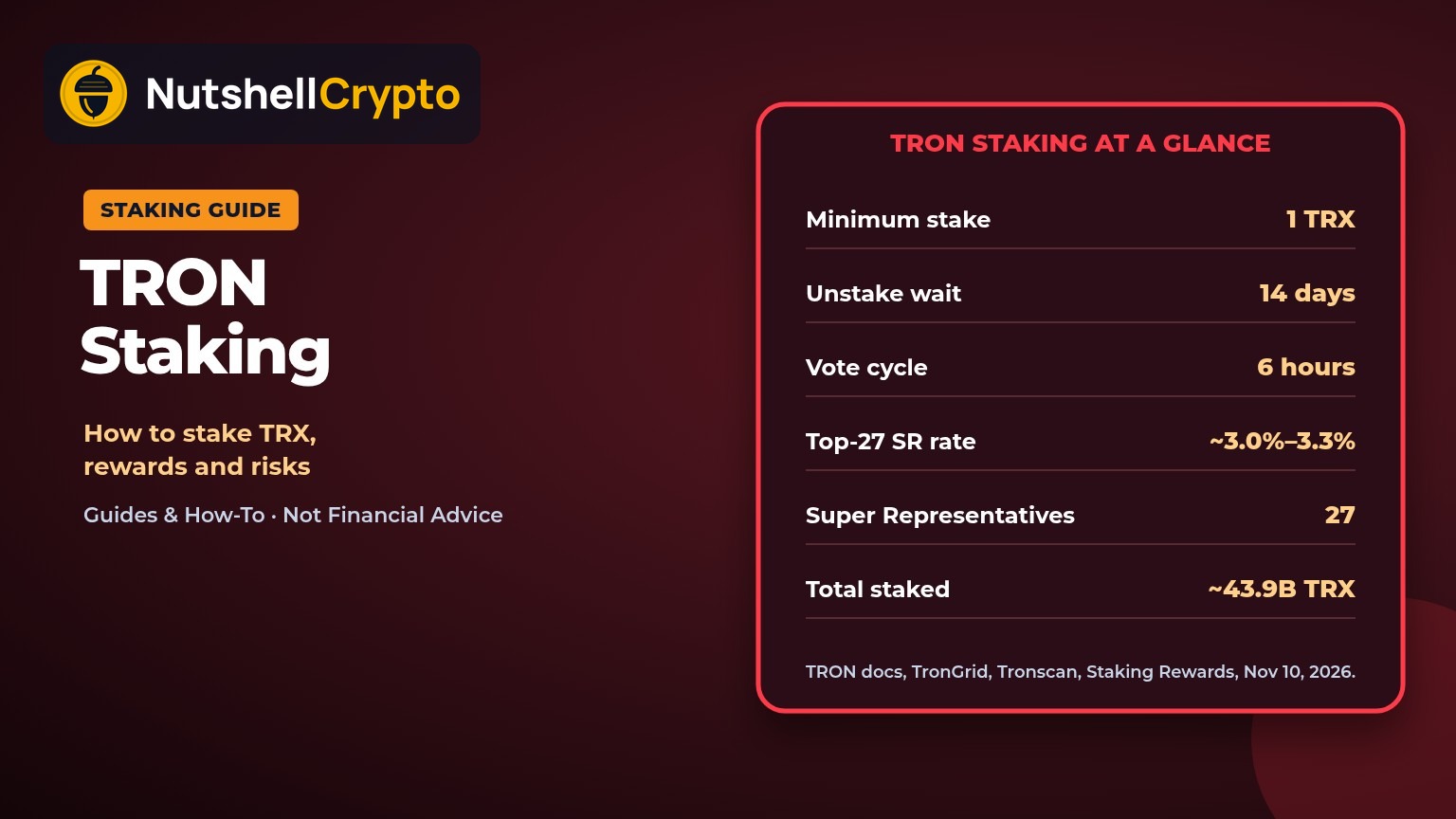
In a nutshell: TRON staking means locking (freezing) TRX under Stake 2.0 to get Bandwidth or Energy plus TRON Power, then using that TRON Power to vote for Super Representatives, who share rewards with their voters. You can stake from 1 TRX in TronLink or on Tronscan, and unstaked TRX takes 14 days to come back. On November 10, 2026, Tronscan showed yearly rates of about 3.0% to 3.3% for the top 27 Super Representatives. Educational only; not financial advice.
TRON staking is a bit different from staking on most other chains. Staking alone does not earn you anything. You also have to vote, and the TRX you stake gives you network resources that can make your TRON transactions, such as USDT transfers, cheaper or free.
This guide covers what TRON staking is, how Stake 2.0 works, how to stake TRX step by step in TronLink, on Tronscan, with a Ledger or on an exchange, the rates we found on November 10, 2026 (checked between about 3:34 and 3:40 PM PKT), the 14-day unstaking wait, fees, risks, and short tax notes for the US, Canada and Australia.
Table of contents
What Is TRON Staking?
TRON uses Delegated Proof of Stake (DPoS). TRX holders stake their coins, get voting power called TRON Power (TP), and vote for the candidates who run the network. The TRON developer docs say the network is run by 27 elected Super Representatives (SRs) who produce blocks and vote on proposals, and the next 100 candidates (ranks 28 to 127) are SR Partners, who earn voting rewards but do not produce blocks. If you are new to the idea, start with our guide to what staking in crypto is.
Your TRX never leaves your wallet when you stake natively. It is locked in your own account, and you keep control of it.
How Stake 2.0 Works
Stake 2.0 is TRON’s current staking system. The Stake 2.0 overview says it has been active since April 7, 2023 (proposal #84, TIP-467), and all new staking uses it. When you stake, you pick one resource and get TRON Power at the same time:
- Bandwidth or Energy. Bandwidth pays for the size of a transaction, and Energy pays for smart contract calls, such as sending a TRC-20 token. Your share depends on how much you stake compared with everyone else, and used resources refill over 24 hours.
- TRON Power. You get 1 TP for every 1 TRX you stake, and 1 TP equals 1 vote.
The minimum is 1 TRX per stake, and there is no upper limit. The docs are clear that unused TP earns nothing: voting is what produces rewards. TRX staked under the old Stake 1.0 system (before April 2023) is still valid and can still be unstaked.
To give a sense of the Energy side, TRON’s mainnet API on November 10, 2026 showed a network Energy limit of 180 billion a day spread over about 18.6 billion TRX staked for Energy. That works out to roughly 9.7 Energy a day for each staked TRX, so staking 1,000 TRX for Energy gives about 9,700 Energy a day at that point. The number moves as more or less TRX is staked.
How TRX Staking Rewards Work
According to TRON’s reward calculation docs, there are two reward streams, and both values matched the live chain parameters we pulled from TronGrid on November 10, 2026:
- Block reward: 8 TRX per block, paid to the SR that produced it. Only the top 27 earn this.
- Voting reward: 128 TRX per block, split among the top 127 candidates by votes.
Blocks come every 3 seconds, which the docs put at about 28,792 blocks a day, or about 230,336 TRX in block rewards and 3,685,376 TRX in voting rewards a day. Each SR keeps a share called the brokerage (commission) and passes the rest to voters. The default brokerage is 20%, but each SR sets its own.
A few timing rules from the voting docs matter:
- Votes are counted every 6 hours, so new votes start earning from the next cycle.
- Each new vote transaction replaces all your earlier votes. If you want to keep some old votes, include them again.
- Rewards build up automatically but are not added to your balance until you claim (withdraw) them, and they do not compound unless you stake them again.
- If your candidate drops out of the top 127, you stop earning from it.
TRON Staking APY on November 10, 2026
We pulled the live Super Representative list from Tronscan’s votes page at about 3:34 PM PKT on November 10, 2026. It showed 446 candidates and about 43.87 billion votes in total. For the top 27 SRs, Tronscan’s estimated yearly rate for voters ranged from about 2.99% to 3.33%, with a median of about 3.29%. Most of the top 27 had a 0% brokerage, and the highest was 10%.
| Rank | Super Representative | Votes | Share of votes | Brokerage | Est. yearly rate |
|---|---|---|---|---|---|
| 1 | Poloniex | 4.86 billion | 11.08% | 0% | 3.13% |
| 2 | Tron Inc. | 3.71 billion | 8.45% | 5% | 2.99% |
| 3 | TRONALLIANCE | 3.05 billion | 6.94% | 0% | 3.17% |
| 4 | JD Investment | 2.74 billion | 6.25% | 0% | 3.18% |
| 5 | Crypto Labs | 2.54 billion | 5.78% | 0% | 3.19% |
Notice that the biggest SRs pay slightly less. That is because the 8 TRX block reward is split among more voters, while smaller SRs share it among fewer.
Other sources showed similar numbers on the same day:
- Staking Rewards showed a 3.26% reward rate, 43.87 billion TRX staked, a 46.16% staking ratio and 0.54% inflation.
- Kraken showed 3.31% APY for bonded TRX staking (14 days bonded, paid weekly) and 1.64% for flexible staking.
- CoinGecko showed TRX at about $0.319 (C$0.451, A$0.462) at about 3:35 PM PKT.
As a rough example, 10,000 TRX earning 3.29% would make about 329 TRX in a year if the rate stayed the same, which it will not. To test your own numbers, you can enter TRON’s rate into our Chainlink staking calculator, which works for any yearly rate. Our guide to staking APR vs APY explains why the two figures differ.
How to Stake TRX Step by Step
Option 1: TronLink
The TronLink help center describes the steps in the browser extension:
- Open TronLink, pick your TRON account and click Stake.
- On the Stake 2.0 page, click Get Energy or Get Bandwidth.
- Choose “Energy + TRON Power” or “Bandwidth + TRON Power”, enter a whole number of TRX and click Confirm.
- Sign the transaction. Ledger users confirm it on the device.
- Click Vote to earn rewards, enter votes for one or more candidates (up to your TRON Power), confirm and sign.
TronLink says the voting data takes about 2 minutes to update.
Option 2: Tronscan with a Ledger
Ledger Wallet (formerly Ledger Live) does not support Stake 2.0 directly. Ledger’s support article says to install version 0.5.0 or higher of the Tron app on your device, connect it to Tronscan, go to Resources > Stake 2.0 > My Stake > Stake TRX, pick the resource and amount, sign on the device, then vote on Tronscan’s Votes page. Ledger also notes that Stake 2.0 balances will not show in Ledger Wallet, so you track them on Tronscan, and it mentions the StakeKit app in the Discover section as another route. Our Ledger staking guide covers the other coins you can stake from a Ledger.
Option 3: Other wallets
Some multi-coin wallets also offer TRX staking inside the app. We covered one in our Guarda wallet review, including how its TRX staking works.
Option 4: An exchange
Kraken offers both bonded and flexible TRX staking, and its page says geographic restrictions apply. Kraken’s staking overview says it takes a commission on rewards and that flexible staking pays rewards on up to 50% of the assets you choose to stake. Coinbase’s TRON staking page said “TRON staking is not supported by Coinbase” when we checked on November 10, 2026. With an exchange, the exchange holds your TRX and picks the votes for you. Our flexible vs locked staking guide explains the trade-off.
Unstaking: the 14-Day Wait
You can unstake at any time, but the TRX is not spendable straight away. The unstaking docs describe two steps: start the unstake, wait for the network’s delay, then withdraw. The delay is chain parameter #70, and the live value from TronGrid on November 10, 2026 was 14 days on mainnet. Our explainer on what an unbonding period is compares this wait with other chains.
- You can unstake part of your stake, but not TRX whose resources you have delegated to another account until you take them back.
- You can have up to 32 unstake requests waiting at once.
- Unstaking removes the same amount of TRON Power. Idle TP goes first, then your votes are cut proportionally.
- Stake 2.0 lets you cancel all pending unstakes and re-stake right away, but cancelled votes are not restored, so you need to vote again.
The 14-day delay is longer than on chains such as Sui, where unstaking is close to immediate, and you can compare it with the rules in our TON staking guide.
Fees and Resources
Native staking has no staking fee as such, but staking, voting, claiming and unstaking are all transactions that use Bandwidth. The resource model docs say each activated account gets 600 free Bandwidth that refills over 24 hours, which covers simple transactions for most people. If you run out, TRX is burned instead. The live chain parameters on November 10, 2026 put that burn at 1,000 sun (0.001 TRX) per Bandwidth unit and 100 sun (0.0001 TRX) per Energy unit.
The other cost is the SR’s brokerage, which comes out of your rewards. Among the top 27 on November 10, most charged 0%. Exchanges add their own commission on top.
Risks of TRON Staking
- Price risk. A yield of about 3% does little if the TRX price falls, and you cannot sell for 14 days after you unstake.
- No rewards without voting. Staked TRX that is not voted earns nothing, and a candidate outside the top 127 earns you nothing.
- Brokerage changes. SRs can change their brokerage, and the new rate applies from the next cycle.
- Concentration. On November 10, 2026, the top two SRs (Poloniex and Tron Inc.) held about 19.5% of all votes between them on Tronscan.
- Wallet risk. Anyone with your recovery phrase can unstake and move your TRX after the wait. Never share it.
- Platform risk. Exchanges and third-party staking apps add their own custody and smart-contract risks.
Staking Rewards says the TRON network does not slash delegator stake, but rewards are never guaranteed.
US, Canada and Australia Tax Notes
This section is general information, not tax advice. We found no IRS, CRA or ATO page that deals with TRON or with resources such as Energy and Bandwidth specifically, so please confirm with a qualified tax professional. For the full picture, see our crypto staking taxes guide.
United States: the IRS says to answer “Yes” to the digital asset question on your return if you received digital assets from staking, and that income from staking is reported on Schedule 1 (IRS digital assets). Revenue Ruling 2023-14 says validation rewards are included in gross income in the year you gain dominion and control over them, meaning the ability to sell, exchange or otherwise dispose of them (Rev. Rul. 2023-14). TRX voting rewards sit unclaimed until you withdraw them, so when you gain control is a question for your tax professional.
Canada: the CRA says rewards from staking on a centralized exchange are generally income when they are credited to your wallet on the platform, and that business income from staking has its own rules (CRA: mining and staking income). That page does not address native staking from your own wallet. More in our Canada crypto tax guide.
Australia: the ATO says the money value of the additional tokens you receive for staking is ordinary income at the time you receive them, and that this value becomes their cost base for working out a capital gain or loss when you later dispose of them (ATO: staking rewards and airdrops). Values are recorded in Australian dollars; at about 3:35 PM PKT on November 10, 2026, CoinGecko priced TRX at about A$0.46.
FAQ
What is the minimum to stake TRX?
1 TRX per stake under Stake 2.0, according to the TRON developer docs. TronLink asks for a whole number of TRX.
How long does it take to unstake TRX?
14 days on mainnet as of November 10, 2026. After the wait, you withdraw the TRX to your spendable balance. You can cancel pending unstakes and re-stake during the wait.
Do I earn rewards just by staking TRX?
No. Staking gives you Bandwidth or Energy plus TRON Power. You only earn TRX rewards after you vote for a Super Representative or SR Partner in the top 127.
What is the TRON staking APY?
On November 10, 2026, Tronscan showed about 2.99% to 3.33% for the top 27 SRs, Staking Rewards showed 3.26%, and Kraken showed 3.31% for bonded staking. Rates change as votes and the TRX supply change.
Can I stake TRX on a Ledger?
Yes, but through Tronscan (or the StakeKit app in Ledger Wallet’s Discover section), because Ledger Wallet does not support Stake 2.0 directly. You sign each step on the device.
Are TRON staking rewards taxable?
In the US, Canada and Australia, staking rewards are generally treated as income, and selling later can trigger gains or losses. Check the country sections above and confirm with a tax professional.
Sources: TRON developer docs, TronGrid mainnet API, Tronscan, TronLink, Ledger, Kraken, Coinbase, Staking Rewards, CoinGecko, IRS, CRA and ATO, all checked on November 10, 2026. Rates, fees and rules change. This article is for education only and is not financial or tax advice.