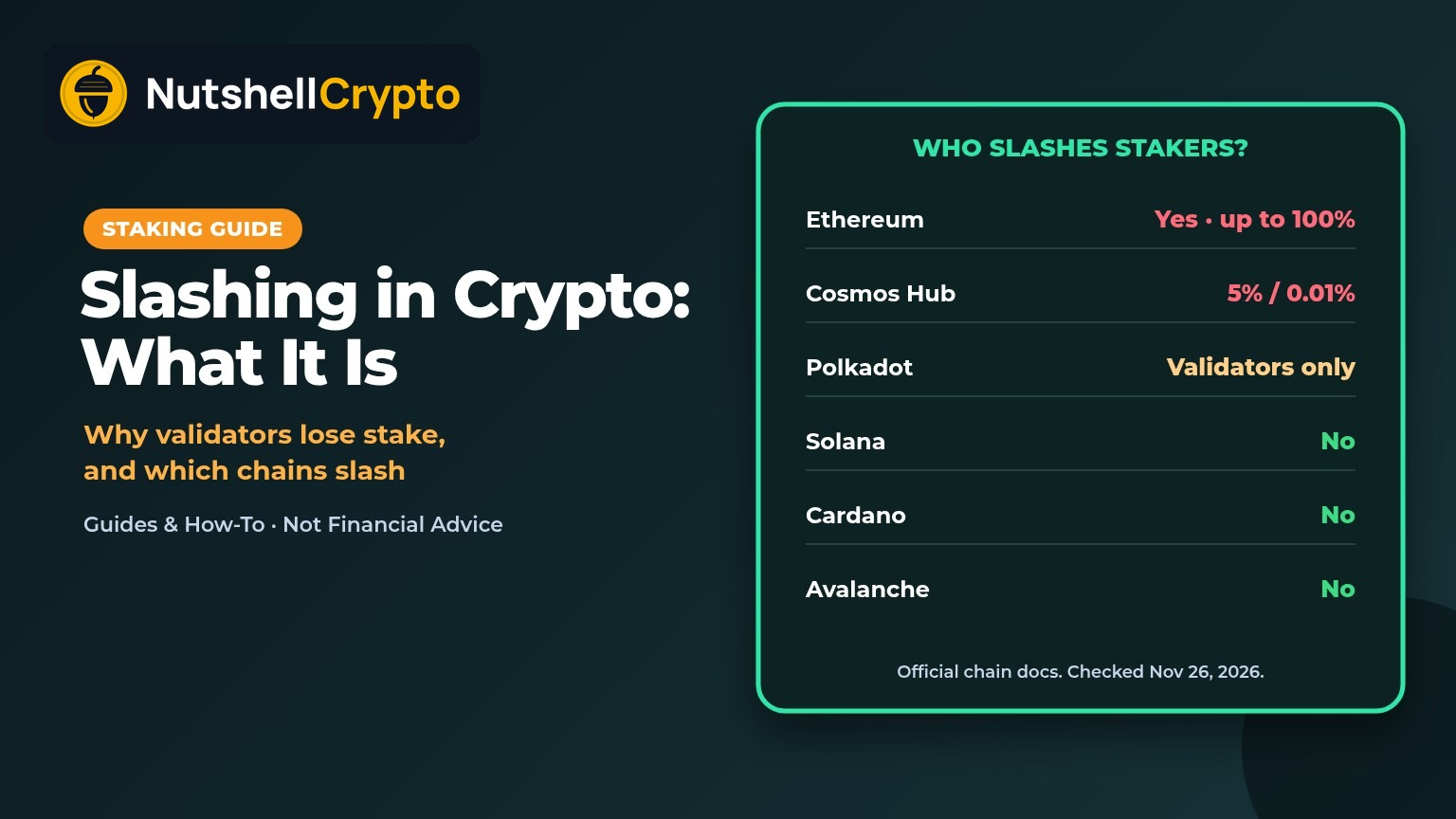
In a nutshell: Slashing in crypto is a penalty that a proof-of-stake network applies to a validator that breaks its rules, usually by signing two conflicting blocks (double signing) or, on some chains, by staying offline too long. Part of the stake is burned, and on some chains the delegators who staked with that validator lose the same share. Ethereum and the Cosmos Hub slash; Solana, Cardano, Avalanche and NEAR don’t, and Polkadot stopped slashing nominators in July 2026. Slashing is rare and mostly caused by operator mistakes, so the main defense is choosing a well-run validator or provider. Educational only; not financial advice.
Slashing is when a proof-of-stake blockchain takes away part of a validator’s staked coins as punishment for behavior that could harm the network. If you delegate or pool your coins with that validator, you can lose part of your stake too, depending on the chain.
This guide explains what triggers slashing, how much you can lose on Ethereum and Cosmos, which major chains don’t slash at all, real slashing incidents, how to lower your risk, and tax notes for the US, Canada and Australia. Figures were checked on November 26, 2026, Pakistan time, on the pages linked below.
Table of contents
What Is Slashing in Crypto?
In proof-of-stake networks, validators lock up coins as collateral so they have something to lose if they cheat. Slashing is the rule that takes that collateral. Coinbase’s help page on minimizing slashing describes it as “a mechanism built into many blockchain protocols to discourage validator misbehavior”, where “a predefined percentage or fixed amount of a validator’s tokens are lost when it behaves abnormally”.
Slashing is different from simply missing rewards. A validator that is briefly offline usually just earns less. A slashed validator loses part of its principal, and on most chains it is also removed (jailed or exited) from the validator set. If you are new to staking, start with our guide to what staking in crypto is.
What Gets a Validator Slashed?
Coinbase says most protocols have two triggers: downtime and double signing. Downtime typically costs a very small penalty, while double signing “can incur a much higher penalty”, and some protocols with correlated slashing can take up to 100% of the stake (Coinbase Help).
- Double signing: the validator signs two different blocks or votes for the same slot. This looks like an attempt to rewrite history, so it gets the biggest penalty.
- Surround votes (Ethereum): a vote that “surrounds” an earlier one, which is another way of trying to change history.
- Long downtime (some chains): Cosmos-based chains slash a small amount if a validator misses too many blocks. Ethereum doesn’t slash for downtime; it uses smaller inactivity penalties instead.
In practice, double signing is rarely an attack. It usually happens when an operator runs the same validator key on two machines at once, for example during a migration or a backup failover.
Slashing on Ethereum
According to ethereum.org’s rewards and penalties page, a validator can be slashed in three ways: proposing and signing two different blocks for the same slot, attesting to a block that “surrounds” another one, or double voting for two candidates for the same block.
When that happens:
- An initial penalty is burned at once. It is 0.0078125 ETH for a 32 ETH validator, and it scales with the validator’s balance.
- A 36-day removal period starts. The validator is forced out of the network and its stake slowly drains during that time.
- A correlation penalty lands on Day 18. Its size depends on how much stake was slashed across the whole network in the 36 days before. A single, isolated slashing costs little, but if many validators are slashed together, they can lose up to their entire effective balance.
The correlation penalty is the key idea: Ethereum punishes mass failures (which look like a coordinated attack or a shared software bug) far more than one-off mistakes. The detailed spec walkthrough in Upgrading Ethereum (eth2book) notes that slashed validators are exited from the beacon chain and “receive three types of penalty”.
Solo stakers carry this risk directly on their own 32 ETH. Pooled and liquid staking spreads it across many operators; see our guides on how to stake Ethereum and Lido staking.
Slashing on Cosmos
The Cosmos Hub is one of the clearest examples of delegators sharing the penalty. Its delegator FAQ says delegators “share the validator’s slashing”, and the Hub’s live slashing parameters (public node query, checked November 26, 2026) were:
- Double signing: 5% of the validator’s entire stake is burned, including delegators’ ATOM, and the validator is tombstoned (removed for good).
- Downtime: signing fewer than 5% of blocks in a 10,000-block window costs 0.01% and a 10-minute jail.
The FAQ adds that unbonding and redelegating stake can still be slashed for faults committed while it was bonded. Unbonding takes 21 days. Our Cosmos staking guide and unbonding period explainer cover the waiting time in detail.
Which Chains Slash, and Which Don’t
Slashing rules vary widely. Here is where major networks stood when checked on November 26, 2026:
| Network | Slashing for stakers? | Source |
|---|---|---|
| Ethereum (ETH) | Yes. Initial burn plus a correlation penalty; validator is forced out over 36 days | ethereum.org |
| Cosmos Hub (ATOM) | Yes. 5% for double signing, 0.01% for downtime, shared by delegators | Cosmos docs |
| Polkadot (DOT) | Validators only. Nominators are no longer slashable since Referendum 1910 (July 2026) | Polkadot Forum |
| Solana (SOL) | No. Not implemented in the protocol today | Solana docs |
| Cardano (ADA) | No. A weak pool just means missed rewards | Cardano developer docs |
| Avalanche (AVAX) | No. Low uptime means no rewards, principal is returned | Avalanche docs |
| NEAR (NEAR) | No. Underperforming validators lose rewards and can be removed | NEAR docs |
| Chainlink (LINK) v0.2 | Node operator stakers only; community stakers are not at risk | Chainlink blog |
A few notes on the table:
- Solana: the Solana staking docs say “there is no in protocol implementation of slashing currently”, but warn that delegators “could risk losing tokens” through slashing in the future. See our SOL staking guide.
- Polkadot: the Polkadot Forum post from July 6, 2026 says nominator unbonding also dropped from 28 days to about 2 days, while validators “remain subject to slashing”. Our Polkadot staking guide has the details.
- Cardano and Avalanche: Cardano’s docs say delegated ADA “is never at risk”, and Avalanche’s docs state that “Avalanche does NOT have slashing”. See our ADA staking and AVAX staking guides.
- Chainlink: in Staking v0.2, node operators serving the ETH/USD feed can be slashed 700 LINK each when a valid alert is raised, while community stakers are not at risk of slashing. Our Chainlink staking guide and Chainlink staking calculator help you estimate rewards.
“No slashing” doesn’t mean “no risk”. You can still lose value if the coin’s price falls, if a liquid staking contract is exploited, or if a custodial platform fails.
Can Delegators and Liquid Stakers Be Slashed?
It depends on how you stake:
- Native delegation (Cosmos-style): yes. Your coins are bonded to the validator, so a slash cuts your stake by the same percentage, even though the validator can never move your coins.
- Solo staking on Ethereum: yes, fully. You are the validator, so any slashing comes out of your own stake.
- Liquid staking pools: the loss is shared across the pool. Lido’s risk page says ETH validators risk penalties “with up to 100% of staked funds at risk if validators fail”, and that Lido spreads stake across many operators and keeps a reserve paid from protocol fees. See our liquid staking guide.
- Exchange staking: the exchange runs or picks the validators. Whether it covers a slashing loss depends on its own terms, so read them before staking.
- Restaking: adds a second layer of slashing. EigenLayer turned on slashing on mainnet on April 17, 2025, according to Eigen Labs, and it only affects operators and their stakers who opt into slashable “operator sets”. Our restaking guide explains the extra risk.
Real Slashing Incidents
Slashing is rare. When CoinDesk reported a mass slashing on September 10, 2025, it noted that fewer than 500 validators out of more than 1.2 million active had been slashed since the Beacon Chain launched in 2020, and that most incidents traced back to operator issues rather than deliberate attacks.
That September 2025 event hit 39 validators in one SSV Network cluster. SSV’s post-mortem says the cause was an Ankr maintenance mistake that ran “a parallel validator instance outside of SSV”, so the same keys were active in two places and signed twice. The lesson for every staker: double signing is usually an operations error, so the operator’s track record matters more than its advertised APR.
How to Reduce Your Slashing Risk
- Know your chain’s rules. If the coin doesn’t slash delegators (Solana, Cardano, Avalanche, NEAR, Polkadot nominators), your validator choice affects rewards, not principal.
- Pick experienced validators. On Cosmos-style chains, check uptime and jail history on an explorer. The Cosmos FAQ warns that a validator jailed for downtime more than once is a warning sign.
- Spread your stake. The Cosmos docs suggest splitting stake across several validators so one slash costs less.
- Avoid the biggest operators on correlated-penalty chains. On Ethereum, the correlation penalty grows when many validators fail at once, so a fault at a very large operator can cost more.
- Read the provider’s terms. Check whether a pool or exchange has a reserve, insurance or refund policy for slashing.
- Solo stakers: never run one key twice. Use your client’s slashing protection, and wait before restarting a validator on a new machine.
Comparing staking options? Our staking APR guide explains how rewards are quoted, and our guide to staking with a hardware wallet covers keeping keys in your own hands.
US, Canada and Australia Tax Notes
United States: under IRS Revenue Ruling 2023-14, staking rewards are gross income at their fair market value when you gain “dominion and control” over them. The IRS has not published guidance specific to slashing losses, so ask a tax professional how to treat stake that was burned. See the IRS digital assets page and our crypto staking taxes guide.
Canada: the CRA’s page on mining and staking income covers how staking rewards are taxed, but it does not address slashing. Keep records of any slashed amount and ask a tax professional how to report it. Our Canada crypto tax guide covers the wider rules.
Australia: the ATO says the money value of staking rewards is ordinary income when you receive them. It has no specific ruling on slashing losses, so ask a registered tax agent.
FAQ
What is slashing in blockchain?
Slashing is a proof-of-stake rule that burns part of a validator’s stake when it breaks protocol rules, mainly double signing and, on some chains, long downtime. It makes cheating expensive. On many chains the slashed validator is also removed from the active set.
Can I lose my crypto when staking?
Yes. On chains like Ethereum and Cosmos, slashing can cut your stake, and on every chain you can lose value if the price drops or a pool or platform fails. Chains such as Solana, Cardano and Avalanche don’t slash stakers, so there the bigger risks are price and platform risk.
How risky is staking?
For most people, slashing is a small risk: CoinDesk counted fewer than 500 slashed Ethereum validators out of more than 1.2 million by September 2025. Price swings, lockup periods and smart contract or custody risk usually matter more. The risk rises with solo staking, restaking and poorly run validators.
Can staking be dangerous?
That’s the title of a popular r/solana thread, and the honest answer is that staking itself is low risk on chains without slashing, but not risk-free. Watch out for fake staking sites, unknown liquid staking tokens and anyone promising fixed high returns.
How much do you lose when slashed on Ethereum?
An isolated slashing burns 0.0078125 ETH at once for a 32 ETH validator, plus smaller penalties during the 36-day exit, per ethereum.org. If many validators are slashed at the same time, the Day 18 correlation penalty can take up to the entire balance.