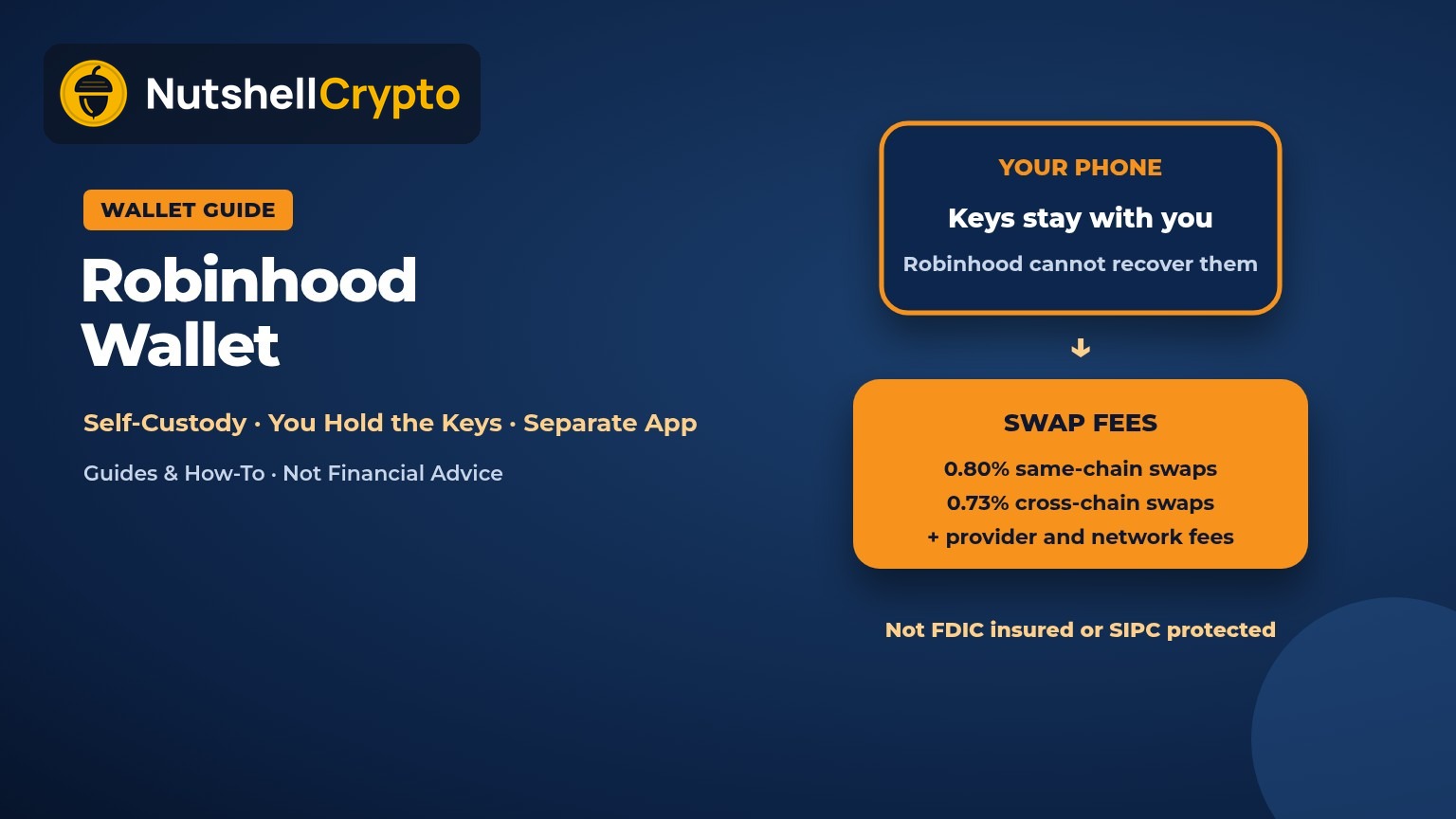
In a nutshell: Robinhood Wallet is a free, self-custody crypto wallet app that is separate from the Robinhood brokerage and Robinhood Crypto accounts. You hold the keys, so Robinhood can’t recover your crypto if you lose your recovery phrase or backup. It supports Ethereum, Bitcoin, Solana, Dogecoin and several other networks, and it swaps tokens through the 0x and LI.FI aggregators. Robinhood’s help center lists a 0.80% swap fee for same-chain swaps and 0.73% for cross-chain swaps, plus a small provider fee and network fees. The biggest risks are scam tokens, fake approvals and phishing, not the app itself. Educational only; not financial advice.
Last updated: November 4, 2026.
Plenty of people already trade on Robinhood and then see a prompt to “create a wallet”. It is easy to assume that is the same account with a new name. It isn’t. Robinhood Wallet is its own app, with its own keys, its own rules and its own risks.
This guide covers what Robinhood Wallet is, how it differs from Robinhood Crypto, how the keys and backups work, which networks it supports, what a swap really costs, the scams that have hit Robinhood users in 2026, and short tax notes for the US, Canada and Australia. Facts come from Robinhood’s help center and news reports, checked on November 4, 2026, at about 10:25 AM PKT.
Table of contents
- What is Robinhood Wallet?
- Robinhood Wallet at a glance
- Robinhood Wallet vs Robinhood Crypto
- How Robinhood Wallet works
- How to set up and back up the wallet
- Supported networks and what you can do
- Robinhood Wallet fees
- Safety, scams and 2026 incidents
- Timeline: how the wallet got here
- Pros, cons and trade-offs
- US, Canada and Australia tax notes
- FAQ
What Is Robinhood Wallet?
Robinhood Wallet is a mobile crypto wallet for iOS and Android. Robinhood describes it as “a self-custody wallet that’s your portal to web3” and says it gives you “full control over your crypto, which means you hold the private keys to your assets” (Robinhood Wallet help). In plain terms, the app stores your keys on your phone, and only the person with those keys, or the recovery phrase behind them, can move the coins.
That makes it a self-custody wallet, the opposite of a custodial wallet where a company holds the keys for you. It is also a hot wallet, meaning the keys live on an internet-connected device; our hot wallet vs cold wallet guide explains what that trade-off means. If self-custody is new to you, start with our self-custody guide and the overview of what a crypto wallet is.
The app is run by a separate company, too. Robinhood’s FAQ says the wallet is “operated by Robinhood Non-Custodial, Ltd.”, while the Robinhood Crypto account is provided by Robinhood Crypto, LLC (Robinhood Wallet FAQ).
Robinhood Wallet at a Glance
| Item | What Robinhood says |
|---|---|
| Type | Self-custody mobile wallet (iOS and Android), separate from the Robinhood app |
| Operator | Robinhood Non-Custodial, Ltd. (a Cayman Islands company) |
| Networks (send and receive) | Ethereum, Bitcoin, Solana, Dogecoin, Arbitrum, Polygon, Optimism, Binance Smart Chain, Base, Robinhood Chain |
| Swaps | Through the 0x and LI.FI aggregators on Ethereum, Solana, Polygon, Arbitrum, Optimism, Binance Smart Chain, Base and Robinhood Chain |
| Swap fee | 0.80% same-chain, 0.73% cross-chain, plus provider and network fees |
| Backup options | iCloud, Google Drive or manual secret recovery phrase |
| Protection | Not FDIC insured or SIPC protected |
Sources: Robinhood Wallet help, FAQ and send, receive and swap help (checked November 4, 2026).
Robinhood Wallet vs Robinhood Crypto
This is the point most people miss. Buying crypto inside the main Robinhood app puts it in a Robinhood Crypto account, which is a custodial account. Robinhood Wallet is a different app. Robinhood’s FAQ says the wallet is “separate from your Robinhood Crypto account” and that Robinhood Crypto “isn’t involved with or responsible for Robinhood Wallet activity”.
| Robinhood Crypto (main app) | Robinhood Wallet (separate app) | |
|---|---|---|
| Who holds the keys | Robinhood | You |
| If you lose access | Robinhood support handles your account | Only your backup or recovery phrase can restore it; Robinhood cannot |
| Dapp connections | Not part of the account | Built-in web3 browser |
| Provided by | Robinhood Crypto, LLC | Robinhood Non-Custodial, Ltd. |
You can move crypto between the two. Robinhood says you can “transfer supported crypto from a Robinhood Crypto account” to fund the wallet, over Ethereum, Bitcoin, Dogecoin, Solana and Polygon. For a broader look at how exchange-style accounts differ from wallets, see our guide to crypto brokers vs exchanges.
How Robinhood Wallet Works
When you create a wallet, the app generates a secret recovery phrase (also called a seed phrase) and the private keys that come from it. You then choose how to lock the app: Face ID or biometrics (recommended), or a custom 6-digit PIN. Robinhood says it never has access to your keys, wallet password or personal wallet information, so its support team cannot recover them for you.
From there, the wallet does four things:
- Holds and shows your balances across the supported networks.
- Sends and receives crypto to any address or exchange that supports the same network.
- Swaps tokens by sending your order to a decentralized exchange (DEX) aggregator, 0x or LI.FI, which finds a rate and routes the trade. Our DEX guide and list of decentralized exchanges explain how that kind of trading works.
- Connects to dapps through a built-in web3 browser on Ethereum, Arbitrum, Polygon, Optimism, Binance Smart Chain, Base and Robinhood Chain. See our DeFi wallet guide for what that means in practice.
Robinhood says swaps can be on a guaranteed or an estimated rate. A guaranteed rate is locked for 30 seconds, and an estimated rate is refreshed constantly and only executes inside the slippage tolerance you pick. Some swaps routed through 0x need a one-time approval of Permit2, a token approval contract that lets you approve several contracts at once and sets expiry times on those approvals.
How to Set Up and Back Up the Wallet
- Install Robinhood Wallet from the official App Store or Google Play listing. It is a separate app from the main Robinhood app.
- Choose Create new wallet, then pick biometrics or a custom PIN.
- Choose a backup: iCloud, Google Drive, or manual. Robinhood strongly recommends a backup, because it is “the only way you can recover your wallet and crypto if you lose or reset your device”.
- If you choose manual, write the secret recovery phrase on paper and keep it offline. You can find it later under Backups & security.
- Fund the wallet by buying crypto through Robinhood Connect or Sardine where available, by Apple Pay or Google Pay, or by transferring from a Robinhood Crypto account or another wallet.
If you already have a wallet, you can import it by entering its recovery phrase. Robinhood’s warning here matters: only import a phrase you created yourself. “If anyone, including someone claiming to be a Robinhood employee, gives you a phrase to import, it’s a scam.” A phrase someone else hands you gives them full control of the wallet, and anything you deposit can be taken.
Before you move meaningful money, test with a small amount and practice a restore. Our guide to crypto wallets for beginners and the checklist for copying a crypto wallet address safely cover the habits that prevent most losses. Robinhood notes that crypto sent to the wrong address or an incompatible network is lost and not recoverable.
Supported Networks and What You Can Do
Robinhood’s FAQ breaks down what works on each network:
| Action | Networks |
|---|---|
| Swap | Ethereum, Solana, Arbitrum, Polygon, Optimism, Binance Smart Chain, Base |
| Send and receive | Ethereum, Bitcoin, Dogecoin, Solana, Polygon, Arbitrum, Optimism, Binance Smart Chain, Base, Robinhood Chain |
| Connect to dapps (web3 browser) | Ethereum, Polygon, Arbitrum, Optimism, Binance Smart Chain, Base, Robinhood Chain |
| Receive NFTs | Ethereum, Polygon |
The help center’s newer send, receive and swap page also lists Robinhood Chain among the swap networks, so the lists differ a little between pages. Check the in-app network list before you send, because only the exact network you choose will receive the coins.
One limit worth knowing: Robinhood says you may not have access to the wallet if you live in a jurisdiction sanctioned under US law. It does not publish a country-by-country list on those pages, so check the app store listing for your country.
Robinhood Wallet Fees
Holding crypto in the wallet costs nothing. Swaps are where the fees are. Robinhood’s help center lists these swap charges, “subject to change”:
| Fee | Amount | Who gets it |
|---|---|---|
| Robinhood Wallet swap fee, same-chain | 0.80% | Robinhood Wallet |
| Robinhood Wallet swap fee, cross-chain | 0.73% | Robinhood Wallet |
| 0x provider fee | 0.05% on all swaps | The aggregator |
| LI.FI provider fee | 0.05% same-chain, 0.12% cross-chain | The aggregator |
| Network (gas) fees | Varies by network | The blockchain, not Robinhood |
| Bridge, approval, tax-token and Solana account fees | Varies | Third parties or the network |
Example: a $1,000 same-chain swap routed through 0x would carry an $8.00 Robinhood Wallet fee (0.80%) plus a $0.50 provider fee (0.05%), so about $8.50 or 0.85% before network fees. A $1,000 cross-chain swap through LI.FI would carry $7.30 (0.73%) plus $1.20 (0.12%), about $8.50, before bridge and network fees. These are our own calculations from Robinhood’s published percentages, not a quote from the app, which shows the live estimate before you confirm.
The fee has changed. In March 2024, The Block reported that Robinhood Wallet users “are not charged service fees on token swaps”, with blockchain fees only (The Block). Robinhood’s current help page lists the 0.80% and 0.73% fees above, so older reviews that say swaps are free may be out of date. Network fees are separate and can matter more on Ethereum; see our guide to Ethereum gas fees and the comparison of crypto exchange fees.
Robinhood also says swaps include a rate that may differ from the market rate, because it is sourced from multiple providers and affected by liquidity and volatility. If a cross-chain swap fails for lack of liquidity, the aggregator tries to return the same asset and amount, but you may get a different token and a non-exact quantity.
Safety, Scams and 2026 Incidents
The wallet design is standard for self-custody: keys on your device, behind biometrics or a PIN. Robinhood also screens tokens with Blockaid, a third-party security provider, and labels some as Spam, Warning or Suspicious. Robinhood is careful to say that a label “reflects Blockaid’s automated screening, not a Robinhood guarantee” and that “the absence of a label doesn’t mean a crypto asset is safe” (Protect your wallet).
The real risks in 2026 have been scams around the wallet rather than a break-in to the app:
- Robinhood Chain scam tokens (July 2026). Protos reported that after Robinhood Chain’s public mainnet launched on July 1, traders posted about scam contracts, rug pulls and wallet drainers, with some alleging losses inside Robinhood Wallet. A Robinhood spokesperson told Protos that the wallet screens tokens with Blockaid and filters those with a malicious rating, and that Robinhood Chain “is permissionless”, which is “a common issue across permissionless chains” (Protos, July 10, 2026). The reports are user claims and have not been independently confirmed by us.
- Fake “recent login” emails (April 2026). Attackers abused Robinhood’s account creation flow to send phishing emails that came from Robinhood’s own address and passed email authentication. Robinhood said it was “not a breach of our systems or customer accounts, and personal information and funds were not impacted” (SecurityWeek, April 28, 2026). A user on Reddit said they clicked the link and created a wallet when prompted (r/RobinhoodApp). The lesson is simple: an email that sends you to “move your crypto to a safe wallet” is a scam, even if the sender looks real.
- Cross-chain bridge risk. Robinhood’s own security page warns that cross-chain swaps usually use third-party bridges, which have been exploited in the past, so a compromised bridge contract you approved could put assets at risk.
Practical habits: never share the recovery phrase, never import one given to you, read what you sign, ignore unsolicited tokens and airdrops, and review your token approvals from time to time. Robinhood says you can revoke approvals through blockchain explorers. For safer storage of larger amounts, an offline device is a different category; see our air-gapped hardware wallet guide.
Timeline: How the Wallet Got Here
- September 2022: limited iOS beta with Polygon as the first network (Blockworks).
- January 19, 2023: rollout to more than 1 million waitlisted users, with Ethereum added (Decrypt).
- March 1, 2023: global iOS launch (CryptoSlate).
- March 20, 2024: Android launch (The Block).
- July 1, 2026: Robinhood Chain public mainnet launch, per Protos, now listed in the wallet’s supported networks.
Pros, Cons and Trade-offs
| Strengths | Weaknesses |
|---|---|
| You control the keys; no account freeze risk from a company | Lose the phrase or backup and the crypto is gone; support cannot help |
| Bitcoin, Solana, Ethereum and several layers on one app | Mobile hot wallet, not a hardware device |
| Swaps and dapps built in, with token screening | 0.73% to 0.80% Robinhood swap fee on top of provider and network fees |
| Backup to iCloud or Google Drive, or on paper | Scam tokens and drainers are a real risk, especially on new permissionless chains |
| Separate from your brokerage account | Not FDIC insured or SIPC protected, and no account recovery |
If you prefer a wallet with no seed phrase to manage, compare the MPC design of the Zengo wallet. If you want a multi-chain wallet with an encrypted backup file, see our Guarda Wallet guide. If open-source code matters to you, read about open source crypto wallets.
US, Canada and Australia Tax Notes
Holding coins in Robinhood Wallet doesn’t create tax, and moving coins between wallets you control is not a sale. Swaps and sales do count. Keep your own records of every swap, because a self-custody wallet is not the same as a brokerage account that tracks things for you. Check Robinhood’s own tax documents page to see what, if anything, it reports for this wallet.
United States: the IRS treats digital assets as property, so swapping one token for another is a sale that can produce a gain or loss (IRS digital assets). Our guide to crypto capital gains tax explains how gains are worked out, and crypto airdrop tax covers unsolicited tokens you decide to keep or sell.
Canada: the CRA treats trading one crypto for another as a disposition, so each swap can create a capital gain or loss, or business income depending on your situation (CRA). More in our Canada crypto tax guide.
Australia: the ATO treats each swap or sale as a CGT event, valued in AUD at the time, and expects records for every transaction (ATO crypto assets). See our Australia crypto CGT guide for how the discount works.
See also: do you pay tax when transferring crypto? This is general information, not tax advice.
FAQ
Is Robinhood Wallet the same as the Robinhood app?
No. Robinhood says the wallet is a separate app from the main Robinhood app, run by Robinhood Non-Custodial, Ltd., and separate from your Robinhood Crypto account.
Is Robinhood Wallet self-custody?
Yes. Robinhood says you hold the private keys and that it never has access to them. That also means Robinhood cannot restore your wallet if you lose your recovery phrase or backup.
Does Robinhood Wallet charge fees?
Robinhood lists a 0.80% fee on same-chain swaps and 0.73% on cross-chain swaps, plus a 0.05% to 0.12% provider fee and network fees. Sending and holding carry network fees only. Fees are subject to change, so check the app before you confirm.
Is Robinhood Wallet safe?
The app is built like other self-custody wallets, and Robinhood screens tokens with Blockaid, but screening is not a guarantee. The main risks are phishing, fake approvals and scam tokens, plus losing your own backup.
Does Robinhood Wallet support Bitcoin?
Yes, for sending, receiving and storing. Robinhood’s FAQ lists Bitcoin under send and receive, but not under swap networks.
Can I move crypto from Robinhood Crypto to Robinhood Wallet?
Yes, for supported coins over Ethereum, Bitcoin, Dogecoin, Solana and Polygon. The in-app list shows exactly which assets you can transfer.
Can I use Robinhood Wallet in the US, Canada and Australia?
Robinhood says you may not have access if you live in a jurisdiction sanctioned under US law, and its disclosures note that availability may depend on regulatory approval in certain jurisdictions. Check your app store listing before you plan around it.
Sources: Robinhood help center and FAQ (checked November 4, 2026), The Block, Decrypt, Blockworks, CryptoSlate, Protos, SecurityWeek, Reddit, IRS, CRA, ATO. This article is for education only and is not financial or tax advice.